Complete history of the NBA Draft Lottery: Four decades of tanking, the efforts to stop it and what’s next
Sunday marks the 42nd installment of the NBA Draft Lottery — the event has an intriguing and contentious past and a future that holds more changes
By
Sam Quinn
May 6, 2026
at
8:57 am ET
•
33 min read
Getty Images/Imagn Images
Stop me if you’ve heard this one before: people are upset about the NBA Draft format. It’s true today. It was true in 2017. And 2014. And 1993. And 1984. And countless other moments throughout the history of the sport. The NBA has been drafting players for 76 years and it has almost never been happy about the manner in which it has done so. The 42nd installment of the NBA Draft Lottery is coming this Sunday as the Pacers, Wizards, Jazz, Nets and others hope the ping pong balls bounce in their favor. More lottery reform is coming next year.
The draft lottery is an almost unique feature of American professional basketball. The NFL has never seen a need to introduce a lottery system to determine who picks where. Major League Baseball didn’t add one until 2022. The only other early adopter among major American men’s leagues was the NHL, which enacted a smaller-scale lottery in 1995. It notably did so under commissioner Gary Bettman … the NBA’s former general counsel. But the stakes are far lower in hockey. Players play in shifts, staying on the ice for only fractions of a game.
A single superstar can change everything in the NBA. That makes the mechanism for assigning such players enormously contentious. Allow teams to draft purely on record, and they’d surely deduce that punting away a single season could set up 10 more years of winning. Safeguards needed to be installed. The worst teams should probably have the best chance at a top pick, but they can’t be allowed to lose with impunity.
This was the genesis of the NBA Draft Lottery. The league determined that those guardrails needed to exist but has never quite been able to settle on their exact dimensions. Depending on your definition of a format change, we have seen somewhere between four and 10 different iterations of the lottery. Another is coming. Ever since our last great reformatting in 2019, tanking has grown into a full-blown epidemic. You could argue that nine of the 10 teams that missed the postseason engaged in some form of it this year, drastically reducing the quality of the regular season. The NBA is currently fine-tuning a proposal to address it.
But as those many now discarded formats suggest, it’s rarely that simple. There are always unintended consequences, and those consequences tend to lead to further changes. So as we prepare for the structural overhaul looming this offseason, it’s worth exploring how exactly we got here and what we can learn from the NBA’s previous missteps and misfortunes. And so, let’s dive into the history of the NBA Draft Lottery.
1950-1983: The pre-lottery era
In 1949, the Basketball Association of American and the National Basketball League merged to form the NBA. A total of 17 teams participated in the inaugural season for the new merged league, but only 12 survived long enough to participate in its first draft, and one of them, the Chicago Stags, folded before it could actually use any of its picks. The draft used a standard, reverse-standings order with one notable caveat: the territorial draft pick.
Territorial draft picks allowed teams to jump the line and select players who had grown up or attended college within a 50-mile radius of its home arena by surrendering their first-round pick. Of the 23 players drafted in this fashion, 12 became Hall of Famers. No team used more of these picks than the Philadelphia Warriors, who made the first pick in NBA Draft history by asserting their territorial rights to future Hall of Famer Paul Arizin. They would use this method to secure seven collegiate stars in the 1950s, the last of whom was the legendary Wilt Chamberlain.
As unfair as this rule seems by modern standards, it was a financial necessity at the time. Professional basketball was in its infancy. Teams folded frequently, and before the widespread adoption of television, the entire business relied on selling tickets. There was no better way to do that then by ensuring amateur stars could continue playing in front of their existing fans.
By 1966, the NBA was on more stable financial footing. Games were starting to get televised more regularly, teams in the right markets had built robust fan bases, and the league could shift focus towards competitive balance. At this point, the territorial draft system was replaced with one that ensured that only the worst teams would have access to the top incoming talent. Most of the draft would retain its reverse-standings order system. However, the worst team in the Eastern Conference and the worst team in the Western Conference would hold a coin flip after the season to determine who would pick No. 1 and No. 2. This system remained in place through the 1983-84 season.
1984: The dawn of tanking
Though it would be impossible to truly peg the first instance of tanking, the concept came into the mainstream in 1984. The Houston Rockets won the first pick in the 1983 NBA Draft through the coin toss and selected Virginia star Ralph Sampson, but as University of Houston star Hakeem Olajuwon soared, the Rockets ended the season on a somewhat suspicious downward spiral. After starting the year 24-36, they closed the season losing 17 of their final 22 games.
This would be considered quaint by modern standards. In a period measured by Yahoo’s Tom Haberstroh, for example, the nine tanking teams this season went 12-167 across a 179-game sample against the 21 winners in 2025-26. But Houston’s actions raised eyebrows, especially in its second-to-last game. The Rockets used 36-year-old future Hall of Famer Elvin Hayes in all 53 minutes of an overtime loss despite him averaging less than 13 minutes per game throughout the season.
This enraged Dallas Mavericks general manager Norm Sonju, according to former Rockets beat writer Fran Blinebury in a Grantland oral history of the 1980s Rockets. “Norm Sonju was outraged that Houston could win back-to-back coin flips. In 1984 at the Board of Governors meeting, Sonju throws out that he wants to get rid of the coin flip and go to the draft lottery.” Sonju didn’t exactly dispute the characterization, saying “the whole thing was basically people feeling that [the Rockets intentionally] lost games.”
The general manager of the Mavericks may have targeted Houston, but their head coach had his eye on another time. In a newspaper clipping dug up by The Athletic’s Mike Vorkunov, then-Mavericks coach Dick Motta accused the Chicago Bulls of tanking. Dallas held Cleveland’s first-round pick in 1984 and therefore had a vested interest in the success, or lack thereof, of the Bulls.
The Rockets picked Hakeem Olajuwon first overall in the 1984 NBA Draft.
Getty Images
Ultimately, neither Cleveland nor Chicago would wind up with the conference’s worst record. Indiana did, and like Cleveland, the Pacers owed their pick to another team, in this case, Portland. The Blazers lost the coin toss and chose second, leaving the Rockets with consecutive No. 1 picks and therefore the right to pair Sampson with Olajuwon. Chicago missed out on its shot at the top pick and had to settle for some guard from North Carolina named Michael Jordan.
1985: The first lottery
On June 27, 1984, the NBA unveiled the introduction of its first-ever draft lottery. The seven non-playoff teams would each participate with equal odds at every selection between No. 1 and No. 7. “We think that will be exciting for all those teams who will have a shot at the No. 1 pick in the draft,” then-commissioner David Stern stated. “And we think it will put to rest once and for all the issue of, ‘You can win by losing.'”
Obviously, we now know it didn’t play out that way, but skepticism was present even in the moment. “I’m not 100% sure it (the new draft system) won’t create a bigger problem,” then-Bullets general manager Bob Ferry stated. “Some teams that might barely make the playoffs and don’t have a realistic chance of winning might prefer not making the playoffs.”
Then-Rockets general manager Ray Patterson gave a more blunt assessment of the situation, mocking Sonju for his perceived shortsightedness. “It gets changed and 10 minutes after, Ray sees me and says ‘Norm Sonju thinks he’s so damn smart,'” Blinebury recounted to Grantland. “‘He’s tired of me winning coin flips. I’ve got Sampson and Olajuwon. How the hell am I going to have the worst record in the West? But he could have the worst record. He could have just cost himself a one-in-two chance of getting the no. 1 pick.’ And then he paused and stated, ‘We could be the first team out of the playoffs. I could get into the lottery, win it, and get Patrick Ewing. How would you like me to stick that up his ass?'”
Already, the executives of the day saw the unintended consequences. As Ferry suggested, the motivation to lose still existed. It had just been moved. Meanwhile, Patterson emphasized the enormous ramifications a single lucky drawing could have. Yet the NBA moved forward, and on June 18, 1985, the first NBA Draft Lottery was held.
The format was simpler than it would ever again be. Seven envelopes featuring the logos of the seven participants were placed in a transparent, spherical container with a crank attached to spin it. Afterward, Stern picked the envelopes out one at a time, with the first envelope representing the first pick. That selection — and the right to draft generational prospect Patrick Ewing out of Georgetown — went to the New York Knicks.
To this day, the 1985 lottery is the subject of conspiracies. Some believe New York’s envelope was frozen before the drawing. Others believe it was intentionally creased. The idea of these theories is that Stern somehow knew as he was selecting which envelope belonged to New York. None of these theories have ever been proven. But there was a subtle change to the process in 1986.
1986: Lottery No. 2
The basic math of the 1986 lottery was unchanged. Seven teams missed the playoffs. All of them had the same odds at the No. 1 pick. This lottery had one interesting quirk, though. The Cavaliers, who didn’t own their own pick, were automatically granted whichever pick came immediately after the Mavericks, but could come in no higher than No. 3.
This was a condition of the sale of the Cavaliers, as former owner Ted Stepien traded away five consecutive first-round picks in the years prior. New owners Gordon and George Gund were then granted the right to purchase first-round picks in the next four drafts to make up for that. As Cleveland’s pick in 1986 went to Dallas, the unusual arrangement granted the Cavaliers the selection after the Mavericks. Now, the NBA has a rule in place to protect against the need for this sort of restitution: the Stepien Rule, which prevents teams from being without first-round picks in consecutive, upcoming drafts.
The other change here had nothing to do with the odds, but rather, the drawing process. This time, Stern wasn’t the one to pull the envelopes out of the drum. Instead, each of the team representatives on the dais selected an envelope themselves. The order in which they did so was determined before the lottery. The first envelope drawn corresponded to the No. 7 pick, and the remaining envelopes were drawn in descending order.
Also, the Knicks brought a live rabbit to the drawing. His name was Lucky Pierre, but as the Knicks fell to No. 5 from the league’s worst record, the moniker proved undeserved. That wouldn’t stop generations of team representatives from bringing all manner of good-luck totems to future lotteries.
1987-89: Shortening the drawing
The first two lotteries drew for every available pick. The best participant could pick No. 1. The worst could fall to No. 7. There was no distinction in the draft order between the teams that just barely missed the playoffs and those that were out of the running all year. The 22-60 Warriors fell five slots in 1985 thanks to the lottery, from No. 2 to No. 7, and the Knicks fell from No. 1 to No. 5 a year later. That seemingly compelled the NBA to introduce a floor.
Instead of drawing for all seven picks, the lottery drew just the top three. After that, teams simply selected in order. This meant that the worst team could pick no lower than No. 4, though odds for the No. 1 overall pick remained flat.
In 1988, two new teams, the Miami Heat and Charlotte Hornets, began play. They were granted the top two non-lottery slots in the 1988 Draft, with Charlotte picking No. 8 and Miami No. 9. When they entered the lottery in 1989, though, they were granted the same odds as everyone else. The same, flat structure remained, but with nine non-playoff teams instead of seven, each team’s odds at No. 1 reduced from 14.29% to 11.11%.
1990-92: The first weighted lottery
The lottery was once again expanded in 1990 thanks to the introduction of two new teams. The Orlando Magic and Minnesota Timberwolves began play in 1989 and, like the Heat and Hornets, were granted the first post-lottery picks in their inaugural draft. In 1990, though, they were eligible for full lottery participation, pushing the number of non-playoff teams in the lottery from nine up to 11.
But that wasn’t the biggest change, though. In 1990, the NBA introduced the first weighted lottery system. Instead of flat odds, team record would determine the likelihood of picking No. 1 overall. The drawing included 66 lottery balls. The worst team in the NBA got 11 of them, the second-worst got 10, and so on in that fashion until the best lottery team was given a single lottery ball. Here is what the odds looked like in full:
Slot
Lottery Balls
No. 1 pick odds
No. 2 picks odds
No. 3 picks odds
Top-three odds
1
11
16.67%
15.56%
14.35%
46.58%
2
10
15.15%
14.47%
13.68%
43.3%
3
9
13.64%
13.31%
12.89%
39.84%
4
8
12.12%
12.07%
11.97%
36.16%
5
7
10.61%
10.77%
10.92%
32.3%
6
6
9.09%
9.4%
9.73%
28.22%
7
5
7.58%
7.97%
8.42%
23.97%
8
4
6.06%
6.48%
6.98%
19.5%
9
3
4.55%
4.94%
5.42%
14.91%
10
2
3.02%
3.34%
3.73%
10.09%
11
1
1.52%
1.69%
1.92%
5.13%
1993: The repeat winner
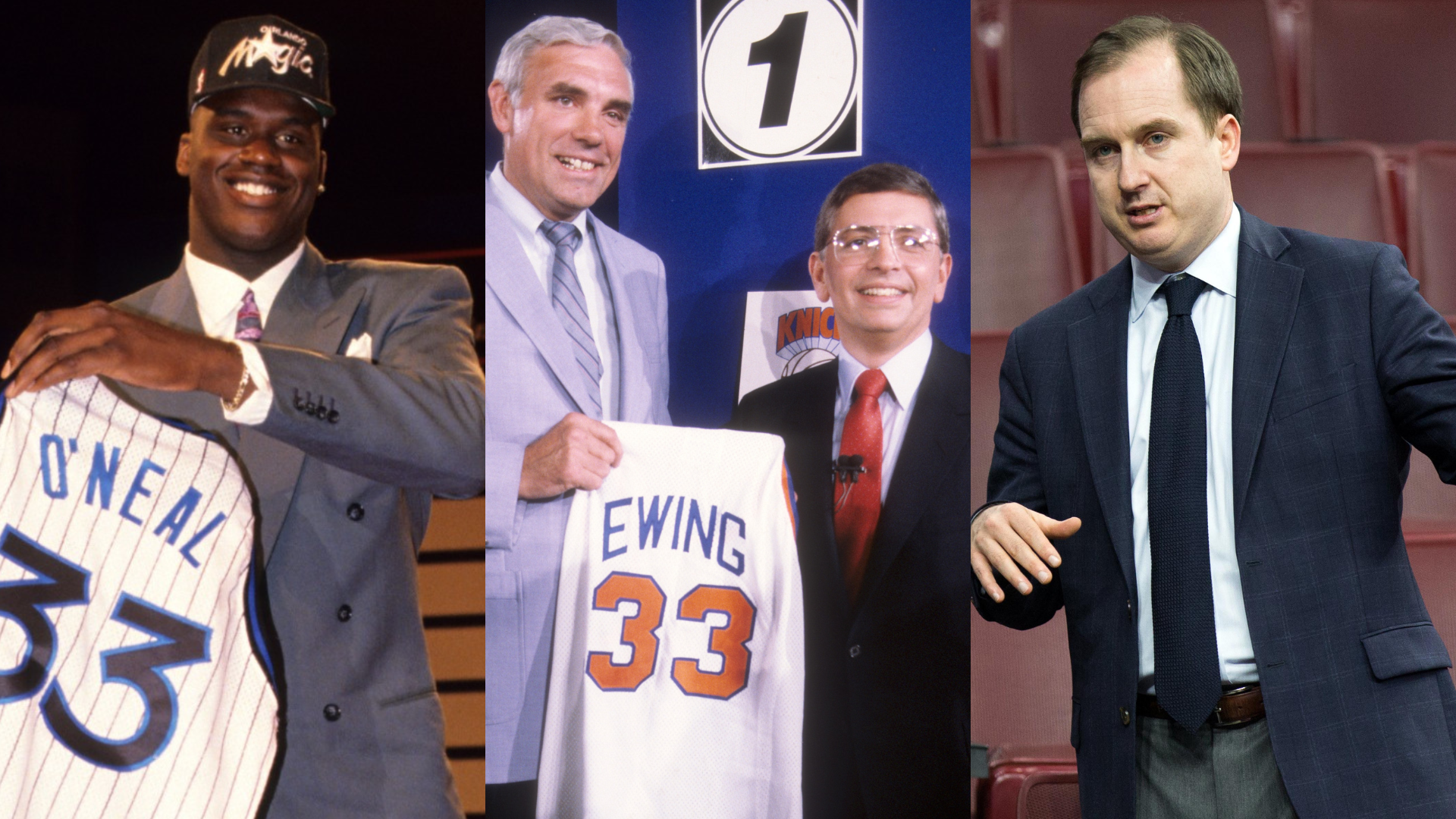
Orlando’s 1992 lottery victory was transformational. Shaquille O’Neal took a 21-win team up to .500, immediately giving a recent expansion franchise an identity and hope for long-term winning. With players like Nick Anderson, Dennis Scott and Scott Skiles by his side, it wasn’t unreasonable to assume the Magic already had enough to compete for titles in the next few years. And then they won the lottery again.
The 41-41 Magic had just one out of the 66 available lottery balls in 1993. That ball delivered a No. 1 pick that would eventually yield, through a trade with Golden State, future All-Star Penny Hardaway and three more first-round picks, setting the Magic up to reach the NBA Finals in 1995 and potentially become a long-term superpower. The rest of the league was not happy.
The Magic drafted Shaq first overall in 1992, and then won the lottery again in 1993.
Getty Images
“It’s a joke, a complete joke,” Timberwolves general manager Jack McCloskey stated at the time. “Orlando getting the number one pick is not what this draft — or any draft — is meant to be.” The Mavericks, to this point our most frequent draft format agitators, were similarly displeased. “It kind of defeats the purpose of using the draft to build the weaker teams,” Sonju added.
The result raised two concerns that would later come up in future discussions about the lottery format. First: how heavily should the odds be weighted in favor of the worst teams? Second: should teams be able to repeatedly stack favorable lottery outcomes?
The latter became a topic in 2026 reform talks, but we’ll get to those later. The former, however, has been debated in every revision in lottery history. That includes the immediate one. On November 11, 1993, the NBA unveiled an overhaul of the lottery format. “It was the consensus of the teams that the NBA draft lottery serves an important purpose and should be maintained,” then-deputy commissioner Russ Granik told the Associated Press. “We felt some adjustment was appropriate.”
1994-95: May the worst team win
When the dust settled on those 1993 talks, the NBA landed on a basic odds structure it would maintain for a quarter-century. Instead of 66 lottery balls, there would be 14 of them numbered 1 through 14. Four of those ping pong balls would be drawn, creating a four-digit combination. Teams were assigned a certain amount of combinations based on their record, with the worst team now receiving 25% of them and the best receiving 0.5%. In the event of a tie between two teams, they would share the combined amount of lottery combinations between them with a separate drawing determining which slot they would fall into for the sake of assigning their picks if they did not ultimately move up. Below is what the format looked like in full:
Slot
Total combinations
No. 1 pick odds
No. 2 pick odds
No. 3 pick odds
Top three odds
1
250
25%
21.72%
18.12%
64.84%
2
203
20.3%
19.23%
17.57%
57.1%
3
162
16.2%
16.34%
16.2%
48.745
4
126
12.6%
13.33%
14.09%
40.02%
5
94
9.4%
10.32%
11.46%
31.18%
6
66
6.6%
7.47%
8.61%
22.68%
7
44
4.4%
5.09%
6.02%
15.51%
8
27
2.7%
3.17%
3.83%
9.7%
9
15
1.5%
1.78%
2.18%
5.46%
10
8
0.8%
0.96%
1.18%
2.94%
11
5
0.5%
0.6%
0.74%
1.84%
Washington Bullets owner Abe Pollin told The Washington Post he wanted stronger measures. But before the changes came, commissioner Stern indicated he was against going too far. “We’re open to any improvements that would seem to make sense, but we think we’re pretty close to what is the best system under the circumstances, if not the best,” he stated at the time.
The change, therefore, represented a compromise. At that point in NBA history, there were loud voices within the league that believed the draft’s intended purpose as a talent-balancing mechanism should take precedence over the lottery’s intended purpose as a deterrent to tanking. This is the single debate that informs all future lottery changes. Those changes come when balance is lost and the scales tip too far in favor of one or the other. In this case, tanking was perceived as a lesser concern to the fairness issue of a single team with minimal odds receiving back-to-back No. 1 picks.
1996-2004: Oh Canada
The Raptors and Grizzlies joined the league in 1995, pushing the lottery up to 13 total participants in 1996. That forced the NBA to tweak the formula slightly to adjust for the deeper pool, and the result was as follows:
Slot
Total combinations
No. 1 pick odds
No. 2 pick odds
No. 3 pick odds
Top three odds
1
250
25%
21.55%
17.85%
64.4%
2
200
20%
18.91%
17.22%
56.3%
3
157
15.7%
15.84%
15.7%
47.24%
4
120
12%
12.71%
13.43%
38.14%
5
89
8.9%
9.77%
10.82%
29.49%
6
64
6.4%
7.21%
8.26%
21.87%
7
44
4.4%
5.06%
5.93%
15.39%
8
29
2.9%
3.38%
4.03%
10.31%
9
18
1.8%
2.12%
2.56%
6.48%
10
11
1.1%
1.3%
1.58%
3.96%
11
7
0.7%
0.83%
1.02%
2.55%
12
6
0.6%
0.71%
0.87%
2.18%
13
5
0.5%
0.6%
0.73%
1.83%
Unlike previous expansion teams we’ve covered, the Raptors and Grizzlies weren’t shuttled to the end of the lottery in their first draft. No, the Grizzlies were initially given the No. 6 pick in 1995 while the Raptors chose No. 7. That might seem better on paper, but they paid dearly for that privilege in the years to come.
How? Well, the Raptors and Grizzlies were eligible to participate in the lottery starting in 1996 … but they weren’t allowed to win it until 1999. If either the Raptors or Grizzlies drew the No. 1 pick in that period, they would instead be shunted down to No. 2 while the drawing for No. 1 was redone. Sure enough, when the drawing was held for the No. 1 choice in 1996, the Raptors were the original winner. However, as they were ineligible, the drawing was redone with Philadelphia coming out on top. Were it not for that restriction, Allen Iverson could have been a Raptor.
2005-2013: Lottery peace and the end of expansion
In 2004, the Charlotte Bobcats joined the NBA under much more favorable terms than the Raptors or Grizzlies did. They were immediately granted the No. 4 pick in that draft, the highest ever given to an expansion team during the lottery era, and they were not restricted from winning future lotteries as the Raptors and Grizzlies were. With a 14th team now in the lottery mix, the odds were once again tweaked, though only minimally:
Slot
Total combinations
No. 1 pick odds
No. 2 pick odds
No. 3 pick odds
Top three odds
1
250
25%
21.51%
17.77%
64.28%
2
199
19.9%
18.81%
17.12%
55.83%
3
156
15.6%
15.74%
15.59%
46.93%
4
119
11.9%
12.6%
13.3%
37.8%
5
88
8.8%
9.66%
10.68%
29.14%
6
63
6.3%
7.1%
8.12%
21.52%
7
43
4.3%
4.94%
5.79%
15.03%
8
28
2.8%
3.26%
3.89%
9.95%
9
17
1.7%
2%
2.41%
6.11%
10
11
1.1%
1.3%
1.58%
3.98%
11
8
0.8%
0.95%
1.15%
2.9%
12
7
0.7%
0.83%
1.01%
2.54%
13
6
0.6%
0.71%
0.87%
2.18%
14
5
0.5%
0.59%
0.73%
1.82%
Aside from the addition of new teams, broadly speaking, the period between the mid-1990s and the early 2010s was the most stable the lottery has ever been. The only change in that window was the realization that Raptors and Grizzlies were treated too harshly upon their admission into the NBA, and that mistake was corrected for the Bobcats.
Otherwise, this was lottery peace. There were no meaningful attempts at reform from the league or vocal calls for changes from stakeholders. There was tanking in this window, most notably for LeBron James in 2003. There were also surprises, like when Chicago jumped from No. 9 to No. 1 for Derrick Rose in 2008. But the system more or less worked as intended. At least until someone broke it.
2013: Dawn of the Process
In 2013, the Philadelphia 76ers hired Sam Hinkie as team president and general manager. He quickly spent his first draft pick on Nerlens Noel, a top prospect recovering from a torn ACL who was therefore expected to miss most or all his rookie season, and then traded Jrue Holiday, Philadelphia’s best remaining player, for future draft picks. “We don’t want to be 41-41,” 76ers owner Josh Harris would later say of Hinkie’s strategy. Harris wanted a championship contender.
In the prior offseason, Philadelphia attempted to build one the traditional way: through star acquisition, but Tony DiLeo’s ill-fated trade for Andrew Bynum cost him his job. So Harris pivoted. He hired Hinkie with a plan to move in the other direction, building a contender not through addition, but subtraction. The 76ers would trade all of their notable veterans, draft high-risk, high-reward prospects who often wouldn’t play as rookies, and hopefully, over time, accumulate enough star-level talent and tradable assets through sheer volume of losing that they would eventually wind up with a sustainable contender. The plan has come to be known as “The Process.”
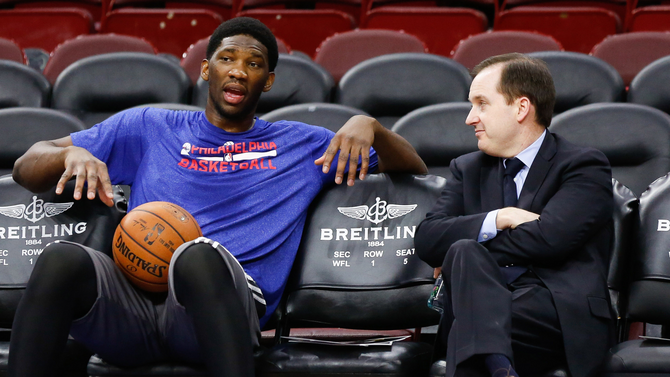
Sam Hinkie (right) drafted Joel Embiid (left) and began ‘The Process’ in Philly.
Imagn Images
This is perhaps the single most important inflection point in the history of draft reform. As we’ve covered, tanking is not new. It has been happening in some form, at the very least, since 1984. Multi-year misery was relatively common as well. Between 1987 and 2009, the Clippers picked in the top four of 10 out of 23 available drafts and made the playoffs only four times. But this was something new. Not a single, circumstantial tank, nor accumulation of multi-year draft value through sheer incompetence. This was a targeted, multi-year plan to game the system. And this begs a critical question: why hadn’t anyone else done this before?
The common answer goes something like this: “the nerds broke the culture of the sport.” Hinkie came up with the Houston Rockets, who were, under general manager Daryl Morey, the NBA’s most forward-thinking organization at the time. He earned an MBA at Stanford. That unusual background made him almost uniquely qualified to upend NBA convention, specifically because he wasn’t working or developing in places that dogmatically adhered to it. Other teams broadly understand the NBA’s incentive structures, but “incentive structures” weren’t a widely discussed concept in basketball at the time. Teams just weren’t that strategic yet. They tried to win games because that’s largely just what you did, minus the occasional end-of-season tank. Hinkie was, in short, an outsider. Likely an inevitable outsider. If it hadn’t been him, it would have been someone else. This sort of strategy was too obvious to remain unattempted for too long.
I’m not dismissing this answer off-hand. In fact I think it explains the motivation. Just not the approval for execution. The strategy is, again, somewhat obvious. The question isn’t “why hadn’t anyone thought of this before,” because someone almost certainly had thought of it before. It’s “why hadn’t anyone done this before,” because the concept had never made the leap from theory to reality. I believe there’s a fairly straightforward explanation for why the 2013 76ers, specifically, were the team to make that leap: money.
Intentional, multi-year losing was not financially viable for most of NBA history. Think back to those territorial draft picks we covered all the way back at the beginning. The NBA started out as a live events business. The NBA Finals were shown on tape delay until 1982. The NBA, as a business, relied first and foremost on putting butts in seats. Television was a meaningful component of that business, but not its primary engine. Television revenue is guaranteed years out through lavish, long-term deals, especially at the national level. But ticket sales are much more reliant on the actual product a team puts on the floor.
But as the decades passed, the NBA’s national media rights contracts grew exponentially. The first television contract the NBA signed that came with publicly-known terms came for the 1973-74 season. It was a three-year, $27 million deal that paid the NBA $9 million per season. By the 2012-13 season, the NBA was nearing the end of an eight-year, $7.54 billion deal with ESPN and Turner that paid $942.5 million annually. This meant that in the roughly four decades covered by that window, there was a more than 10,000% rise in annual television revenue, and as we know, in 2014, the NBA would sign yet another huge TV deal, this one worth $24 billion over nine years. Somewhere in this window, the NBA shifted from primarily being a live events business to primarily being a media business.
The exact point at which this shift came is unclear, and even if we could identify it in hindsight, we don’t know when teams identified it or started acting on it. But something else happened at around this point that made an all-out tank slightly more palatable: the 2011 lockout. During the 2010-11 season, the NBA claimed that 22 of its 30 teams were losing money. The veracity of these claims is both unknowable and contextual. The NBA did not open its books to the public, and even if it did, there’s a difference between teams losing money because of a flawed business model and teams losing money because owners overspent on players trying to win. Regardless, the 2011 Collective Bargaining Agreement represented an enormous victory for the owners. Whereas players had previously received 57% of Basketball Related Income, they dropped to between 49-51% in the new deal.
These factors together created a much more favorable long-term climate for owners. Harris and his group bought the 76ers just before the 2011 lockout for $280 million. A year later, the Bensons bought the Hornets, a team that was then-owned by the NBA and appeared less valuable on paper, for $338 million. This wasn’t a fluke, either. Soon after, Robert Pera bought the Grizzlies, again in a smaller market in Memphis, for $377 million. The cat was out of the bag by 2014, when Steve Ballmer dropped $2 billion for the Clippers. We were in a franchise valuation boom, and Harris group had bought in at the perfect moment. The primary value of owning an NBA team was no longer in its year-by-year revenue, but by holding onto the asset for a long time and watching its value balloon.
Put all of this together and we can start to paint a picture. For most of NBA history, it just wasn’t financially viable for a team to intentionally lose games for a sustained period of time because doing so would cost them too much revenue in ticket sales. At some point between the 1970s and the 2010s, the equation shifted and television provided a greater and more reliable multi-year revenue stream. The 2011 lockout further shifted the financial balance of power in the league towards owners, and under those conditions, aggressively pursuing long-term championship contention became a more appealing strategy because year-to-year revenue was less important.
Who would care about two or three miserable years if it produced a decade of winning? In the context of team valuation, a decade of playoff winning can change everything. Just ask the Warriors, who were sold for $450 million in 2010 and are now worth an estimated $11 billion. Take an owner who wants to win championships, just bought into the league at what quickly looked like a bargain price and likely assumed another huge television deal was coming and you have all of the conditions needed to absorb a decline in ticket sales and undergo a mutli-year tank.
And once the 76ers broke the seal, copycats followed. Tanking was no longer isolated or confined to the end of seasons. It was an out-in-the-open strategy that threatened the competitive integrity of the sport. These aren’t just histrionics, and it’s not as simple as some unwatchable games at the end of March or even a few ugly years watching your favorite team on television. Think back to what Sonju stated after Orlando won the lottery in 1993: “It kind of defeats the purpose of using the draft to build the weaker teams.” When so many teams are trying to be bad, it becomes far more difficult to actually identify who the weaker teams actually are.
The NBA’s response may have been motivated in part by these competitive concerns. It was certainly motivated by financial ones. ESPN’s Brian Windhorst unveiled that the other owners urged the NBA to step in and guide Philadelphia’s management starting in the summer of 2014 because the 76ers, a high-revenue team, had become an economic drag on the league’s revenue-sharing system and were hurting attendance when they visited other arenas. Either way, the NBA attempted swift reform against The Process.
2013-2017: Lottery reform vs. the Sams
Before the 2014-15 season, the NBA proposed lottery reform to its board of governors. The proposal would have given the four worst teams in the NBA identical 11% odds at the No. 1 pick and increased the drawing from three teams to six, and the changes were widely expected to pass. But when the vote was held on Oct. 22, 2014, only 17 of the 30 NBA governors were in favor. The vote needed a three-fourths majority, or 23 out of 30, in order to pass. Therefore, the NBA’s 2014 attempt at reform was denied.
So what happened? According to Grantland’s Zach Lowe, an NBA general manager named Sam aggressively campaigned teams behind the scenes to vote against the proposal. That general manager was not Sam Hinkie, but rather, Oklahoma City general manager Sam Presti. He reportedly argued that the reforms would make rebuilding too difficult for small-market teams.
Remember, this came at peak player-empowerment hysteria. Stars were still frequently moving through free agency at this time in league history, and more often than not, they were going from small markets to big ones. With free agency less accessible to certain teams than it was to others, Presti successfully convinced a number of teams — including his former team, the Spurs, and several others run by his former Spurs coworkers — that reform would do more harm than good. This forced the league back to the drawing board.
2019-2026: The flattened-odds era
The tanking problem persisted in the years following the NBA’s first failed attempt at reform, so in 2017, it tried again with a compromise proposal. Rather than flattening the odds to 11% for the worst four teams, it would flatten them to 14% for the worst three. Meanwhile, the proposed six-team drawing would be reduced to four, which would still be an increase over the three teams that the lottery drew for at the time. On Sep. 28, 2017, the proposal passed 28-1-1, with Oklahoma City voting against and Dallas abstaining.
Notably, this meant that even Philadelphia, now through its tanking period and attempting to win, voted for the changes. Hinkie resigned from his post in 2016, months after former Suns owner Jerry Colangelo was hired as Philadelphia’s chairman of basketball operations. Rumors persisted for years — especially after the disastrous manner in which Colangelo’s tenure in Philadelphia ended — that the NBA influenced the hire. Adam Silver has denied those claims.
“The only role I played was making an introduction to Jerry for Josh Harris,” Silver told SiriusXM NBA Radio.” But I would say this was something that was initiated entirely by Josh Harris and he’s the principal owner and the governor of the Philadelphia 76ers. Contrary to what I read in some of the reports this was not arm-twisting from the league office telling the 76ers they had to change course. This was not other owners calling me and saying, ‘You’ve got to force the 76ers to do something.'”
This new format would kick in for the 2019 NBA Draft, not the upcoming 2018 Draft, to give teams more time to adjust to the changes. Below is the odds structure that will remain in use through the 2026 NBA Draft.
Slot
Total combinations
No. 1 pick odds
No. 2 pick odds
No. 3 pick odds
No. 4 pick odds
Top four odds
1
140
14%
13.4%
12.7%
12%
52.1%
2
140
14%
13.4%
12.7%
12%
52.1%
3
140
14%
13.4%
12.7%
12%
52.1%
4
125
12.5%
12.2%
11.9%
11.5%
45.2%
5
105
10.5%
10.5%
10.6%
10.5%
45.2%
6
90
9%
9.2%
9.4%
9.6%
37.2%
7
75
7.5%
7.8%
8.1%
8.5%
31.9%
8
60
6%
6.3%
6.7%
7.2%
26.3%
9
45
4.5%
4.8%
5.2%
5.7%
20.3%
10
30
3%
3.3%
3.6%
4%
13.9%
11
20
2%
2.2%
2.4%
2.8%
9.4%
12
15
1.5%
1.7%
1.9%
2.1%
7.1%
13
10
1%
1.1%
1.2%
1.4%
4.8%
14
5
0.5%
0.6%
0.6%
0.7%
2.4%
The theory here was that by reducing the benefit of being absolutely terrible, teams would be less inclined to strip their rosters down to the studs like Philadelphia did, and with more randomness introduced to the lottery as a whole, teams would be more afraid of actually taking the plunge and starting a tank. Instead, the opposite played out. These changes helped launch some of the most widespread tanking in NBA history.
By making the top few spots in the lottery less valuable, the league made the middle slots that follow them significantly more valuable. Every combination they took away from the worst teams had to go somewhere, so suddenly teams in the middle of lottery or even the eventual Play-In Tournament race had much more to gain by tanking. Every slot between No. 4 and No. 13 in the new system had higher odds at No. 1 than it did in the prior system, which meant tanking to move up just one or two slots was potentially more lucrative.
Think of what Bob Ferry stated all the way back in 1985. “Some teams that might barely make the playoffs and don’t have a realistic chance of winning might prefer not making the playoffs.” The math supports that thinking under this format more than it ever has. Though their primary motivation to do so was a protected pick, it is worth noting that the 2022-23 Mavericks did decide to tank their final two games of the season while technically still alive for a postseason berth.
Meanwhile, increasing the drawing from three teams to four suddenly gave the worst teams another reason to try to lose. They were no longer doing it to maximize their odds at a best-case outcome, but minimize the pain of a worst-case outcome. Now, the worst team in the NBA could pick as low as No. 5, and even if the third-worst team had the same odds at No. 1, it had a lower draft floor all the way at No. 7. Flattening the odds among the three worst teams was designed to stop competition for the worst record, but the nightmare scenario of wasting a whole season to tank only to land the No. 7 pick scared those teams into tanking even harder.
Lottery reform wasn’t the only factor hastening the tanking crisis, though. The subtler but no less important factor here was rule changes that largely weren’t meant to interact with the NBA Draft.
During the 2011 CBA, standard veteran extensions were capped at either 107.5% of the player’s previous salary or the estimated average salary, whichever was higher so long as the new number didn’t exceed that player’s max. In the 2017 CBA, that figure rose to 120%, and in 2023, it rose to 140%. These changes, coupled with the introduction of the supermax contract in 2017, made it far easier for players to sign contract extensions with their existing teams.
This created a feedback loop that essentially killed high-level free agency. The best players signed extensions because it was suddenly financially viable to do so. Teams saw fewer high-level free agents available and stopped preserving cap space, instead choosing to extend their own players. Players saw less available cap space, and so on, and so on. In 2025, only four free agents changed teams for more than the non-taxpayer mid-level exception, and three of them moved through sign-and-trades worth only slightly more. The only free agent to sign into someone else’s cap space at something resembling an average starter’s salary in 2025 was Myles Turner.
With free agency suddenly less powerful, teams became more reliant than ever on trades to bring in veteran talent. Of course, teams recognized this, and the price to acquire archetypes that were once readily available in free agency went through the roof. Players who had never made All-Star Teams were suddenly getting traded for several first-round picks. Teams can’t build through free agency or trades nearly as reliably as they once did. That has made them more reliant on the draft than they’ve ever been, which has led to a corresponding increase in tanking.
2026: Modern lottery reform
This all leads us to the 2025-26 season, which has arguably featured more tanking than any season in NBA history. In February, the NBA fined the Utah Jazz $500,000 for conduct detrimental to the league and the Indiana Pacers $100,000 for violating the Player Participation policy. In the statement announcing those decisions, Silver revealed the league’s intention to make changes.
“Overt behavior like this that prioritizes draft position over winning undermines the foundation of NBA competition and we will respond accordingly to any further actions that compromise the integrity of our games,” Silver stated. “Additionally, we are working with our Competition Committee and Board of Governors to implement further measures to root out this type of conduct.”
Proposals were initially relatively small. A brainstorming session in December reportedly centered around limiting pick protections in trades, preventing teams from finishing in the top four of the lottery in consecutive years and potentially locking the lottery order on March 1 to prevent the sort of egregious tanking we so frequently see at the end of seasons. As talks progressed, though, the NBA seemingly decided those measures didn’t go far enough.
As of this writing, the reporting suggests that the NBA has settled on the following proposal:
A 16-team, 37-ball system in which three lottery balls (8.1% chance at No. 1) are assigned to the seven best teams to miss the postseason, two balls (5.4%) are assigned to the three worst teams that miss the postseason as well as the No. 9 and No. 10 seeds in each conference, and one ball (2.7%) is assigned to the loser of the No. 7 vs. No. 8 Play-In game in each conference.
Teams would be forbidden to pick No. 1 in consecutive drafts, or pick in the top five of three straight drafts.
A drawing would be held for all 16 picks in the lottery, though the three worst teams could pick no lower than No. 12. Teams could not protect slots 12-15 when trading picks.
The commissioner would have increased powers to discipline teams for tanking, including altering lottery odds or changing a team’s draft position.
A “sunset” provision that would only enact these rules for the 2027, 2028 and 2029 NBA Drafts before the board of governors would either need to approve extending them or once again make changes.
That last note is critical, because if this history has taught you anything, it is the rough cycle of how these reforms will play out. The next few years will likely see a reduction in tanking, though external factors—like a few weak upcoming draft classes and several current tankers naturally graduating from that portion of their rebuilding cycle—will have as much or more to do with that than the changes.
And then something is going to happen, because something always happens. Some team will get lucky in a way that threatens the competitive balance of the sport as the 1993 Magic did, perhaps the Thunder or Spurs winning a lottery with a traded pick or the wrong playoff team’s trajectory materially changing because of one drawing. Meanwhile, it will become harder and harder for new challengers to those lucky few teams to emerge without multiple years of reliably high draft picks. The NBA’s upper class will remain entrenched for longer, but so will its lower class. A handful of teams will inevitably draw the short straws and suffer through years of poor lottery results. This will alienate fanbases who no longer feel their teams have any real long-term hope.
So at some point in the near future, potentially 2029, or perhaps years after that if it takes the unintended consequences of these changes to present themselves, we’ll probably be doing this again. If these reforms wind up failing, more extreme ideas will start to gain steam. Maybe this is what it takes for the NBA to more seriously consider divorcing draft order from team record entirely. Ideas like Mike Zarren’s wheel or rookie free agency could gain prominence. If superstars really do occupy a uniquely valuable position in basketball compared to other sports, then perhaps the only truly fair way to allocate them is completely randomly. If not, perhaps the odds will re-steepen as they did in 1994.
All we can say for certain is that no solution will satisfy everyone. Formatting the NBA Draft is a matter of picking your poison. Right now, the prevailing opinion within the NBA seems to be that tanking is so corrosive to its ecosystem that the league is willing to potentially dilute its intended parity mechanism in order to root out intentional losing. That was the prevailing opinion in 1984 as well. But the pendulum will swing back. It always does.