Why Man United should think twice about hiring Carrick as permanent coachplayMichallik: Man United need major squad improvements (2:16)Janusz Michallik believes Manchester United must invest in their squad to reach the next level. (2:16)Ryan O’HanlonMay 12, 2026, 07:00 AM ETClose
Ryan O’Hanlon is a staff writer for ESPN.com. He’s also the author of “Net Gains: Inside the Beautiful Game’s Analytics Revolution.”
Follow on X
Multiple Authors
Email
Print
I don’t even have to keep up the bit.
The first time Manchester United fired their cantankerous Portuguese manager with the team two spots adrift of the Champions League places, they hired a beloved former player with no high-level managerial experience to be the interim coach … and then won 14 of their next 19 games. Players stated things like this: “Of course we want him to stay. The results have been great.” And this: “What else does he have to do?” Or this: “I don’t think I need to say much after all these results, it looks certain.”
It soon became certain, and Ole Gunnar Solskjaer lasted a little over a full season as the permanent manager after Jose Mourinho.
And, well … then this season Manchester United fired their cantankerous Portuguese manager with the team two spots adrift of the Champions League places, and so they hired a beloved former player with no high-level managerial experience to be the interim coach … and he won 10 of his first 15 games in charge.
Players are saying things about Michael Carrick like this: “In my opinion, he completely deserves it [the Manchester United job], I think he’s a guy who has already demonstrated that he has very good qualities to be a Manchester United coach.” And this: “To be part of everything that he did is a pleasure, and then of course I think he deserves it.” Or this: “You want to follow him. You want to fight for him. You want to die for him on the pitch.”
With Man United clinching Champions League qualification for the first time in three seasons — just a year after they finished in 15th place under Ruben Amorim — and with players willing to risk their lives for him on the field, it seems quite likely that Manchester United are going to make Michael Carrick their permanent manager. In a lot of ways, it seems obvious that they should.
But haven’t United already tried this once before? Shouldn’t they, at least, be a little wary of riding too high off a nice run of short-term results?
– Lamine Yamal and risk created by too much of a good thing
– Why Champions League tells us little about Premier League
– USMNT depth chart: Top 15 players in each position, ranked
The case for Man United keeping Carrick
This one’s pretty easy, huh?
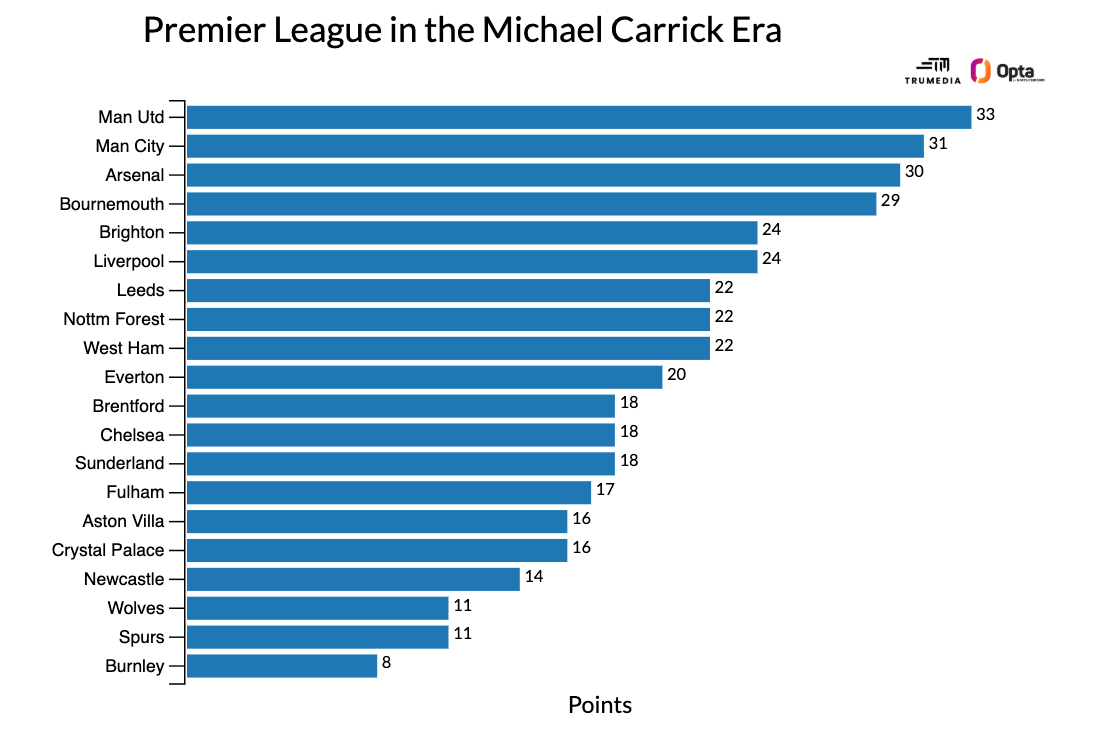
Since Carrick took over at Old Trafford, Man United have won more points than any other club in the Premier League:
Extrapolate that out over a full season, and United are on an 84-point pace. If Arsenal win their final two matches, they’ll win the Premier League with 85 points. So, you can at least squint your eyes and see where someone like Mason Mount is coming from when he says he thinks this team can win the Premier League next season.
Plus, those weren’t some simple 33 points. No, United have played everyone else inside the Premier League’s top five since Carrick took over. Their record against Arsenal, Manchester City, Liverpool, and Aston Villa? Fifteen points from a possible 15. They’ve also beaten Chelsea and Spurs, which is less impressive than it’s supposed to be, but all of those clubs have played in the Champions League over the past two years, and United have won all seven of those games.
On top of that, Carrick has done the thing that Amorim was especially terrible at: not alienating academy stars. Marcus Rashford and Alejandro Garnacho were seemingly driven away from the club because of Amorim’s inflexibility — either in how he plays, or how he’s willing to manage different personalities — and Kobbie Mainoo barely played.
Under Amorim this year, the now-21-year-old Mainoo featured in just 12% of the Premier League minutes. Since Carrick took over? Mainoo is playing 92% of the time, he has signed a new contract, and he’s telling the media that he’s willing to lose his life for his new coach.
play
0:49
Michael Carrick: Man Utd contract is out of my hands
Michael Carrick says “clarity” is needed about his future at Manchester United but believes the decision is not up to him.
As I’ve written in the past, if United are ever going to challenge for titles again, they need to hit on a couple of academy stars.
If Liverpool or Arsenal acquired players of equivalent quality to Trent Alexander-Arnold or Bukayo Saka, they would’ve had to spend upward of $200 million on salaries and transfer fees. Instead, they both got and still get many years of world-class performance without any transfer fee at all. They were then able to put all of that saved spending into strengthening other areas of squads that became two of the best teams in the world.
You, of course, can’t do that if your coach isn’t willing to give those kinds of players a chance to actually play. United will be very lucky if Mainoo ever comes close to the level of play that we’ve seen from TAA and Saka, but there’s no indication that Carrick wouldn’t give opportunities to any other promising prospects who emerge from the pipeline.
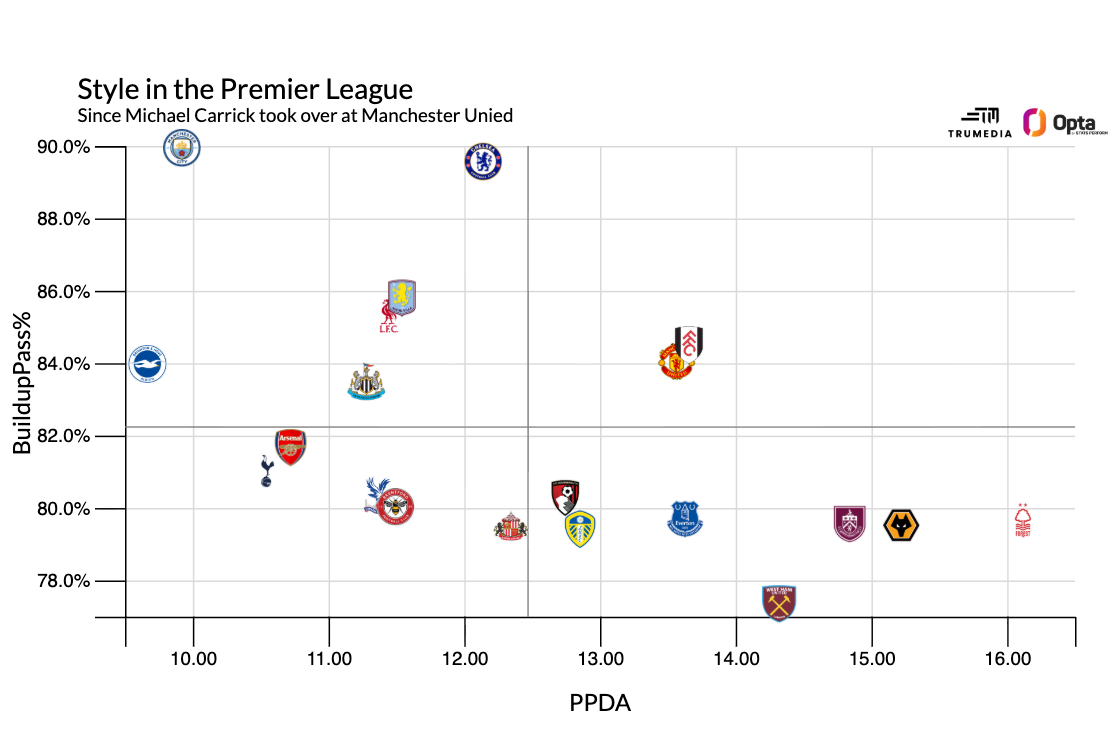
And then, lastly, Carrick has changed the way United play. Under Amorim, United had adopted an up-and-down approach that led to lots of shots and lots of chaos at both ends of the field. That is … the exact opposite of what we’ve seen under Carrick. They no longer press high (as measured by passes per defensive action, or PPDA), and they no longer panic under pressure outside the attacking third (buildup pass completion percentage):
So, Carrick has re-instilled a devotion to youth, he has completely revamped United’s tactical approach, and oh yeah, he’s winning more games than anyone else in the league. And yet …
The case against Man United keeping Carrick
What actually is managing? It was just graduation weekend at the university where I teach, so maybe I’m wistful and wanting to do some dorm-room philosophizing, but seriously: what does a manager even do?
In the broadest sense, a manager’s goal is to get the players to perform at the highest level that their collective talent allows. And that involves some combination of tactical instructions, player selection, substitution strategizing, morale building, fan assuaging, technical guidance, coaching-staff selection and delegation, opponent analysis, self-analysis and re-education, reacting properly to randomness, and protecting your staff from the people above you.
That’s a lot! It’s further complicated with every extra game you play, and United simply haven’t played many games since Carrick took over. Thanks to the issues of the Amorim era, the team Carrick came into was already eliminated from both domestic cups and hadn’t even qualified for the Conference League.
Carrick has managed 15 total games since replacing Amorim. Here’s how many games all of the Premier League teams who qualified for European competition have played over the same stretch:
• Arsenal: 29
• Manchester City, Chelsea, Nottingham Forest, and Newcastle: 25
• Liverpool and Aston Villa: 24
• Crystal Palace: 22
• Tottenham: 19
There are two important points here. The first is that coaching one game a week, like Carrick has, is a very different job than doing it twice a week. You get way less training time because you’re traveling and also playing an extra game. So your match prep is completely different. And then, on top of that, you have to figure out whom to actually play in those games in order to prevent injuries.
The worst coaches just try to optimize for the game immediately in front of them, but the best coaches at top clubs are constantly making changes that might weaken their team in the short term but maximize their chances over the whole season. Those are difficult choices to make, and we’ve never seen Carrick faced with any of them.
The second point is that, because of all of these factors, teams that play in Europe tend to perform worse in the Premier League when you add games to their schedule. Roughly, the numbers show that three added European matches leads to about a point lost in the Premier League.
So, we might expect United to suffer a bit next season as they take on the Champions League and potentially survive for a little longer in both domestic cups. And we also might expect them to suffer because they’re not doing most of the things that typically win soccer games.
Well, yes, they’re scoring, and goals actually win games. But this is a low-scoring sport prone to incredible amounts of randomness. And under Carrick, United haven’t been particularly good at the things that tend to lead to goals.
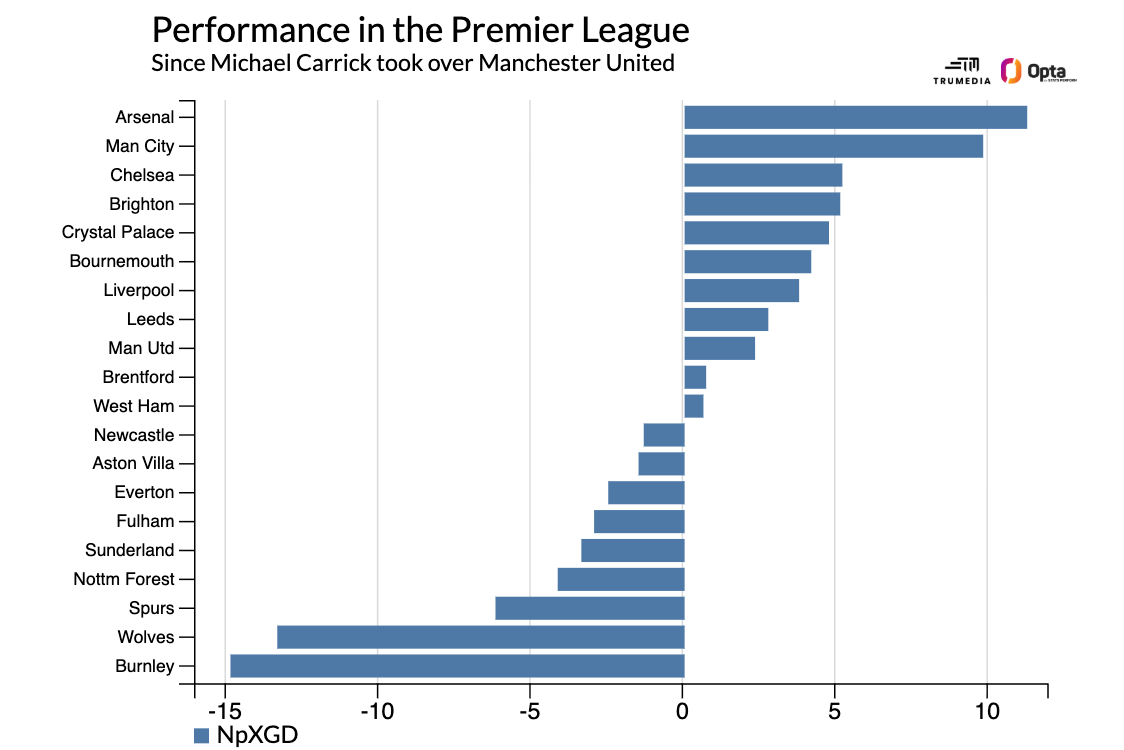
Here’s where United fall in the Premier League since Carrick took over for non-penalty expected goal differential:
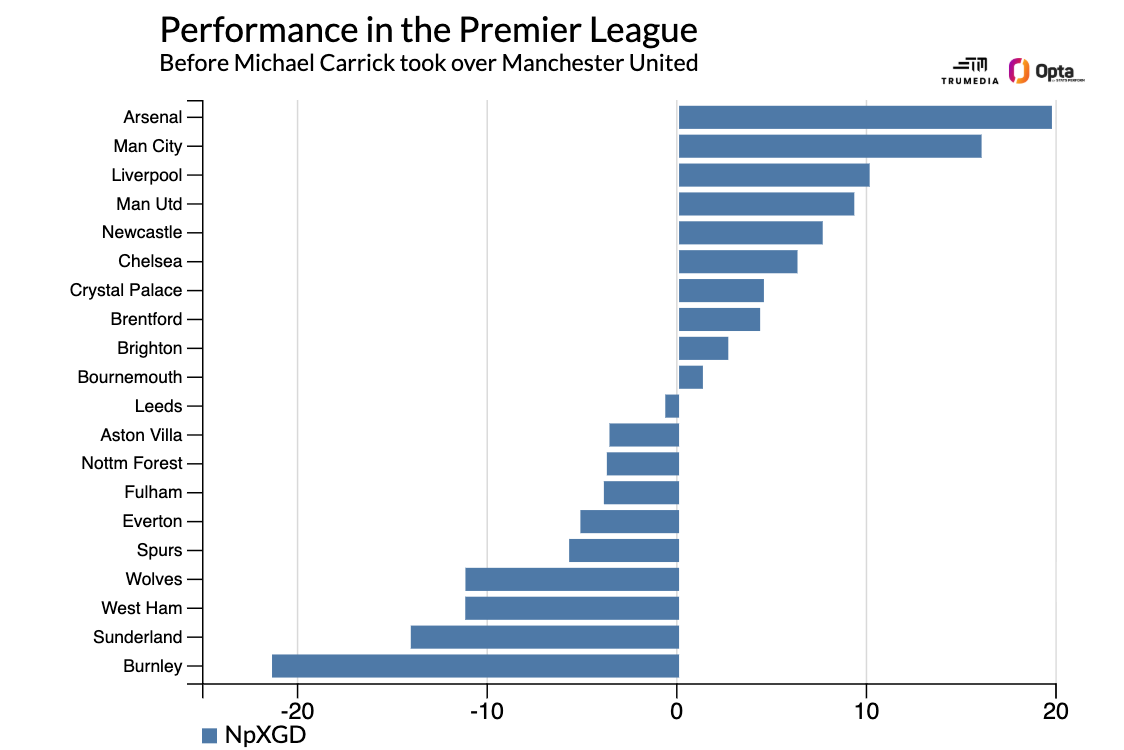
And here’s where they were before he came in:
On a per-game basis, they were at plus-0.35 under Amorim — they’re down at plus-0.15 under Carrick. To break it down a little further, just looking at expected goals this season:
• Attacking under Amorim: 32 non-penalty goals from about 33 xG
• Attacking under Carrick: 25 non-penalty goals from 19 xG
• Defending under Amorim: 29 non-penalty goals conceded from 26 xG
• Defending under Carrick: 13 non-penalty goals conceded from 16 xG
Overall, that looks like a plus-3 non-penalty goal differential under Amorim from a collection of shots we’d expect to be worth closer to plus-7, while Carrick’s team has a plus-12 goal differential from shots we’d expect to be worth around plus-3. Those are completely normal discrepancies outside of a manager’s control over less than half of a season, and it almost totally explains the difference in results between the two coaches.
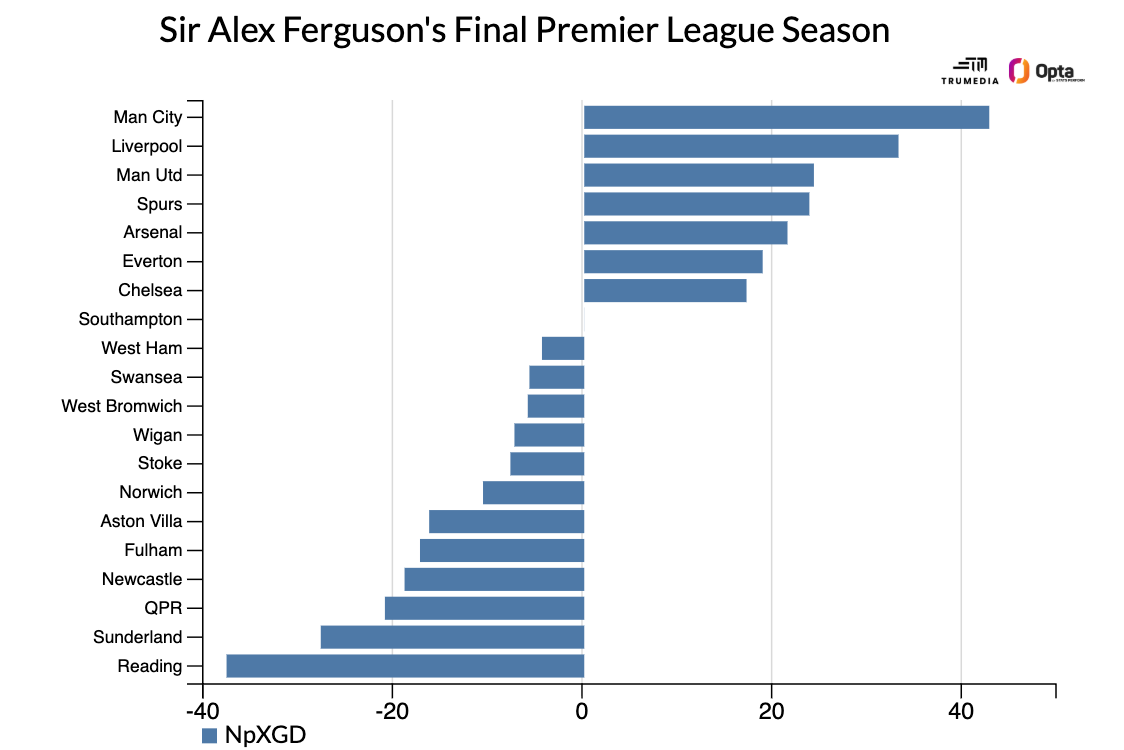
We’ve seen this before — under just about every manager since Sir Alex Ferguson other than Amorim. Louis van Gaal, Mourinho, Solskjaer and Erik ten Hag all had really successful early seasons that weren’t propped up by the requisite quality of chance creation and prevention, and then each one’s tenure soon fell apart. You could even apply the same pattern to David Moyes.
Guess which team finished with 89 points and won the league by an 11-point margin:
It was Manchester United, who won the league thanks to some incredible (and unsustainable) finishing from Robin van Persie in Ferguson’s final season.
Of course, they fell back to earth the following year, while Liverpool and Manchester City, the top two teams in the chart, duked it out for the title. You can’t consistently win games without consistently creating better chances than your opponents — United have been taught this lesson every couple of seasons, but they’ve still never internalized what it actually means.
Obviously, there are other factors that can lead a team to create better chances than its opponents, but Carrick’s United haven’t done any of that, either. They’re controlling only 48% of the final-third possession in their matches, and they’re allowing more touches inside their own penalty area (25) than they’re generating in the opposition box (24).
Now, Amorim wasn’t fired because he was overseeing a terrible team. He was fired because he refused to fit into a modern decision-making structure, he was incredibly inflexible, and he kept freezing out all of Manchester United’s talented homegrown players.
Carrick, meanwhile, will do the opposite of all those things, and he also just seems like the complete opposite of what United have been ever since Ferguson left: expensive, emotional and overconfident. There’s a good case to be made that he’s exactly what United need — especially in an age when managerial influence is being marginalized by the day.
United have all kinds of information that we can’t see from the outside, and Carrick did coach a more possession-dominant team in the Championship with Middlesbrough (although they never pressed well). If he checks all your boxes from what you’ve seen from day to day, and you’re convinced that some more talent will turn the passive possession approach into better performances that actually tilt the field in your favor, then sure: why not?
But if you’re really one of the people making the decision here, it’s worth thinking twice about.
Let’s say there was another coach, at another club, with the exact same profile: none of the favorable underlying statistics that best predict future performance, no evidence of developing a possession-dominant style in a top league, and no experience managing the rigors of a four-competition campaign.
If your end goal was to win the Premier League and compete in Europe, would you hire him?