Is Kimi Antonelli being overhyped due to results that largely he’s been a tad fortunate with? Aside from China, in Miami he benefited from a better strategy call by Mercedes to beat Lando Norris, Suzuka was the safety car and Canada saw McLaren’s mistake and George Russell retire. – Gavin

Kimi Antonelli has definitely had luck on his side this year, and there is no question that the size of his lead over Mercedes team-mate George Russell – 43 points after five races – is in large part a consequence of that.

Russell’s retirement from the lead with an engine problem in Canada was particularly damaging for the Briton.

It’s also true that the timing of the safety car in Japan handed Antonelli the lead on a plate, that Russell’s technical problems in China qualifying – first with a gearbox glitch and then a front-wing issue – prevented him from fighting for pole there, and that McLaren dropped the ball on strategy in Miami, allowing Antonelli to undercut Norris for the lead.

At the same time, there is no question that Antonelli has raised his level significantly this year, is living up to the potential Mercedes have long seen in him, and is a legitimate championship leader.

In China, his front wing actually had the same problem on his final lap in qualifying as Russell’s did. And in Japan, Mercedes felt he was on track to take the lead regardless of the safety car, such was his pace on medium tyres once in clear air.

And you can hardly hold against him McLaren’s fallibility in Miami, or the issue with Russell’s engine in Montreal.

While Russell was leading in Canada when he retired, it was very far from a comfortable lead. Antonelli was all over him, and looked faster. The destiny of the victory was wide open.

And while they are tied in the head-to-head qualifying battle 4-4, Antonelli is slightly quicker on average so far this season, by 0.074secs.

So, yes, the size of Antonelli’s lead is partly due to circumstances, but it’s equally true that he has had an outstanding season so far against a driver who is himself outstanding.

There are plenty of twists and turns to come, and luck usually evens itself out over a season – although that was not the case between Hamilton and Nico Rosberg at Mercedes in 2016, it has to be reported.

Figure caption,

Mercedes teammates are battling it out for the drivers championship

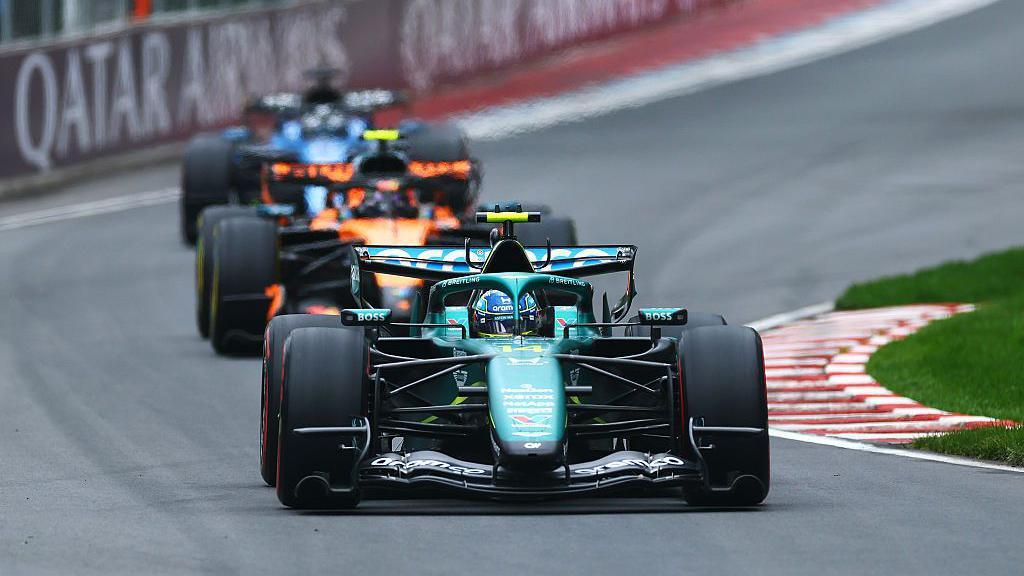
Given the massive attention to detail associated with F1 engineering, what possibly happened when Fernando Alonso was forced to retire from Canada with a loose seat. Surely such a fundamental item should be fitted correctly? – Ian

The question contains a misunderstanding of what happened to cause Fernando Alonso’s retirement in Canada.

He did not have a loose seat. He had a problem with his seating position.

As Alonso reported after the race: “I felt increasingly uncomfortable. The position wasn’t right and, since we were out of the points, far from the points zone, and with no threat of rain, we decided to put an end to the pain. We tried to adjust a few things last night, but it didn’t work.”

Aston Martin’s chief trackside officer Mike Krack explained that the issue was rooted in a seating position that this year is more reclined than in previous seasons, the idea being to lower the centre of gravity.

Krack reported: “He hasn’t felt completely comfortable for a while now – never to the point of becoming a real obstacle, but it’s like a pressure point that gets worse lap after lap, and I think we need to reconsider the seating position a bit.

“With these cars, you always try to sit as low as possible, and if you look at how drivers have been sitting in recent years, the position has become increasingly more relaxed. Maybe we’ve gone a step too far, but it’s something we need to look into.”

This issue has nothing whatsoever to do with Alonso’s age.

The team are going to try out a few solutions to the problem in Monaco this weekend, such as Alonso perhaps sitting a little higher, or adjusting the pedals.

Fernando Alonso on track for Aston Martin in Canada Image source, Getty Images
Image caption,

Fernando Alonso and Aston Martin team-mate Lance Stroll are yet to score a point in the drivers’ championship this year

FIA president Mohammed Ben Sulayem seems to be gathering together all the strings of power within the FIA into his own hands. His newest move appears to give himself the presidency for life. Why aren’t we hearing more voices condemning this, as it surely cannot be a good thing? – Phil

This is a reference to the story in which BBC Sport revealed last week that Ben Sulayem is seeking to remove presidential term limits from the FIA statutes.

This is the newest of a series of moves in recent times that seem designed to entrench Ben Sulayem’s position and, critics argue, undermine good governance and transparency at the FIA.

These moves have been extensively revealed on by BBC Sport in the past two years or so, but they include removing checks and balances in the FIA’s governance structure, repeated sackings of people following apparent disagreements with Ben Sulayem, and the fact that he ended up facing no opposition in the election campaign last year as a result of an arcane rule that prevented anyone else from standing.

This rule was in place before Ben Sulayem became president.

The FIA has always offered a robust response to any such accusations, insisting it is a democratic organisation upholding good governance standards.

It says it has “taken steps since 2021 to strengthen its corporate governance policies”, which “ensure its rules, practices and processes are robust and transparent”.

It also points out that all changes to governance processes were voted through by member clubs with heavy majorities.

Ben Sulayem and the FIA election process are currently being challenged in the French courts by former racing driver Laura Villars.

There has been a significant level of disquiet in F1 at the way Ben Sulayem is conducting himself in office since very early in his first term, and little has changed on that front.

At the same time, people in F1 are wary of speaking publicly on the matter, for fear of recriminations.

There is also very little anyone in F1 can do about it. Neither the teams nor F1 itself have any say in the running of the FIA. Ultimately, only the FIA member clubs have a say on their president. And the voting numbers are heavily in Ben Sulayem’s favour.

Monaco Grand Prix

5-7 June with race at 14:00 BST on Sunday

Listen on Sounds

Live commentary on BBC Radio 5 Live and BBC Radio 5 Sports Extra 2 and 3; live text updates on BBC Sport website and app

Given the increased performance, power deployment and higher grip levels of the newest F1 cars, shouldn’t some of the circuits be improved to reflect this increased performance and to ensure the safety of drivers? – John

The 2026 F1 cars do have faster acceleration than their predecessors, owing to the increased output of the electrical components of the power-units.

However, their total engine power is in the same ballpark as last year’s engines – about 1,000bhp – and they actually have significantly lower grip levels than before.

Downforce has been reduced this year by quite a large amount, and the cars’ performance in, particularly, high-speed corners is much reduced compared with last year.

As for circuit safety, the FIA and F1 are constantly working to improve and refine this; changes are made every year in one way or another.

At the same time, the performance of the cars is also kept under consideration, and when rules change, this tends to be reined in a little, to ensure speeds do not get out of balance.

Get in touch

Send us your question for F1 correspondent Andrew Benson

Related topics

  • Formula 1

✔ today silver rate

✔ 2026 winter olympics

✔ chat gtp

✔ silver rate today

✔ silver rate today live

✔ 2030 winter olympics

Read More

Sports

Leave a Reply

Your email address will not be published. Required fields are marked *