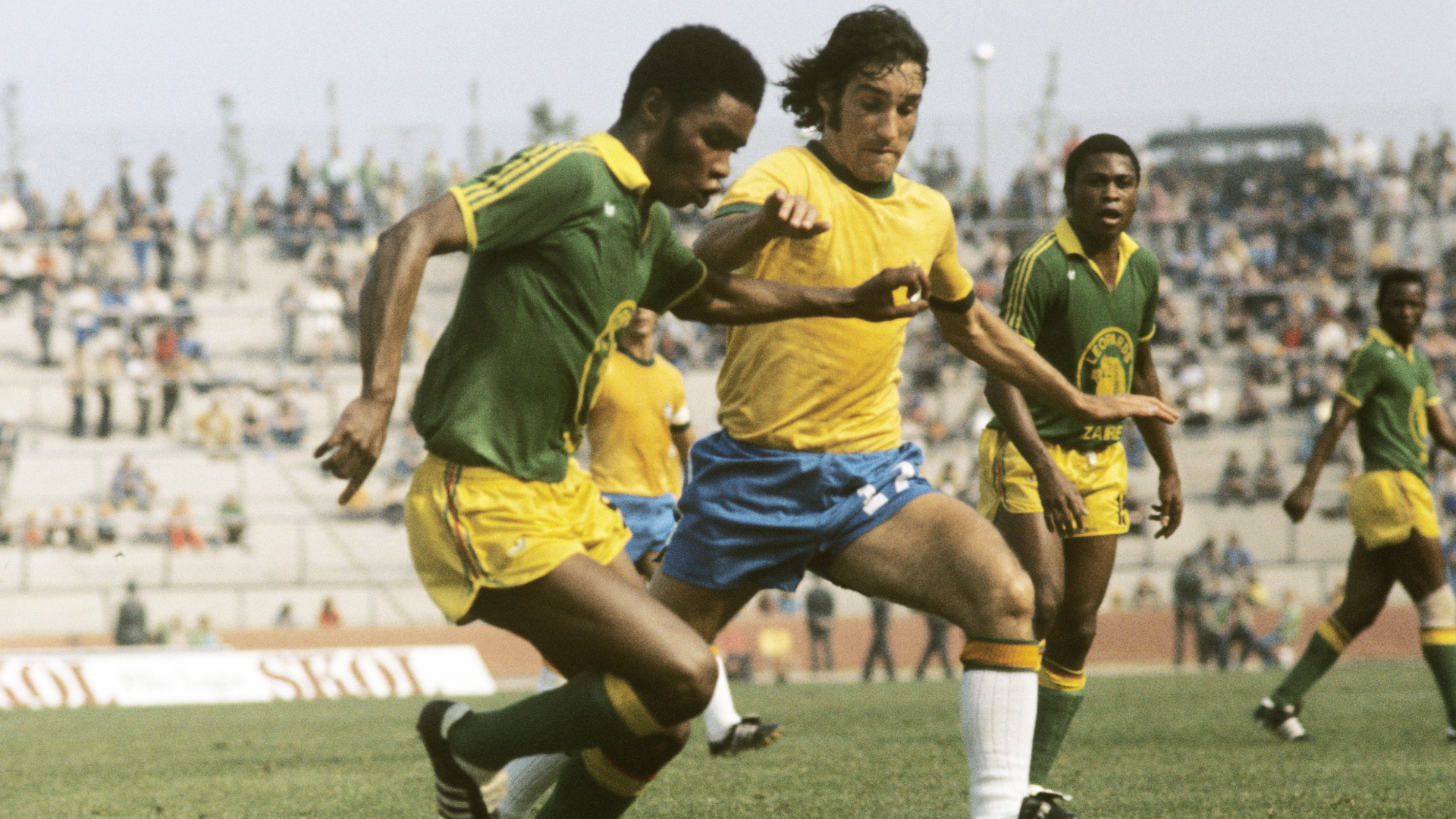
The World Cup is not just about a game, a soccer star or the passion of billions of fans around the globe. The World Cup, and the sport in general, is the ultimate reflection of our society, of our flaws but also of our qualities. Every day, we see what’s happening around the world and how politics and sport are increasingly becoming intertwined, perhaps more than they should. We often have the illusion that the past was better than the present. While that may be true in some cases, when it comes to the relationship between politics and sport, it certainly isn’t. These are some of the stories that shaped the 20th century, and in particular, the 1974 World Cup — one of the most politicized tournaments in history. The dictator who threatened the players The 1974 World Cup was full of incredible stories between sport and politics. One of the saddest ones is the one of Zaire, now called the Democratic Republic of Congo, which will be back at the 2026 World Cup for the second time ever, the first one since 1974. Patrice Lumumba, the first Prime Minister of what was known as the First Congolese Republic, was assassinated on January 17, 1961, during the Congo Crisis after Congo’s independence from Belgium. Lumumba was executed by officials and soldiers of the breakaway state of Katanga after being transferred there from central Congo. Belgian officers and officials were directly involved in the events that led to his death. Four years later, in 1965, Mobutu Sese Seko seized power in a coup and established a long-running authoritarian regime. In 1971, he renamed the country Zaire, a name it would retain until his overthrow in 1997.Like many dictators and leaders, he saw in sports a perfect opportunity to improve the status of his leadership in the country. This is why he personally invested in bringing players back to the domestic league from Belgium; most of them played for Mazembe, a team that, decades later would also become the first African club to play in the Club World Cup final, losing to Inter in 2010. Back in 1974, Zaire qualified for the World Cup that was hosted by West Germany, becoming the first Sub-Saharan African team to participate in a World Cup. The players, coaching staff, and manager Blagoje Vidinic were hailed as national heroes, and Mobutu promised them substantial financial rewards for their achievements. In the first match of the group stage against Scotland, Zaire lost 2-0 in Dortmund and Mobutu let the team know that he wasn’t considering paying them what he promised after the first defeat. The players were upset and decided to go on strike in the second match against the former Yugoslavia, and after 18 minutes Zaire were losing 3-0. The final score was an eye-raising 9-0. After the third goal, Mobutu contacted his representatives at the stadium and ordered coach Vidinic to replace the goalkeeper. Vidinic himself later came under suspicion because of his Yugoslav origins and was accused by some officials of being an outsider who could not be trusted. What unfolded before Zaire’s final match against Brazil remains one of the most tragic and unsettling episodes in World Cup history.
Mobutu personally flew to West Germany to meet the squad and delivered an ultimatum: if they lost to the reigning world champions, Brazil, by more than three goals, they should not expect to return home safely, and neither should their families. In the 85th minute of Zaire’s final group-stage match, with Brazil leading 3-0, Brazilian star Rivelino was preparing to take a free kick when Zaire defender Ilunga Mwepu suddenly sprinted out of the wall and kicked the ball away before the referee had even blown the whistle, leaving players, officials, and spectators stunned. For years, the incident was mocked as a sign of ignorance of the rules, but the reality was far more tragic.
It was a desperate act by a player terrified of the consequences of conceding another goal, after Mobutu had threatened the team and their families if they lost by more than three goals. He wants to get a red card and not risk returning home. Whether that means he would have left the stadium or tried to defect is unknown. But in 2014, he opened up about the situation.”I wanted a red card,” he told L’Equipe.
“We were really unhappy. We had just spent two months far from our families, without anyone by our side. There weren’t the same forms of communication as there are today. And they take our money? You don’t do that.
“Two hours before kick-off, we still didn’t want to play. Then there were threats. We were told to play, otherwise we’d be sent to a dungeon, so we went on to the pitch, but we sabotaged the match. A bit like a strike. That’s why we lost 9-0.
“At the same time, it was also an opportunity that I took to provoke the referee. I wanted him to give me a red card.
“I reported to myself: ‘I’m not playing anymore. Why would I stay on the field and take the risk of not returning home when the others — the people who took our money — are watching us peacefully from the stands?”
Mwepu’s intervention has since come to symbolize the fear and political pressure hanging over the squad rather than any misunderstanding of the game.
After the end of the World Cup, Mobutu lost interest in promoting soccer for his regime and decided to go for something even bigger that could distract him from the World Cup humiliation, and in October 1974 he organized the most famous boxing match in history — Rumble in the Jungle: Mohamed Ali against George Foreman. Another example that illustrates how politics and sports are often impossible to separate into two distinct spheres.
The Cold War at the World Cup
The 1970s were also the years of the Cold War, and ironically, the tournament was hosted by West Germany. At the time, there were rules for the draw like there are nowadays, that, for example, would avoid matches between countries that have some political tension, at least in the group stages. Examples are UEFA draws for Ukrainian and Russian teams before the ban in 2022 that then prevented Russian teams from playing in European tournaments altogether. In 1974, it was different, and East Germany and West Germany ended up in the same group, alongside Australia and Chile (we will talk about them next), and the then-neighbors faced each other in the last crucial game of the group.
While West Germany won the opening two games against Chile and Australia, East Germany won against Australia before drawing against the South American team. The third and final match saw East Germany facing West Germany, one of the greatest examples of politics and sports at the World Cup. Players who usually couldn’t compete against each other in their own country, they could meet at the highest stage of world soccer. In fact, at the time, Germany had two different leagues: the Bundesliga in West Germany and the DDR-Oberliga that lasted until 1991, two years after the fall of the Berlin Wall and the beginning of German reunification.
The teams that dominated the DDR-Oberliga were Dynamo Dresden, and most notably Dynamo Berlin, who won 10 titles in a row from 1979 to 1988 and was the team owned by the Stasi, the official secret police and intelligence agency of East Germany from 1950 to 1990.
The head of the Stasi, Erich Mielke, was a big soccer fan and controlled the club, which was opposed by Union Berlin, the other major team of the capital that played in the east. Their supporters became a symbol of counterculture during the Cold War: supporting Union became a way to oppose the regime and the war through the sport.
In the 1974 World Cup East Germany surprised everyone and won the third game thanks to the crucial goal scored by Jurgen Sparwasser in one of the most iconic moments in the history of the tournament. West Germany ended up winning the World Cup while East Germany were knocked out in the second group stage after losing to Brazil and the Netherlands and drawing against Argentina in their last game, but that unexpected win has a permanent place in history.
The game that never took place
If the previous two stories were powerful examples of politics interfering in soccer, the third is even more disturbing. The 1970s were horrible years in South America, with military revolutions and governments that imposed extreme rules on the citizens with coercive violence. One of the most striking examples came from Chile. Following the overthrow of Salvador Allende in September 1973, General Augusto Pinochet seized power and established a military dictatorship that would dominate the country for nearly 17 years. His regime became one of the longest-lasting and most influential authoritarian governments in South American history, remaining in power until 1990.
Once again, history, politics and sport met and went in the same direction, as two months later, in November 1973, Chile and the Soviet Union had to meet for the last spot at the World Cup in the intercontinental playoff.
Tensions between the two countries quickly escalated as the Soviet Union accused Chile and the United States of orchestrating the overthrow of Allende, who had become South America’s first democratically elected Marxist president when he won the 1970 election. The coup deepened Cold War divisions and turned Chile into a focal point of ideological conflict between the United States and the Soviet Union. After the first leg ended 0-0 in Moscow, the Soviet Union asked FIFA to move the second leg that was set to be played at the Estadio Nacional in Santiago, as thousands of prisoners had been arrested and killed at that same venue only a few weeks earlier. When Pinochet took power, the national stadium became a prison for political activists and more than 40,000 people were detained, according to since-released documents.
FIFA Vice President Abilio d’Almeida and FIFA General Secretary Helmuth Kaser were sent to Santiago, where they were dispatched to evaluate the safety of the venue, but the duo revealed that the match could be played in that venue. The Soviet Union disagreed with the decision and decided to not travel to Chile and boycotted the second leg. The Chilean team nevertheless took to the pitch and, after the referee’s signal, completed a symbolic move before rolling the ball into an empty net. With no Soviet players present, the match was abandoned and Chile were awarded a 2-0 victory, securing qualification for the 1974 World Cup. In a remarkable twist of fate, Chile were then drawn into the group featuring both West Germany and East Germany, another surreal coincidence of the 1974 World Cup.