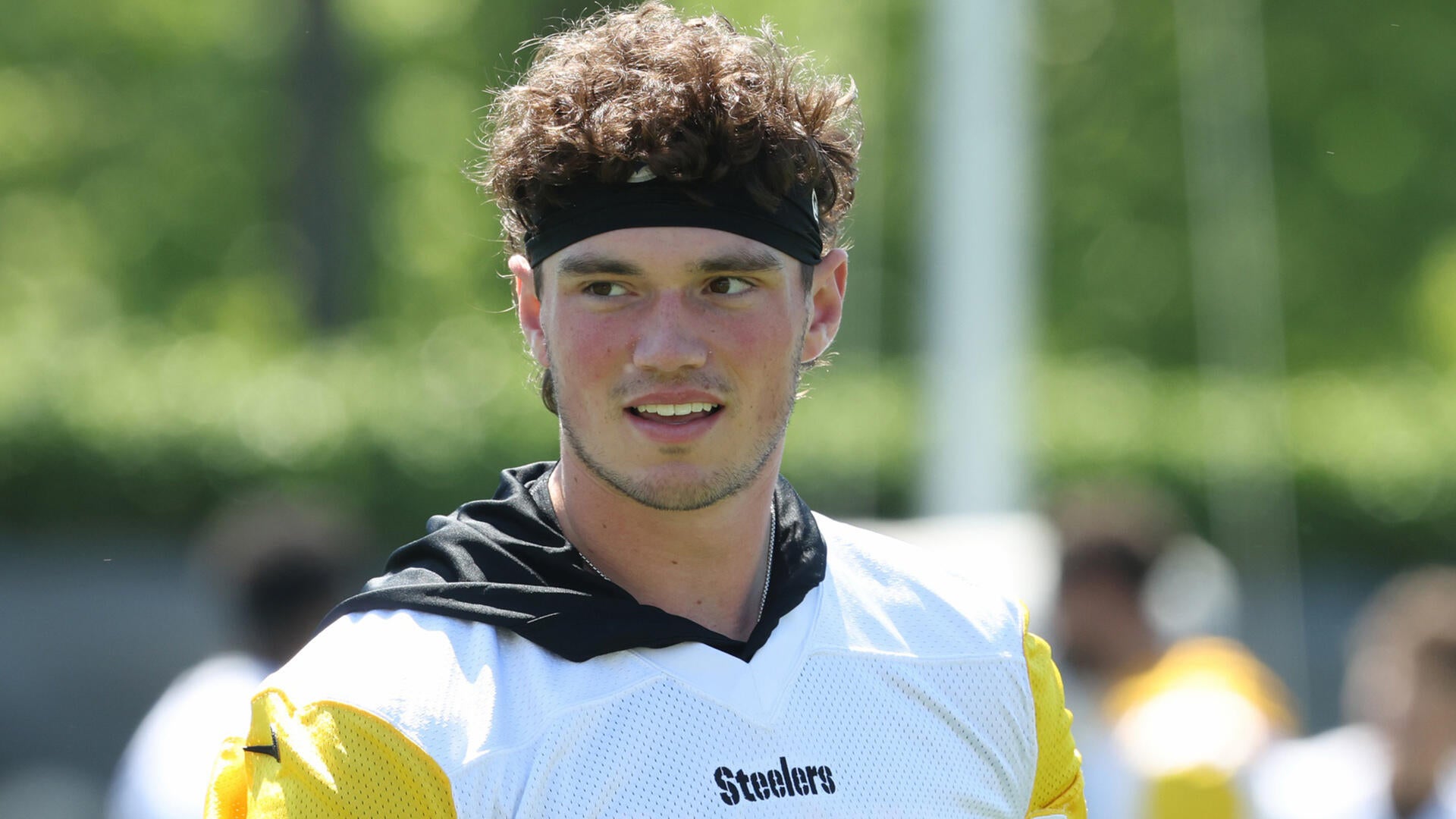
When the Steelers selected Drew Allar in the third round of the 2026 NFL Draft, I didn’t love the pick, not even a little bit.
Yes, the physical traits were obvious – they’ve always been obvious. Yes, he can make every throw, create outside structure and do things physically that most QBs wouldn’t even try. The problem was everything that came after that.
During his last two seasons at Penn State, I kept coming back to the same concerns. The footwork got hurried, and pressure often sped up his process. Too many games followed a familiar script: flashes of next-level throws followed by stretches where the consistency disappeared. There were glimpses of Allar looking like a future star, followed by moments where he was still trying to figure things out – it’s why I gave him a fifth-round grade.
So when Pittsburgh selected him with the 76th overall pick, my initial reaction wasn’t that the Steelers found a steal; it was that they drafted him a little too early.
The more interesting question, though, is whether I was focusing on the wrong things.
Because after digging through the data, revisiting the tape and examining the situation he’s walking into in Pittsburgh, I came away believing Allar has a much better chance of outperforming his draft slot than I did a few weeks ago. And, look, the flaws remain. But what changed for me is how fixable many of those flaws appear to be, given the team that drafted him.
The model liked him more than I did
Part of the reason I rethought Allar had nothing to do with the Steelers.
I wrote earlier this week about trying to project the best- and worst-case outcomes for five rookie quarterbacks in the ’26 class using quarterback data from 2015-25. The goal wasn’t to predict the future. It was to identify the traits most closely associated with quarterbacks who successfully graduated to the NFL.
And every time I ran the model, Allar kept outperforming expectations. And that forced me to ask a question: what was the model seeing that I wasn’t?
One theme emerged repeatedly. The quarterbacks who transitioned most successfully weren’t always the ones with the biggest stat lines or the strongest arms. The model consistently rewarded QBs who moved the chains, had meaningful starting experience and showed they could function when things weren’t perfect around them.
His 37.9% first-down rate was among the best in the class and significantly better than the public conversation around him would suggest. While completion percentage and touchdown totals often fluctuate based on scheme and supporting cast, first-down rate gets closer to the question NFL teams are actually trying to answer: can this quarterback consistently keep an offense on schedule?
The data suggest he is certainly capable.
Allar also brought significant starting experience to the table. Historically, quarterbacks with more collegiate starts tend to handle the transition to the NFL better because they’ve seen more football. They’ve encountered more disguised coverages, more third-and-long situations, more blitz looks and more late-game pressure. Experience doesn’t guarantee success, but it often raises the floor.
If the conversation stopped there, Allar might have been viewed as a second-round talent.
What’s interesting is that none of these lines up particularly well with how I viewed Allar entering the draft. Based on the tape, I ultimately gave him a fifth-round grade. The physical tools were obvious, but I never felt like the production consistently matched the talent. Too often, I’d come away from games with the same notes: the footwork got frenetic when pressure arrived, the decision-making sped up, and the accuracy suffered when the pocket got muddy. There were flashes of a quarterback capable of making every NFL throw, but there were also long stretches where he looked uncomfortable operating when things weren’t clean. When his 2025 campaign was cut short by injury, it felt less like a player building momentum toward the draft and more like a quarterback leaving evaluators with many of the same questions they’d had entering the season.
That’s why I was surprised when the Steelers selected him in the third round. Had Allar landed with a team expecting him to start immediately, I probably would’ve viewed the pick much differently.
Part of my initial skepticism stemmed from opportunity cost. Third-round picks aren’t lottery tickets. They’re often expected to become contributors relatively quickly, whether that’s a rotational pass rusher, a nickel corner, a swing tackle or a depth piece who eventually grows into a larger role. By selecting Allar, the Steelers weren’t just betting on a developmental quarterback. They were passing on the chance to add a player who could potentially help them win games immediately.
At first glance, that’s a fair criticism. But the more I looked at the board, the less compelling that argument became. Between Allar at No. 76 and Pittsburgh’s next selection of CB Daylen Everette at No. 85, the board was filled with names who projected primarily as role players, developmental starters or depth pieces. The same held true for the next 10 picks, until the Steelers selected OL Gennings Dunker at No. 96. Basically: there wasn’t an obvious blue-chip prospect sitting on the board demanding to be selected.
That’s what makes the Allar decision easier to defend. The Steelers weren’t choosing between a developmental quarterback and an immediate-impact starter. They were choosing between a developmental quarterback with legitimate starting upside and a group of prospects who largely projected as role players, developmental starters or depth pieces. If Allar becomes even an average NFL starter, the calculus changes dramatically. Suddenly, the opportunity cost isn’t the rotational defender or backup offensive lineman that Pittsburgh passed on. It’s the quarterback Pittsburgh almost didn’t take.
Why the tape told a different story
The tape complicated the evaluation. Going back through my notes from 2024 and 2025, I kept coming back to the same observation. Allar often looked like two different quarterbacks. At his best, he made some of the most impressive throws in the class. He could drive the football outside the numbers, layer throws over defenders and attack tight windows with anticipation. There were stretches where he looked every bit like an NFL starter.
But those periods where the pocket got muddy and everything sped up often followed those flashes. The footwork became hurried. The accuracy suffered. The decision-making wasn’t always as clean. Several games featured the same pattern: confident, decisive throws early, followed by more erratic play once pressure began arriving consistently.
NFL teams weren’t questioning whether he could make NFL throws. They were trying to determine whether he could consistently make NFL decisions when the environment became chaotic.
And that’s where I think the story shifts.
Allar’s weaknesses were real, but they were also largely developmental. His issues weren’t arm strength, athletic limitations or a lack of playmaking ability. They were operational: pocket management, footwork, processing speed and confidence under pressure.
Those are difficult problems to solve. They’re also the exact kinds of problems NFL coaching staffs spend years trying to fix.
Why Pittsburgh changes the conversation
And the more I looked at the fit in Pittsburgh – and the story the data were telling – the more it started to make sense. Pittsburgh isn’t asking him to be the answer on Day 1. He’s walking into a stable organization, a quarterback-friendly system and a coaching staff with a long history of developing talented, imperfect passers. Just as important: the issues that pushed him down my board – footwork, pocket discipline, processing under pressure and operational consistency – are the same areas Mike McCarthy has spent decades coaching.
Put another way: my skepticism about the player hasn’t completely disappeared. The flaws I saw on tape are still there. What has changed is my confidence in the environment. The Steelers aren’t betting on the quarterback Allar was at Penn State. They’re betting on the quarterback he can become. And the more I looked at the data, McCarthy’s track record and Pittsburgh’s developmental plan, the easier it became to understand why they were willing to make that bet.
The Drake Maye blueprint
If you’re looking for the optimistic path for Allar, it might look something like Drake Maye.
The comparison isn’t perfect, but there are similarities. Going through my notes on Maye, many of the concerns sound familiar: inconsistent footwork, occasional accuracy lapses, a tendency to drift into pressure and stretches where he’d bypass easier throws in search of bigger plays downfield. Those concerns existed alongside flashes of a quarterback capable of making NFL throws that few players can. The anticipation, arm talent, athleticism and ability to create outside structure repeatedly showed up on tape. The data saw those traits too, which is one reason Maye projected so well despite the inconsistencies.
That’s where things become less straightforward. Many of the concerns are similar, but so are the underlying strengths. The model liked Allar’s combination of experience, first-down production and relatively low screen dependency, while the tape showed a quarterback capable of making throws most passers simply can’t make. If the footwork becomes less frenetic, if the pocket management improves and if McCarthy can help him play more consistently on schedule, there’s a version of this story where people look back in a few years and wonder how a quarterback with Allar’s tools lasted until the third round.
So does the comp to Maye hold up? More than I thought it might. If nothing else, the table below provides some useful context; the results are less about finding exact quarterback clones and more about identifying players who entered the NFL with similar questions. Some got there through the data. Others got there through the tape. And one QB kept showing up in both places.
|
Name |
Similarity Score |
Tape Profile |
Starts |
Time to Throw |
Pressure % |
Screen % |
1D % |
|
Drew Allar |
– |
– |
35 |
2.84 |
29.2% |
26.3% |
37.9% |
|
Michael Penix Jr. |
94 |
65 |
45 |
2.64 |
27.4% |
25.1% |
37.5% |
|
Jaxson Dart |
92 |
75 |
41 |
2.81 |
31.8% |
25.9% |
36.2% |
|
Jayden Daniels |
89 |
60 |
55 |
2.92 |
29.6% |
25.6% |
37.0% |
|
Drake Maye |
87 |
90 |
30 |
2.86 |
33.6% |
23.8% |
36.7% |
Similarity Score: Compares quarterbacks using the five variables that proved most predictive in the rookie-QB model: collegiate starts, time to throw, pressure rate, screen dependency and first-down rate. Higher scores indicate prospects whose statistical profiles most closely resembled Allar’s entering the NFL.
Tape Profile: Based on my pre-draft scouting reports, comparing traits, play style, strengths, weaknesses and developmental concerns. Higher scores indicate quarterbacks whose overall scouting evaluations more closely mirrored Allar’s coming out of college.
Penix Jr. emerged as Allar’s closest statistical match, but Maye was the closest match when both the numbers and the scouting report were considered. Which is why Maye’s developmental path may offer the clearest blueprint for what Pittsburgh hopes Allar eventually becomes.
|
Drew Allar |
Drake Maye |
|
|
Collegiate Starts |
35 |
30 |
|
Time to Throw |
2.84 sec |
2.86 sec |
|
Pressure Rate |
29.2% |
33.6% |
|
Screen Dependency |
26.3% |
23.8% |
|
First-Down Rate |
37.9% |
36.7% |
|
Rushing Yards |
732 |
1,209 |
|
Rushing TDs |
12 |
16 |
|
Rushing First Downs |
75 |
93 |
|
Missed Tackles Forced |
66 |
55 |
|
Tackle-Avoidance Rate |
23.0% |
16.2% |
|
Yards After Contact/Rush |
3.72 |
3.88 |
Maye was the more productive runner, but the gap athletically isn’t as large as you might think. Allar actually forced more missed tackles in college and posted a higher tackle-avoidance rate, reinforcing what occasionally showed up on tape: he’s a better athlete than he gets credit for.
What’s revealing about those numbers is that they get a little closer to functional athleticism than raw rushing yards do. Anybody can rack up rushing yards on designed quarterback runs or by taking off through a huge hole. Missed tackles forced, tackle-avoidance rate and yards after contact tell us what happens once a defender actually has a chance to make a play. Can the quarterback make someone miss? Can he break a tackle? Can he turn a potential two-yard gain into eight?
Those aren’t the first numbers most people examine when evaluating QBs (nor should they be), but they matter because they show up when plays break down. And when you compare Allar and Maye, the takeaway isn’t that they’re identical athletes. It’s that Allar may be a lot closer to Maye in that phase than most people realize. That’s what makes the comparison more than a simple stylistic comp. Both entered the league with questions about consistency, footwork and operating under pressure, but both also showed flashes of being able to create when the play didn’t go according to plan.
That’s one reason Pittsburgh may have been the ideal landing spot. Another reason? The head coach.
Why Mike McCarthy matters
Had Allar ended up with a team expecting him to start immediately, I’d be significantly less optimistic. Young quarterbacks forced onto the field before they’re ready often develop bad habits rather than eliminate them. The Steelers don’t need Allar to save the franchise in 2026. They need him to develop.
That distinction matters. The presence of Mike McCarthy may matter even more.
Regardless of how anyone feels about his overall coaching resume, McCarthy’s track record with quarterbacks is undeniable. Brett Favre, Aaron Rodgers and Dak Prescott all played some of the best football of their careers under his watch. In fact, for Allar’s purposes, McCarthy’s track record of developing QBs might be more important than his track record of winning games. He’s spent decades helping talented passers clean up the details that often separate flashes from consistency.
The encouraging part of Allar’s projection isn’t simply that he landed with Mike McCarthy. It’s that the areas where Allar needs the most improvement happen to align with the areas McCarthy has historically emphasized with quarterbacks. Throughout his career, McCarthy’s first two years with a passer have often followed a similar pattern: interceptions decline, completion percentage rises and pocket discipline improves.
Whether it was Aaron Brooks in New Orleans (where McCarthy was the offensive coordinator), Brett Favre late in his Green Bay tenure, Aaron Rodgers after taking over for Favre or Dak Prescott in Dallas, McCarthy’s offenses consistently reduced mistakes while making life easier on the quarterback. Footwork, timing and playing on schedule are recurring themes throughout those success stories, and those same areas sit at the center of Allar’s evaluation.
The Aaron Rodgers effect
The offensive line discussion is where the story becomes a little more nuanced.
On the surface, Pittsburgh appears to offer one of the best pass-protection environments in football. The Steelers reduced their sack rate allowed from 8.9% in 2024 to 5.3% in 2025, while pressure rate allowed dropped from 38.6% to 25.0%. Those are enormous improvements and would normally be viewed as a major positive for a developing quarterback.
The problem is that those numbers don’t tell the whole story.
One of the most important lessons from modern football analytics is that sacks and pressures are often as much quarterback statistics as offensive-line statistics. Quarterbacks control how quickly the ball comes out. They identify protections before the snap. They determine whether a pressure becomes a completion, a throwaway or a sack. Few quarterbacks have ever done those things better than Aaron Rodgers.
In 2025, Pittsburgh’s offense was built around quick decisions and yards after the catch. The Steelers averaged just 3.4 air yards per completion, the lowest mark in the league. Rodgers consistently got the ball out before pass rushers could finish their work. He also handled protection adjustments at an elite level, routinely identifying blitzes and getting the offense into favorable looks before the snap.
That’s not to say the Steelers’ line didn’t improve because it did. But it does suggest that some portion of that improvement belonged to the quarterback. And that’s where the evaluation gets a little more complicated.
Because one of the recurring themes on his tape was pressure management. When the pocket became crowded, he didn’t always respond the way Rodgers would. He occasionally left clean pockets. His feet sped up. The rhythm of the play sometimes deteriorated.
The Steelers aren’t asking Allar to become Aaron Rodgers. They’re asking him to learn some of the same lessons Rodgers spent years learning under McCarthy.
Betting on development
If Pittsburgh gets the version of Allar that trusts his eyes, plays on time and takes the easy completions, this could end up looking like one of the best quarterback-team fits in the class. If the old habits show up — the happy feet, the rushed decisions, the tendency to create pressure where none exists — the learning curve could be steeper than the raw offensive-line numbers suggest.
That’s why I keep coming back to him. Not because he’s the safest bet in the class, but because his weaknesses feel more fixable than most.
Fernando Mendoza may have entered the league with the strongest analytical profile, but he’s fighting an uphill battle against years of organizational inertia. Carson Beck may have the safest floor, but there are legitimate questions about how high his ceiling is. Cade Klubnik remains one of the toughest projections in the class. Ty Simpson may possess enormous upside, but he also enters the league with significantly less experience.
Allar sits in a unique middle ground. Which brings us back to the easiest mistake in quarterback evaluation: confusing unfinished with untalented.
He has first-round physical traits, starter-level experience and strong underlying metrics compared to the other QBs in the class. He also landed with an organization known for stability and a coaching staff whose strengths happen to align with his biggest weaknesses. That doesn’t guarantee success, of course, but it does create a pathway.
The arm talent, the size and the athleticism are already there. What’s left are the details: the footwork, the pocket management and the ability to remain calm when the picture changes after the snap. Coincidentally – or perhaps not – those are the same areas McCarthy has spent two decades emphasizing with quarterbacks he’s coached. From Brooks to Favre to Rodgers to Prescott, the pattern has remained remarkably consistent: fewer mistakes, better timing and more efficiency.
Those aren’t easy fixes. They’re also exactly the kinds of problems Mike McCarthy, a veteran quarterback room and a patient organization are capable of solving.
It’s also why the Steelers may not have drafted a developmental backup in the third round. They may have drafted a future starter. The reality is that quarterback projection remains one of the hardest jobs in football. Teams miss on first-round QBs every year, and every draft cycle produces a handful of players who outperform where they were selected.
If you’re going to bet on upside, this is the position worth betting on. And if Pittsburgh is right, Drew Allar won’t be remembered as a reach. He’ll be remembered as one of the best values in the 2026 draft.