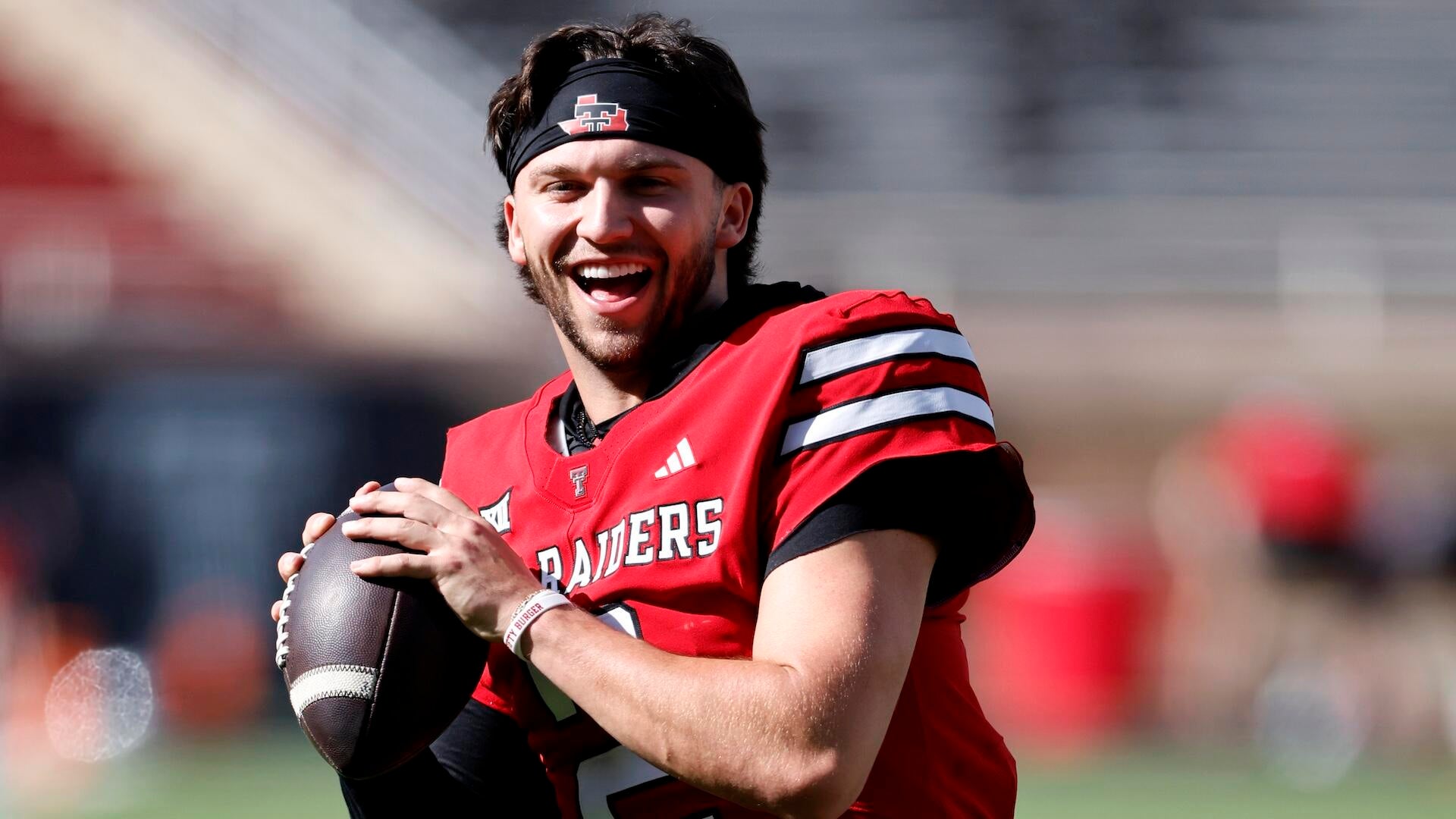
June 8, 2026, is a banner day for college athletics.Bet on it.That’s the day a judge in Lubbock, Texas, granted Texas Tech quarterback Brendan Sorsby a temporary injunction against the NCAA that overturned Sorsby’s season-long suspension for betting on college football. Sorsby, per court documents, admitted to placing at least 40 bets on Indiana when he was a freshman quarterback with the Hoosiers in 2022. He went on to bet on various sports on thousands of occasions over the next four years before checking into a gambling rehab program earlier this year.
Even a single bet on your team is enough to trigger a lifetime ban under NCAA rules.
Sorsby’s new punishment, per the court ruling, is a two-game suspension. That means Sorsby will miss home games against the juggernauts that are Abilene Christian and Oregon State.
It’s a farcical penalty and a complete upending of the foundational rules that make college athletics a sport. There’s no more critical regulation in sport than preventing the athletes themselves from gambling on the sport they play.
Fans have to believe the product they spend countless hours obsessing over and spending money to consume is untainted.
It’s a question of the product’s integrity.
Brendan Sorsby granted 2026 eligibility: Texas Tech QB wins injunction vs. NCAA amid gambling probe
Shehan Jeyarajah
Any hint that a game could be affected by an athlete’s point shaving or by compromising the final score is disastrous, especially in an era where all one needs to do to bet is download an app and place a wager. Or, in the case of Sorsby, log in via a family member’s app and place the bet that way — obvious evidence he knew what he was doing was wrong.
The judge who granted Sorsby a temporary injunction stated that Sorsby would suffer “probable, imminent and irreparable injury” if the court didn’t issue one.
That’s true.
He could have lost millions this season — Sorsby signed for a $5 million-plus contract with Texas Tech when he transferred from Cincinnati — and his NFL future would have been impacted.
But the self-inflicted harm to Sorsby’s career is nothing compared to the dam breaking for college athletics’ ability to enforce itself.
We’ve seen judges in prior years overrule NCAA rules on eligibility, transfers and even how much a school can pay an athlete. It’s been a steady erosion of the NCAA ruleset, creating an environment of chaos throughout the sport that has NCAA leaders spending hours and hours in Washington, D.C., each week begging for a federal solution.
“The NCAA has a major problem on its hands, which is bigger than any one case,” attorney Darren Heitner told CBS Sports. “Athletes are being classified as third-party beneficiaries of the NCAA bylaws by judges across the country, and the NCAA cannot act arbitrarily and capriciously, or it will keep losing these battles.”
Much of the NCAA’s problem is self-inflicted. It’s a slow-moving organization that buried its head in the sand for decades rather than making reasonable, necessary changes to its student-athlete model. Many of the rulings that have gone against the NCAA on transferring and pay-for-play were reasonable and needed.
Gambling on your sport is different, however, as those rules were needed to serve as barriers to protect the sports themselves.
By overturning Sorsby’s career suspension, the judge didn’t just ignore NCAA rules. He picked up the rulebook, set it on fire and watched it burn with an almost bewildering forcefulness. It’s a precedent-setting ruling that forever alters NCAA enforcement on a core principle of sports.
“What few teeth the NCAA had left are clearly gone,” a Power Four front office staffer messaged CBS Sports in the wake of the ruling.
There’s really nothing stopping a star athlete from betting on their team in the post-Sorsby landscape. If you’re rich enough and find a lawyer willing enough, you can just take the NCAA to court and hope to overturn the ruling.
And let’s not pretend like it can’t (and hasn’t) happened.
We’re less than a year removed from the FBI arresting Miami Heat guard Terry Rozier for helping gamblers place bets on his performances in NBA games (though he has pleaded not guilty). In March of this year, a fixer pleaded guilty to leading a betting scheme that led to millions in profits on NCAA basketball games. More than a dozen players tried to fix games as part of the scheme, according to the Associated Press. Betting scandals have rocked Iowa and Iowa State football in recent years. And that’s just a few examples.
The Sorsby ruling emboldens hundreds of thousands of current and future college athletes to attempt the same.
“The order doesn’t go into a lot of detail, but I’m not totally surprised by it,” attorney Mit Winter told CBS Sports. “It’s obviously a very bad decision for the NCAA and underscores its continued and growing legal vulnerability. It’s also another example of how plaintiffs’ lawyers are now relying on state law contract claims against the NCAA instead of just relying on antitrust claims. It keeps the cases in state courts, where athletes have a pretty good record against the NCAA. To me, it’s just another example of why a model with collective bargaining is needed. A federal law with an antitrust exemption won’t stop these types of claims.”
It should be mentioned that Sorsby’s argument of addiction is a sympathetic one. Addiction is crippling, and gambling at the rate he did can send someone into debt and ruin lives. The proliferation of gambling apps and ads on ESPN and other sports broadcasts each day is a siren song for many, and he’s far from the only college student to bet when he shouldn’t.
But Sorsby also knew the rules. Each Power Four school provides gambling education to its athletes. And Sorsby only admitted fault when he was caught. He didn’t turn himself into Texas Tech. A third-party betting operator flagged the bets Sorsby made, and it launched an investigation.
Remorse in the face of a career-altering penalty feels more like desperation than true regret.
The NCAA will surely appeal the ruling in Sorsby’s favor. It released a statement Monday morning stating the outcome “undermines and corrupts the integrity of sports.”
Maybe the NCAA will win on appeal. It has recently been successful in appealing eligibility injunctions for Alabama basketball star Charles Bediako and Tennessee quarterback Joey Aguilar.
Yet it’s obvious from this ruling that the NCAA’s last vestiges of enforcement power died Monday. Lawyers and aggrieved athletes had been tearing the NCAA apart at the seams for years.
For decades, betting on your own team was the one rule the NCAA could enforce without debate. On Monday, a judge told the NCAA it couldn’t enforce that rule either.