What’s going on with stoppage time at the World Cup?Image source, Getty ImagesImage caption, Pierluigi Collina, Fifa’s head of referees, has been searching for a way to get more time into the game without adding on lots of stoppagesByDale Johnson
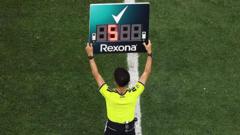
The stoppage-time board used to be met with groans. Ten, 11, 12 minutes or more would be signalled by the fourth official.
But not at the 2026 World Cup.
Even factoring in the three minutes for the hydration break, the added time has been surprisingly low – sometimes only five or six minutes going up on the board.
So what is happening?
Fifa referees’ chief Pierluigi Collina decided to wage war on time-wasting, changing tack from the last tournament where he told referees to add absolutely everything on.
In Qatar, matches were lasting on average more than 100 minutes.
But at this tournament – ignoring the time for hydration breaks – matches are clocking up 96 minutes.
“The goal we want to achieve is to increase the tempo of the match,” Collina reported ahead of the finals.
Collina introduced a number of measures, such as putting five-second countdowns on goal-kicks and throw-ins.
Tactics were introduced to try to limit how teams would break up games, by placing a 10-second clock on substitutions and forcing players who require treatment to stay off the field for one minute.
The changes have, so far, been well received in the United States, Mexico and Canada.
But do the stats show that Collina’s masterplan is actually working?
Collina’s philosophy was pretty simple.
If you stop players taking too long over the mundane tasks, that time could be given back to the game without adding it on at the end.
“The objective is to eliminate, as much as possible, the disruption of the tempo of the match,” Collina explained.
This was never supposed to be about awarding loads of corners, or being strict on substitutions.
The aim was to change behaviour or, as Collina put it, “players will respect the limit”.
So far, that does seem to be the case.
Only one goal-kick has been changed to a corner, when DR Congo took too long during their 1-1 draw with Portugal on Wednesday.
There have been no cases of a substitute not being allowed to enter the pitch because the substituted player has taken too long to leave the field.
So you have to forget about the old way of doing things, like adding 30 seconds for each sub. Now players leave the field within 10 seconds.
For that reason, you might see substitutions take place in stoppage time and no more additional time added.
It at least feels like there have been fewer stoppages for injuries, while referees have been quick to tell some players they must go off even if they don’t have the physio on.
The threat of playing with 10 men for at least a minute appears to be working as a deterrent.
The video assistant referee checking corners does not seem to have impacted games, though Fifa has many more video match officials and enhanced technology which would not be available to the domestic leagues.
With goalkeeper tactical time-outs banned too, games appear to have a had a better flow to them.
The key measure for success is usually the ball-in-play time.
Previously, the target was to get to 60 minutes, but that has proved very difficult to achieve.
Even in Qatar, with all that added time, Fifa could only get up to 58:03 of actual football.
So how does the 2026 World Cup compare?
First off, the automatic six minutes applied for hydration breaks has been removed. This is effectively not part of a regular match time.
The average length of matches at this World Cup is 96:08 – just over six minutes additional across both halves.
In Qatar, it was 102 minutes 43 seconds for the first round of games – more than double the stoppage time.
Yet in Russia it was 96 minutes 54 seconds, only slightly higher that this summer’s edition.
All three tournaments had four on-field VAR reviews.
So, games are shorter at this World Cup than at either of the previous two.
But is this strategy backed up by the average ball-in-play time?
In Russia, it was 54 minutes 50 seconds. With so much stoppage time, it should be no surprise that went up to 58 minutes eight seconds in Qatar
There has been a small reduction to 57 minutes 22 seconds at this World Cup. Does that mean it has not quite worked.
The best way to truly judge it might be to look at the relative ball-in-play time.
What percentage of the length of a match is football being played?
That is where we see this World Cup is the most effective – 59.38% of the match time has seen the ball in play.
Qatar, with the games being so long, was below this at 56.86% and Russia at 56.25%.
It is early days for Collina’s masterplan, but so far it appears to be working.
Whether the same impact can last 380 Premier League matches might be more of a challenge.
✔ today silver rate
✔ 2026 winter olympics
✔ chat gtp
✔ silver rate today
✔ silver rate today live
✔ 2030 winter olympics
Sports