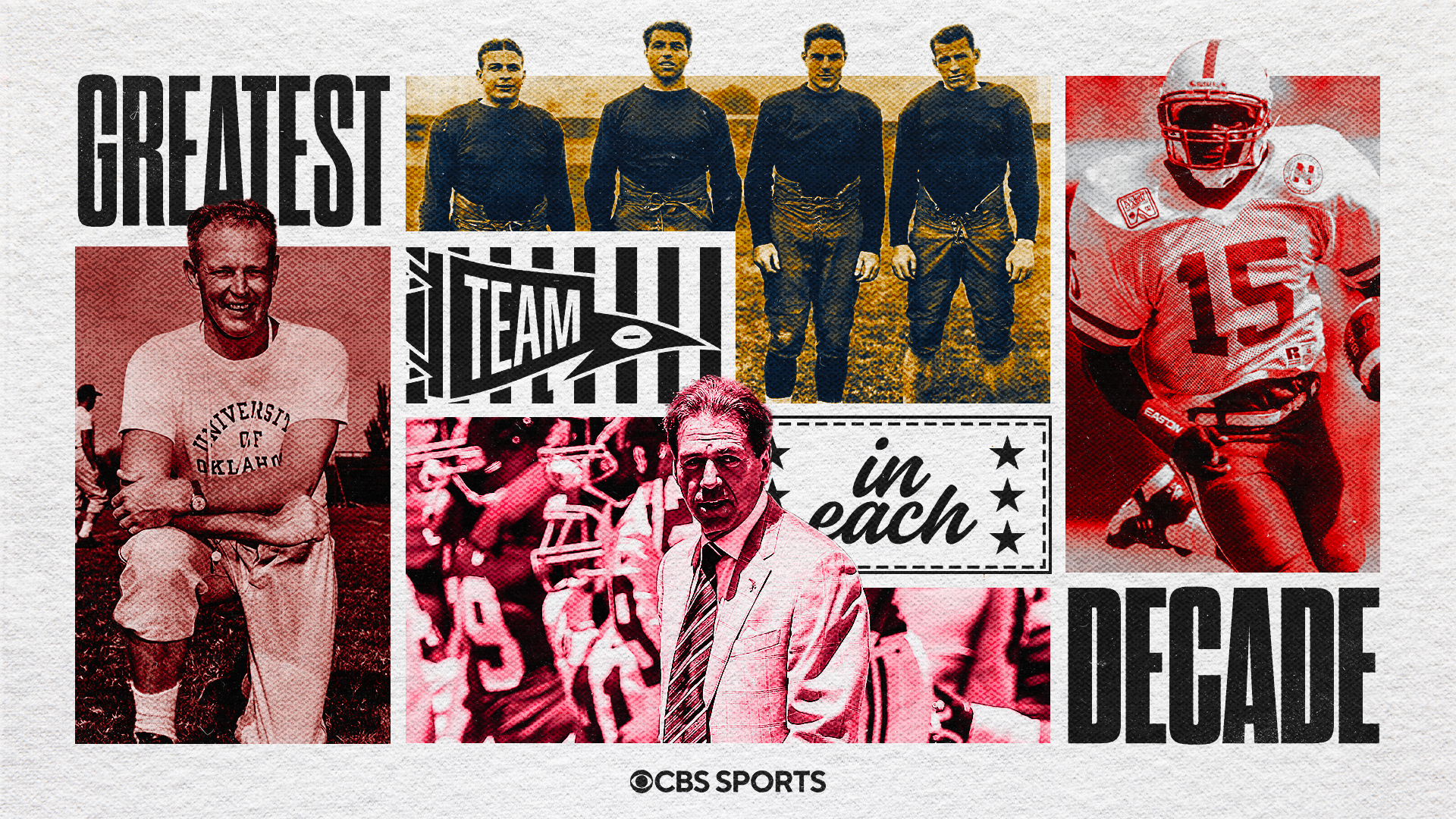
As we gather with family and friends this holiday weekend to celebrate the 4th of July, it is natural to spend some time reflecting on American history over the decades. And while college football was not up and running when the founding fathers signed the Declaration of Independence in 1776, the sport has been undeniably American since its founding in the late 19th century.
In fact, when you consider its association with universities, the involvement of politicians and the way college football has continued to reflect our nation’s culture, you could argue that college football is the most American sport we have.
So, as we sat down with the challenge of naming one program as the “Best Team of the Decade” for each of the last 100 years, it was striking how often the stories of college football’s growth and development ran alongside the changes in our nation. Technological advancements impacting travel, television and even air conditioning played massive roles in the way the sport grew from its early Northeastern and Midwestern roots, providing a college football map that by the end of the 20th Century more closely aligned with the expanse of our country. Throw in cultural developments like integration, war and the challenging of social norms, and you continue to find that college football history is American history.
So while we are spending some time waiting for fireworks or cleaning up from the celebration, let’s reflect on American history and also the role college football has played. After hours of debate and research, we have assembled an imperfect and biased read on the best teams from the last 100 years, separated by decade. Hopefully, it’s as entertaining as that loud and proud fireworks finale.
1920’s: Notre Dame (83-11-3)
It helps that this exploration starts with one of the most recognizable coaches and programs in college football history, as Knute Rockne was a shining star for the sport, leading Notre Dame in the 1920’s.
Two of Rockne’s three national titles would come in this decade (1924, 1929), and the third would come shortly after in 1930. The descriptions of the “Four Horsemen backfield” in 1924 and Rockne’s larger-than-life personality — legendary halftime speeches and all — still carry weight to this day, but the consistency throughout the 1920’s is what gives Notre Dame the honor for the decade. Eight of the 10 seasons had just one loss or fewer, and nine of them included a double-digit point differential per game. In fact, for the 97-game sample of Notre Dame football in the 1920’s, the Fighting Irish were winning by 18.0 points per game on average.
The sport, like the country, was extremely regionalized, with dynasties popping up in different corners. Cal and USC were warring for supremacy out West, Wallace Wade laid the foundation for Alabama’s excellence in the South and Cornell claimed three of its five national titles in the 1920’s, but if there’s just one program for the whole decade, there’s no debate that Notre Dame and Knute Rockne take the cake.
1930’s: Alabama (79-11-5)
Honorable mentions: USC (72-25-9), Tennessee (79-17-4)
Wallace Wade’s work in the 1920’s paid off with a sustained run of excellence throughout the next decade, starting with a 10-0 national championship season in 1930 — his last year with the Crimson Tide. Frank Thomas picked up the baton from Wade and, in no short order, doubled down on the standard.
Alabama claimed a conference title in the newly formed SEC in 1933 and followed that with a 10-0 national championship season in 1934, culminating in a Rose Bowl win over Stanford. Though the decade featured just two national titles and two conference titles, the consistency again proves to be a differentiator. Alabama won three of the first five SEC titles and lost more than two games just once across the entire decade. We haven’t even gotten to the Bear Bryant or Nick Saban portion of the proceedings, but it’s clear why the multi-generational expectations have been so high in Tuscaloosa.
USC gets our first nod for honorable mention after a decade that saw three claimed national championships (1931, 1932, 1939) but also a mid-decade dip under Howard Jones. The Trojans finished third or worse in the Pacific Coast Conference five times and had back-to-back losing records in 1934 and 1935. Jones is an all-time coaching great, with claimed titles at Yale (1906) and Iowa (1921) before he even arrived in Los Angeles, and these 1930’s years were the finishing touches on his Hall of Fame career.
As for Tennessee, it should be noted here that the Vols are victims of the specifics of his exercise, since the arbitrary decade lines divide some of the program’s foundational success during the 20th Century. General Robert Neyland’s 1938 and 1939 squads are worthy for consideration among the best individual teams of the decade, remembered for their defensive dominance, but Tennessee was at its strongest at the beginning and end of the decade, and like USC faced a mid-decade slump that serves as a tiebreaker for this debate.
1940’s: Notre Dame (82-9-6)
Honorable mention: Army (68-17-7)
World War II disrupted all facets of American life, and college football was certainly among them, with coaches and players leaving the sport to serve in various branches of the military. Army and Navy still fielded football teams (with Army in particular standing out for its title-winning success), but the programs that rose to the top did so in an era of roster fluidity most recognizable to today’s transfer portal. Here, it was the steady hand of Frank Leahy who was able to guide the Fighting Irish through the chaos, even as he also missed two seasons of the decade while serving in the Navy.
A former Notre Dame tackle who played for Knute Rockne, Leahy guided his alma mater to four national championships and six top-three finishes in the AP poll throughout the 1940’s, including 36 wins, zero losses and just two ties in a post-war run from 1946-49. Notre Dame also produced three Heisman Trophy winners in this decade, becoming the first school with three different winners of the award. Things may have been uncertain and uneasy in the world order, but back home, college football felt familiar, with Notre Dame at the top of the sport.
As mentioned earlier, Army’s success in wartime is the peak of coach Earl Blaik’s Hall of Fame career. Blaik was 121-33-10 over 18 seasons at West Point, but earning at least a share of three straight national championships from 1944-46 is the strongest argument for inclusion in this debate. A scoreless tie with Notre Dame at Yankee Stadium in 1946 is the stuff of legends, pitting the two most iconic programs of the decade against each other with the No. 1 ranking hanging in the balance. At the end of that season, both teams would be undefeated with the 0-0 tie as the only blemish, and the AP voters decided to slot Notre Dame at No. 1 while Army received the Coaches’ Trophy to have their own claim to a title.
1950’s: Oklahoma (93-10-2)
Every single season of the 1950’s ended with a trophy for Oklahoma, as Bud Wilkinson cemented his status as a Hall of Fame coach, leading the most successful program of the decade. The Sooners won their conference championship every single season from 1950-59, adding eight top-10 finishes in that span and national championships in 1950, 1955 and 1956. Perhaps the most long-lasting mark of Wilkinson’s Oklahoma run is the 47-game winning streak between 1953 and 1957 that still stands as a Division I record to this day,
Oklahoma had already established itself as a regional power in its conference under previous regimes, but the sustained dominance of the Wilkinson era laid the foundation for the investment and expectations that would follow the Sooners through the decades. Speaking of investment, perhaps a preview of the disciplinary issues that would surface later, NCAA probation would arrive in Norman during this decade, but not to the detriment of the team, which continued to stack wins year over year through the 1950’s.
Wilkinson was not without peers at the time, as Notre Dame continued to find success with a couple of top-three finishes in Frank Leahy’s final years and Woody Hayes won the first two of his five national championships at Ohio State. But awarding one team for an entire decade was a fairly simple exercise, since Oklahoma did not have a bad year during this run.
1960’s: Alabama (90-16-4)
Honorable mentions: Texas (86-19-3), USC (76-25-5)
We have now entered what I have lovingly declared the “names on buildings” decade in college football. This decade was highlighted by Bear Bryant’s rise at Alabama, Johnny Vaught’s best seasons at Ole Miss, Darrell Royal’s pair of national titles at Texas and trophy-worthy seasons for icons like John McKay at USC, Woody Hayes at Ohio State, Ara Parseghian at Notre Dame and more. American culture was becoming more connected with the explosion of television, and this collection of Hall of Fame coaches at blue-blood programs made college football attractive to the sporting public.
A big question when making the final decisions for this feature was whether to give Alabama the solo spotlight for the 1960’s, when Bryant won his first three national titles and had eight top-10 finishes in the AP poll, or the 1970’s when the Crimson Tide flexed more SEC dominance (and won more games in total) but similarly pulled in three national championships and eight top-10 finishes in the AP poll. The story of college football is a multitude of colors and characters, so we can’t have everything covered in houndstooth and crimson, but from 1960 to 1981, there were very few seasons that did not include Alabama as a primary piece of the national picture.
Ultimately, it is with an eye on the emerging powers of the 1970’s that Bryant and Alabama get the nod for returning Alabama to its pre-WWII position at the top of college football’s mountain. The Crimson Tide won national championships in 1961, 1964 and 1965 and finished as the only unbeaten and untied team in the country in 1966, but the AP voters gave that title to Ara Parseghian’s Notre Dame squad at 9-0-1. These teams included stars like Joe Namath and Kenny Stabler at quarterback, and future coaching legends like Gene Stallings and Howard Schnellenberger on staff. It was not an era without controversy, as Alabama (the university and state) became the focus of national desegregation and Civil Rights efforts throughout the 1960’s, and Bryant himself did not play a Black player in a game until 1971.
John McKay ran a similar race to Bryant, guiding USC back to the heights of a pre-war era as he picked up two national championships and terrorized opponents with the “Student Body Left-Student Body Right” ground game. Meanwhile, Darrell Royal was elevating Texas from a conference contender to a national power and guiding the Longhorns to their first-ever national championships, claiming the crown in 1963 and 1969. Woody Hayes and Bo Schembechler began their rivalry in earnest by the end of the decade and even Joe Paterno broke through with a pair of runner-up finishes in the AP poll before the arrival of the 1970 season. Much like American culture, college football entered the 1970’s looking very different from it did 10 years earlier.
1970’s: USC (93-22-7)
Honorable mentions: Alabama (103-16-1), Oklahoma (102-13-3), Nebraska (98-20-4)
John McKay’s success in the 1960s would return at the start of the decade, with the Trojans claiming two more national championships in 1972 and 1974. But USC’s bona fides were strengthened when he handed the reins to former assistant John Robinson, and the Trojans added a share of a third national championship in 1978. It’s a shared title with Alabama, which is interesting not just because USC won a head-to-head game that season in Birmingham, but also because the Crimson Tide similarly have a strong claim to being the best program of the decade.
But while Alabama’s run through the 1970’s was an extension of Bear Bryant’s rule over the sport, USC’s decade reflected a successful transition of leadership without losing the program’s standing against its peers. Between the final four years of McKay and the first four years of Robinson’s tenure, there are six conference championships and five top-two finishes to go with the three national titles. Heisman Trophy winners continued to come out of Los Angeles (Charles White being the program’s third winner in 1979), and USC’s power as a television draw allowed for its stars to become household names well outside of California.
Alabama’s argument for inclusion here is extremely strong, boasting a better win-loss record and far greater consistency over the decade than the Trojans. Bear Bryant’s Tide lost more than one game in a season just twice throughout the entire decade, and had more conference championships and top-10 finishes, tying USC for three national championships (including the 1978 title they share).
Elsewhere, the Big Eight Conference was proving to be fertile ground for the growth of one of college football’s all-time rivalries as Nebraska took off under Bob Devaney with the 1970 and 1971 national championships, challenging Oklahoma not just for local supremacy but also for spots at the top of the national polls.
The Sooners, of course, were taking the sport by storm with Barry Switzer and the wishbone offense, which set the stage for one of the many “Game of the Century” labels when Oklahoma and Nebraska faced off in a No. 1 vs No. 2 showdown in 1971 (Nebraska won 35-31). Switzer would go on to lead the Sooners to national championships in 1974 and 1975, navigating the program through postseason and television sanctions as OU demanded attention with its dominance. Nebraska, meanwhile, saw Tom Osborne take the program over from Devaney in 1973 and deliver six top-10 finishes before the end of the decade but just two share conference titles.
It would be wrong to call the relationship between Oklahoma and Nebraska symbiotic, since they were both the biggest roadblocks to each other’s success in a given season, but the competition between these two conference rivals certainly fueled an “iron sharpens iron” dynamic that drove both programs to landscape-shifting levels of success.
1980’s: Miami (99-20)
Honorable mention: Nebraska (103-20), Penn State (89-28-2)
Later Miami teams would have a case as one of the best ever, especially at the start of the 2000s, but the success and impact of those first three title squads make this the best decade of Hurricanes football. The story starts with the 1983 title team, as Howard Schnellenberger had finally realized his vision for Miami football.
With an elite defense leading the way, the Hurricanes bounced back from a season-opening loss to Florida and rolled off 11 straight wins, culminating with an upset of No. 1 Nebraska in the Orange Bowl. Given Nebraska’s accomplishments not just in that season but in the era as a whole, the upset victory was impressive enough for voters to vault Miami from No. 5 to No. 1 and their first national title. Schnellenberger then handed the reins to Jimmy Johnson, and that’s when the profile elevated from plucky upstart in South Florida to college football’s newest challenge to the establishment.
The swagger shook more traditional football fans, but history has properly reframed Miami’s success by acknowledging the talent and competitiveness of those early Hurricanes teams. Practices were more challenging than games, at times, and that was reflected in the records over the back half of the decade. From 1985 to 1989, Miami carried a 55-7 record and finished in the top two of the final AP poll four times. National championships under both Jimmy Johnson (1987) and Dennis Erickson (1989) only furthered the mystique of “The U,” because the program was no longer associated with just one leader. The program was packed with star power but the brand of Miami football was even more powerful. Other titles would follow in 1991 and 2001, but the combination of on-field dominance and cultural impact makes it easy to name Miami the team of the decade.
Penn State played a role in multiple title races of the 1980’s, finishing in the top three four times, and Joe Paterno finally got his breakthrough season 14 years after his first runner-up finish with his first and second national championships. The Nittany Lions went 11-1 in 1982 but held off Herschel Walker and Georgia in the Sugar Bowl to take over the No. 1 spot to claim the school’s first national title. That was followed by another title in 1986, which was cemented by shutting down a seemingly unstoppable Miami offense in the Fiesta Bowl with five interceptions of Vinny Testaverde.
Again, Nebraska makes an appearance here as it builds its argument to be one of the top programs of the late 20th Century. Tom Osborne led the Cornhuskers into a major bowl game every year from 1981-89 and finished ranked inside the top 11 of the AP poll every single year of the decade. The issue in this debate is the lack of national championships and a 3-6 record in major bowl games. Nebraska had a seat at the table throughout the decade, but just like the Orange Bowl at the end of the 1983 season, this is going to be a battle that’s lost to “The U.”
1990’s – Nebraska (108-16-1), Florida State (109-13-1)
While we have been gracious in giving attention to many of the finalists for each of these decades, this is the only one in which we will award co-champions. Splitting hairs between Nebraska, which had been knocking on the door of Tom Osborne’s title-winning breakthrough for decades, and a Florida State program that had just started throwing haymakers against the sport’s best is too difficult. Celebrating both programs is necessary to the story of college football in the 1990’s, so to make it up to you, we will award NO HONORABLE MENTIONS and stick to focusing on why Florida State and Nebraska stand out among the rest.
For years, Bobby Bowden famously took an aggressive approach to scheduling, which had the Seminoles willing to take on anyone, anywhere, as Florida State laid the foundation to become a national power. Then, in the 1990s, a good portion of their scheduling was taken out of their hands by giving up Independence and joining the ACC, producing one of the most stunning runs of dominance in major-conference college football. Florida State joined the ACC in 1992 and proceeded to win its first 29 conference games, claiming a conference championship in every season of the decade and finishing the 1990’s with a 62-2 record against ACC opponents.
On the national stage, the Seminoles never finished lower than No. 4 in the AP poll throughout the decade and won the national championship in 1993 and 1999. The truly stunning statistics showcasing Florida State’s peak under Bobby Bowden stretch back to 1987 and through 2000 (double-digit wins and top-five finishes in every season), but it was in the 1990s that the spear was planted in the sport and the Seminoles became synonymous with college football at the highest levels.
Nebraska, meanwhile, ended a national title drought that spanned back to 1971. Tom Osborne built that consistency through the 1970’s and 1980’s, but it was not until the middle of this decade that everything clicked into place for a firework-like finale to his Hall of Fame career. The Cornhuskers went 60-3 from 1993-97, claiming at least a share of the national championship in three of Osborne’s final four seasons. Nebraska may not have had the year-to-year consistency of Florida State throughout the entirety of the 1990’s, but three national titles (to FSU’s two) and a top-three finish by Frank Solich in 1999 helped solidly the argument for a true co-champion honor. It’s fitting, I guess, that the last decade of shared championships includes the honor shared honors for this feature.
2000’s: Florida (100-30)
Honorable mentions: Oklahoma (110-24), Texas (110-19)
It’s really tempting to just name “The SEC” as the best of the decade in the 2000’s, especially given a more modern review of the decade where Oklahoma and Texas are conference members. Using the current membership, the SEC can lay claim to seven of the 10 national championships of this decade, with only the 2001 (Miami), 2002 (Ohio State) and 2004 (USC) seasons not ending with one of those southern-fried programs hoisting the BCS National Championship trophy. Oklahoma’s only title of the 2000’s came at the beginning with Bob Stoops’ win in 2000, but thanks to Nick Saban and Urban Meyer, the decade would finish with a string of SEC kings.
And it really is in that Florida-LSU debate that we find ourselves trying to identify one team as the decade’s best. Nick Saban got things started in Baton Rouge and Les Miles added another ring in 2007, and we have given credit for a program getting multiple titles under different coaches in the same decade. But to truly extend the parameters to the end of the decade, the Gators can claim Steve Spurrier’s last SEC Championship from 2000 and carry that success through two-time champion Tim Tebow, who led the Gators to No. 3 overall with a 13-1 record in 2009. With two national championships, three conference championships and five SEC Championship Game appearances in a decade when the league ascended to the top of the sport, Florida gets to take the honor as the team of the decade.
It is admittedly showing some late-decade bias, because the early part of the decade saw the Gators take a dip under Ron Zook while USC, Oklahoma, Texas and Miami were very much the entrenched powers of the era. But a slight step back for USC and Miami later in the decade proved to be tiebreakers, making Oklahoma and Texas the most appropriate squads for the honorable mention.
The Sooners’ sustained success this decade is not unprecedented in college football history (or even in Oklahoma history), but it is certainly worth celebrating. After winning the national championship in 2000, Stoops would lead Oklahoma to an additional five top-five finishes before the close of the decade. The Sooners won six Big 12 titles in the 2000’s as well. Texas only won the conference in 2005 and 2009, both en route to BCS National Championship Game appearances, but did finish in the top-five of the final AP poll five times. Both programs were consistently in the mix at the top of the rankings, but fell a game or two short of the ultimate goal, particularly in the back half of the decade.
2010’s: Alabama (124-15)
Other coaches changed college football with a scheme or some play-related innovation. Meanwhile, Nick Saban changed the sport by winning. By the end of the 2010’s, the Sabanization of college football had not been so much about his defense or recruiting blueprint; it was, top to bottom, the way he organized and ran a modern power in the sport.
At different points in the decade, Alabama had won three of four, four of seven and five of nine national championships. The final total of six rings at Alabama for Saban includes 2009 and 2020, but this sustained success in the 2010’s made Alabama not just the best program of the decade but the most consistent character in the college football conversation. Every season, the annual player or team of the moment has to take their talents to face big bad Alabama. Saban’s recruiting machine was a turn-key operation for future NFL Draft picks, and so even off nights could be overcome by the advantage in height, weight and speed. With only 15 defeats in 10 seasons, every Alabama loss felt like an epic opera and many of those games have gone down as all-timers.
You can track the biggest stars of the decade, noting that the common thread between Cam Newton, Johnny Manziel, Deshaun Watson, Trevor Lawrence and Joe Burrow is a win against college football’s juggernaut dressed in crimson.
But by the end of the decade, the game had changed again, with the transfer portal and NIL throwing new wrenches into old ways of roster construction. Saban would go on to win his seventh overall national championship in the first year of the next decade and make the College Football Playoff again in 2023, but his run of dominance throughout the 2010s had no peer. LSU, Clemson, Georgia, Notre Dame, and a few pesky Auburn teams made for some fierce rivals — and Urban Meyer did get the best of Saban in the 2014 CFP with Ohio State — but on the decade as a whole, there was no question who was wearing the crown.
2020’s: Georgia (73-9)
Honorable mention: Ohio State (66-11)
And now we reach the unfinished portion of the proceedings, with just over half of the decade gone and four years remaining before the 2020’s are added to the library of college football history.
The decade started with an extension of Alabama’s run through the 2010’s, as Nick Saban and the Crimson Tide navigated the challenges of the COVID-impacted 2020 season better than anyone and fielded one of the most dominant teams of the modern era. It was Saban’s sixth ring at Alabama and seventh overall, and while the Tide would make it back to the College Football Playoff in 2021 and 2023, the balance of power shifted following that 2020 season.
Alabama defeated Georgia in the 2021 SEC Championship Game, adding to Kirby Smart’s list of frustrating defeats against his former boss. You already had the 2017 national title game and the 2018 SEC Championship Game from the previous decade, and suddenly, Bryce Young was blitzing through an all-time Dawgs defense in Atlanta to hand Georgia its first loss of the 2021 season. But two games later, Georgia and Smart would get their ultimate revenge with a 33-18 win against Alabama in the national championship game. It was Georgia’s first national title since 1980 and now stands as a reference point for one of the great runs of the 21st Century.
From the start of the 2021 season through the end of 2023, Georgia went 42-2 with two national championship game wins and the only defeats coming to Nick Saban and Alabama in SEC Championship Game appearances. And while the winning percentage has dipped a bit in the last two seasons (23-5), those years have each included SEC Championship Game wins. Kirby Smart helped build the juggernaut of the 2010’s with Saban, and as we stare down the final four years of the 2020’s, he’s currently driving the frontrunner to be the team of the decade.
But Georgia is not without challengers.
Ohio State and Ryan Day, like Georgia, had its own local issues to handle before ascending to the top of the mountain. A four-game losing streak to Michigan placed immense weight on Day and the Buckeyes, but a bounce back in 2024 to win the first-ever 12-team College Football Playoff moves Ohio State back in line to challenge the Bulldogs for decade supremacy.
Ohio State needs another national title to get level with Georgia in the decade count, but given the level of recruiting and consistency under Day, it’s likely they’ll have a roster talented enough to win it all nearly every year between now and 2029.
Ohio State and Georgia are the only programs to finish in the top-10 of the final AP poll in each of the last five years, setting a standard that Oregon, Notre Dame, Indiana and Kalen DeBoer’s Alabama are pushing to match. There is plenty of time left for Georgia or Ohio State to be unseated, but it’s easy to look at those two as the programs that have ruled the first six seasons of the 2020’s.