Less than a calendar year ago, the Toronto Blue Jays were barely a hairsbreadth from toppling the mighty Los Angeles Dodgers, winning the World Series for the first time in more than three decades, and perhaps even reshaping ongoing labor negotiations.
That would seem to be a foundation for success in the current season, especially since the winter in between that pennant and the present moment saw the Jays make the headline addition of Dylan Cease, who’s delivered and then some in his first season in Toronto. Still and yet, the Jays at this writing are below .500 and on pace to shed 15 wins from their 2026 regular-season tally. If the season ended today, the Jays would miss the postseason altogether.
These unexpected struggles raise a couple of matters that merit further exploration — how it happened, how the Jays have tumbled from World Series contender to likely draft lottery participant, and how the organization has responded to those disappointments. Finally, we’ll note that, despite it all, one thing is keeping the Jays alive in the here and now. Let’s jump in.
What happened to the Jays
The complete and total offensive collapse is mostly to blame for what’s befallen John Schneider’s club this season. Consider the following 2025 to 2026 key indicators …
| Year | Runs scored rank | HR rank | OPS rank | wOBA rank |
|---|---|---|---|---|
|
2025 |
4th |
11th |
3rd |
3rd |
|
2026 |
29th |
29th |
30th |
30th |
That’s not an offensive decline; that’s an outright collapse. Toronto last season excelled with runners on base and in scoring position, and that was likely to undergo a correction. But this? This is a cratering that goes well beyond standard regression.
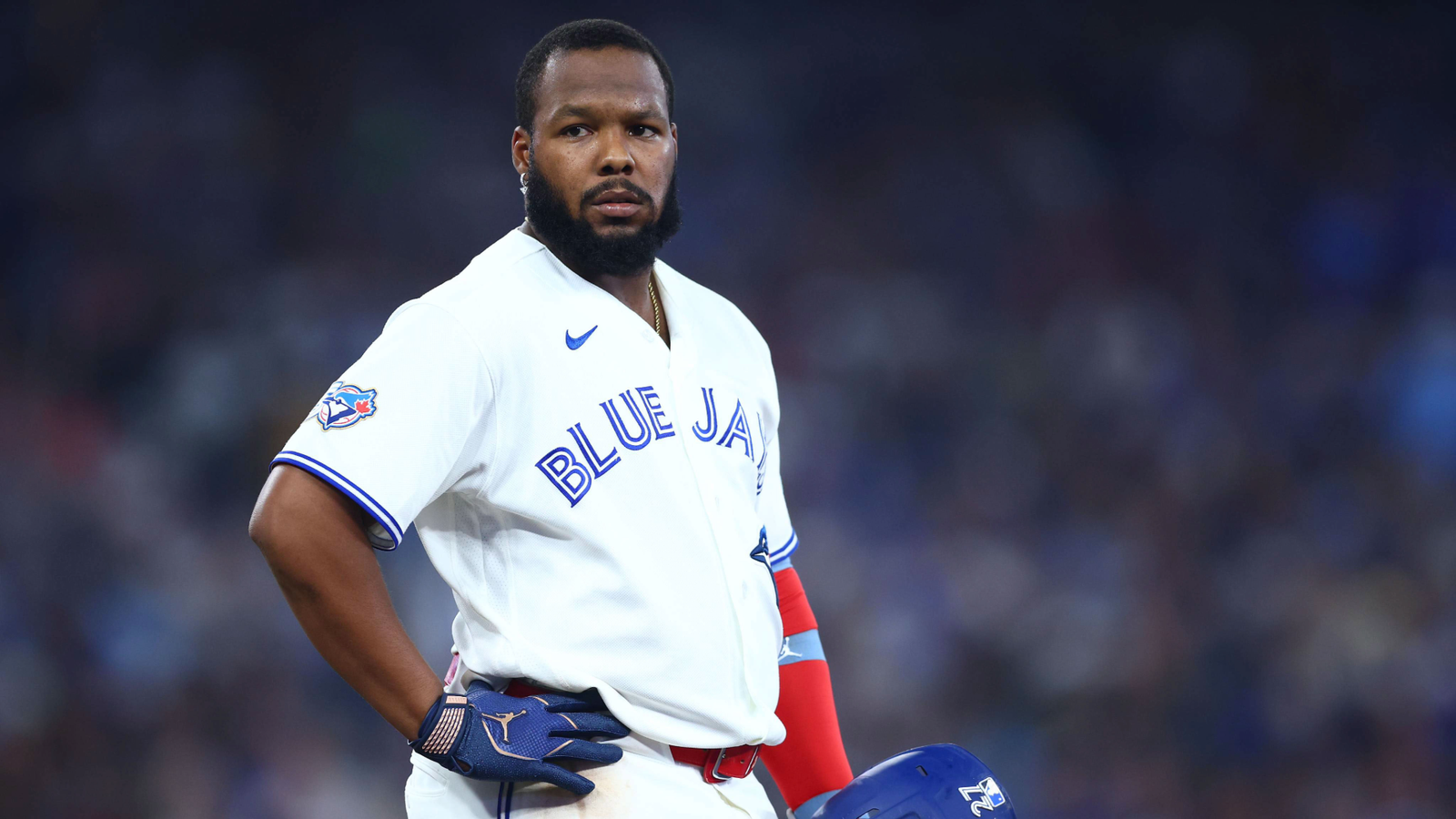
At an individual level, the leading culprits are DH George Springer and first baseman Vladimir Guerrero Jr. In terms of OPS+, Springer has seen his production decline a whopping 44.4% from last season to this one. At the time, Springer’s outstanding 2025 looked like a late-career renaissance, but now the 36-year-old appears to be back in his deep decline phase. As for Guerrero Jr., his OPS+ has fallen from 132, or 32% better than the league-average OPS on a park-adjusted basis, in 2025 to 91, or 9% worse than the league average, in 2026. Especially jarring is Guerrero Jr.’s loss of power. This season, he has just seven home runs — all on the road — and he’s slugging just .356. First base is a power position, which makes those numbers all the more unacceptable. He just hasn’t been able to elevate the ball consistently, as he ranks in just the 10th percentile of MLB hitters this season when it comes to how often he hits the ball at the ideal launch angle range for power production. It’s been a steady power decline, last year’s playoffs notwithstanding, for a hitter who launched 48 homers as a 22-year-old.
The loss of Bo Bichette to the Mets via free agency didn’t help matters, and Andrés Giménez hasn’t come close to replacing Bichette’s lost production at the shortstop position. Daulton Varsho’s production dropped prior to being traded at the deadline. Addison Barger has been limited to just 28 plate appearances because of an elbow injury, and Alejandro Kirk also lost a significant chunk of his 2026 season to injury.
The offense hasn’t been the only culprit — rotation depth has been a challenge, and the bullpen is such that the Jays are carrying a couple of post-deadline waiver claims in it — but the crumbling of the offensive attack has been the story of Toronto’s (probably) failed bid to defend their pennant.
The front office doesn’t think their window is closing
The temptation is to think that the Jays, in response to such a disappointing season, would seek to pivot toward the long-term and perhaps even rebuild again. Thus far, though, there’s little sign of that, and that’s a reflection of their maneuverings leading up to the Aug. 3 trade deadline. Those moves positioned the Blue Jays not as clearly defined sellers or buyers but rather a club with its eyes on 2027 and beyond.
In all, general manager Ross Atkins and the rest of the front office pulled off six trades leading up to the deadline. Of the 10 new players they brought into the organization via those trades, four are ready-now MLB contributors. Yes, the Jays parted with the likes of the aforementioned Varsho, Kevin Gausman, Jeff Hoffman (their closer earlier in the season), and shortstop Arjun Nimmala (one of their top prospects), but they brought in rotation help, among other assets. Right-hander José Soriano, acquired from the Angels, immediately became their No. 2 starter behind Cease, and the 27-year-old is under team control for two more full seasons. The Jays also got 26-year-old Spencer Arrighetti from the Astros for Varsho. Once Arrighetti, who isn’t a free agent until after the 2029 season, returns from a minor-league rehab assignment (foot injury), he’ll slot into the back half of the rotation. Those two deadline additions line the Blue Jays up for a 2027 rotation that will go a little something like this:
- Dylan Cease, RHP
- José Soriano, RHP
- Trey Yesavage, RHP
- Spencer Arrighetti, RHP
- ?
The Jays at some point in 2027 will get José Berríos and then Bowden Francis back from Tommy John surgery, and top pitching prospect Nolan Perry should be ready for the highest level next season. It’s also possible the Jays will add from the outside over the winter. The larger point is that the additions of Soriano and Arrighetti mean the Jays weren’t really buyers and weren’t really sellers at the deadline. They were, in a sense, 2026 sellers and, at the same time, 2027 buyers. The lesson is that the Jays will be angling for a rebound in 2027 and aren’t prepared to say their window for contention is closed.
The 2026 team isn’t dead yet
This is not because the Jays are good — they’re four games under .500 with a -57 run differential. Rather, this is an acknowledgment that the all-ages show known as the American League wild-card race welcomes almost anyone. Toronto right now is a mere half-game out of playoff position despite being 61-65. In all, seven teams are within two games or less of the third wild-card spot, and, yes, all of those teams have losing records. That’s why, despite the Jays’ poor season to date, their hopes of returning to the World Series aren’t dead yet. While there is, as noted, some degree of focus on 2027 and getting back to the quality of the 2025 season, 2026 has burdened us with a truly awful race for the final postseason spot in the AL bracket. That’s why the Jays’ 2026 season is disappointing but not yet a certifiable disappointment.
Yes, if you’re a Blue Jays rooter in 2026, it’s been weird out there.