How big is too big? Evaluating Kadyn Proctor’s rare size before the NFL Draft — and why he’s worth betting on
The Alabama tackle’s massive frame raises real questions, but his traits and film suggest one of the highest ceilings in the 2026 class
tamil yogi
How big is too big? Evaluating Kadyn Proctor’s rare size before the NFL Draft — and why he’s worth betting on
The Alabama tackle’s massive frame raises real questions, but his traits and film suggest one of the highest ceilings in the 2026 class
Mike Renner
Mar 1, 2026
at
2:17 pm ET
•
6 min read

“The bigger, the better” is a core ethos of American culture. Nowhere is this motto exemplified better than every Sunday in America’s Game.
Size may not technically be a skill on a football field, but evaluators value it all the same. The archetypes for most positions are often size outliers: Calvin Johnson (6-foot-5, 237 pounds) at wide receiver, Jonathan Ogden (6-foot-9, 345 pounds) at offensive tackle and Kyle Hamilton (6-foot-4, 220 pounds) at safety. While it’s taken as a given that size is beneficial, is there a limit?
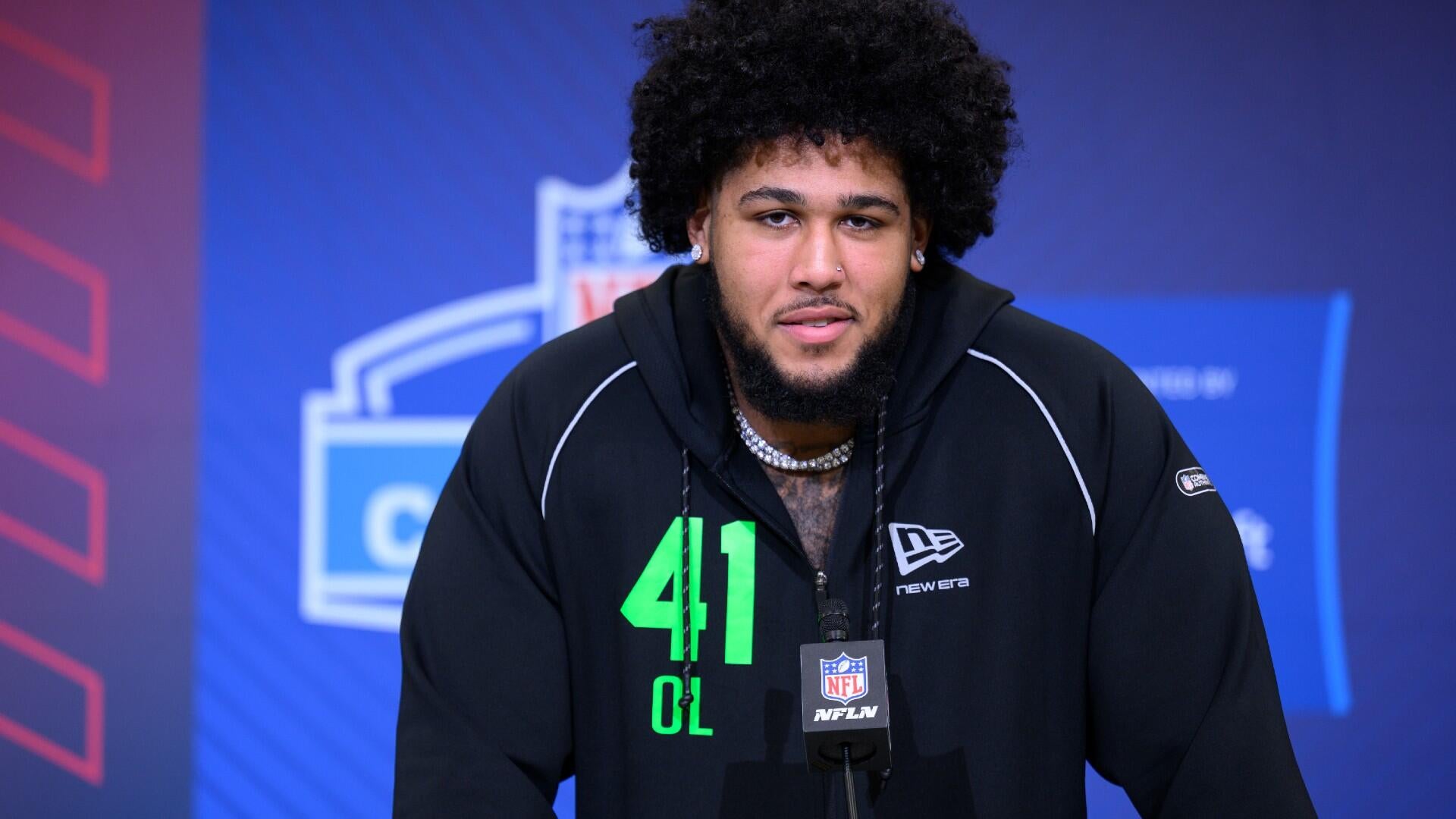
That’s a question NFL general managers will ask when it comes to Alabama tackle prospect Kadyn Proctor. He is a truly gargantuan human being at his listed 6-foot-6⅝ and 352 pounds. The true junior reportedly carries 274 pounds of lean muscle mass, meaning he couldn’t get down to the 300 range even if he tried. There simply isn’t enough there to lose. The 20-year-old has already shed significant weight to get where he is now, arriving in Tuscaloosa closer to 400 pounds.

Kadyn Proctor
View Profile
Let’s start with how that weight helps him on tape, then how it can hinder him, before finishing with where Proctor’s film fits within the historical precedent of offensive tackles in his weight class.
The positives are obvious on film. His play strength is prodigious for his age. It shows up most impressively in his ability to corral defenders outside his frame. He can stonewall a slanting defensive end with little more than an outstretched right arm. Proctor’s ability to absorb power without giving ground is easily his biggest selling point. That trait leads to wider pockets more consistently than slighter offensive tackles who may not technically “lose” reps as often.
#Alabama OT Kadyn Proctor. 6’7, 356.
Vs UGA.
Pass pro is not passive. Hand placement & core strength. Hip mobility/lower halr movement. Effort & finish through the whistle. pic.twitter.com/yane9Cv9gA
— Kyron Samuels (@kyronsamuels) February 6, 2026
In the run game, Proctor’s ability to generate movement shines on double teams. When he had Tyler Booker to his right side in 2024, the duo routinely drove 3-techniques five-plus yards off the line of scrimmage. The scary part is that, at his age, you can still reasonably expect significant development in the strength department.
LT Kadyn Proctor casually launching one defender into the other to seal outside run for 6. pic.twitter.com/od9iZdVdWF
— Dane Brugler (@dpbrugler) October 20, 2025
While the strength aspect is an obvious plus, the added weight carries numerous potential downsides for an offensive lineman. The biggest is play speed — not only with the feet, but with the hands as well. In the equation Force = Mass x Acceleration, applying the same amount of force with more mass necessitates a decrease in acceleration. Accelerating — and decelerating — 352 pounds is much harder than moving 310 pounds.
Kadyn Proctor (6’7/380) vs the True Freshman Desir Twins, James Williams, and Stefon Thompson
🐘 6 Pressures Allowed (CAREER HIGH)
🐘 1 Sack Allowed
🐘 2 Hits Allowed
🐘 1 PenaltyProctor’s 6 Pressures Allowed were the MOST in the Country during Week 1 https://t.co/BAD9LjLlu7 pic.twitter.com/9exPAXR3NY
— Clay Fink (@clay_fink) August 31, 2025
That’s why most high-end pass protectors tasked with mirroring edge rushers who run in the 4.4s look more like Joe Thomas than Jordan Mailata. That split-second difference in foot speed and hand quickness can make all the difference. You see this most clearly when Proctor plays in space in the run game. He has a number of whiffs on linebackers or defensive backs out on the edge.
Another less obvious concern with weight is how it functions as a leading indicator. Yes, these players are massive, but nearly all of them could get into the 330 range if they wanted to. Bad weight can signal bad habits. It doesn’t apply across the board, but it quite obviously rang true with Isaiah Wilson coming out of Georgia.
Another less obvious concern with weight is its functioning as a leading indicator. Yes, these guys are massive, but pretty much all of them could get into the 330-range if they wanted to. Bad weight can be a sign of bad habits. It doesn’t apply across the board, but it quite obviously rang true with Isaiah Wilson coming out of Georgia.
Wilson is one of 10 tackles over the past 15 years who checked in at 350-plus pounds at the NFL Scouting Combine:
| Player | Weight (lbs) | Draft Year | Round |
|---|---|---|---|
| Trent Brown | 380 | 2015 | 7 |
| Dawand Jones | 375 | 2023 | 4 |
| Daniel Faalele | 370 | 2022 | 4 |
| Jordan Mailata | 365 | 2018 | 7 |
| Mekhi Becton | 363 | 2020 | 1 |
| Kadyn Proctor | 352 | 2026 | TBD |
| Orlando Brown Jr. | 350 | 2018 | 3 |
| Isaiah Wilson | 350 | 2020 | 1 |
| Giovanni Manu | 350 | 2024 | 4 |
| Amarius Mims | 350 | 2024 | 1 |
It’s hard to look at that list and say it’s a bad thing for Proctor’s draft prospects:
The “misses” on that list were a player with lackluster tape to begin with (Daniel Faalele), a pure project who didn’t even play college football (Giovanni Manu), and a player who infamously stopped showing up to play football altogether (Isaiah Wilson).
What could be working against Proctor, though, is the jersey he wore in college. Alabama has produced two top-15 offensive tackle picks over the past half-decade. Both were listed at 350-plus pounds in college, and both have struggled in their transitions to the NFL. Evan Neal (337 pounds at the combine) is one of the biggest tackle busts in recent memory, while JC Latham (342 pounds at the combine) is already being discussed as a potential guard convert heading into his third season.
This is lazy rhetoric for a couple of reasons. First, Proctor played in a far more pass-happy scheme under Kalen DeBoer that regularly tested him in protection. Second, Proctor has put significantly better play on tape, particularly in the balance department.
An unfortunate reality of carrying that much upper-body weight is that when a player’s center of gravity drifts too far over his base, he becomes far more likely to topple over. Proctor is almost never on the ground on tape. Neal was a mess in this regard at Alabama, and it only worsened in the NFL. Latham was slightly better than Neal at staying on his feet, but not nearly as good as Proctor. Balance is a crucial building block for a tackle, and Proctor has clearly shown a unique capability in that area.
As with everything in the NFL Draft, it’s important to remember that every prospect is unique. Trends matter, but evaluators must contextualize each player’s strengths and weaknesses within those trends. With that in mind, Proctor provides plenty of reason to believe he can succeed in the NFL.
Proctor’s blend of youth, improvement on tape and elite traits makes me believe he has the highest ceiling of any prospect in the offensive tackle class — which is why he’s ranked as my No. 1 prospect at the position and No. 4 overall.
At such a traits-driven position, Proctor has everything necessary to become an All-Pro at the next level. While not every player reaches his ceiling in the NFL, Proctor’s is worth betting on.
Kadyn Proctor is a massive, physically imposing left tackle who blends rare size with the kind of movement skills you usually see from much smaller players. A freak athlete, he has even been used at wide receiver and running back in goal-line situations, showcasing his unique versatility. While he’s a powerhouse in the run game and capable of consistently moving defenders at the point of attack, he’s still refining his technique in pass protection. He showed improvement during the 2025 season. And though he may transition to guard early in his professional career, his high ceiling and natural tools make him a cornerstone prospect.
About
Strengths
Weaknesses
✔ today silver rate
✔ 2026 winter olympics
✔ chat gtp
✔ silver rate today
✔ silver rate today live
✔ 2030 winter olympics