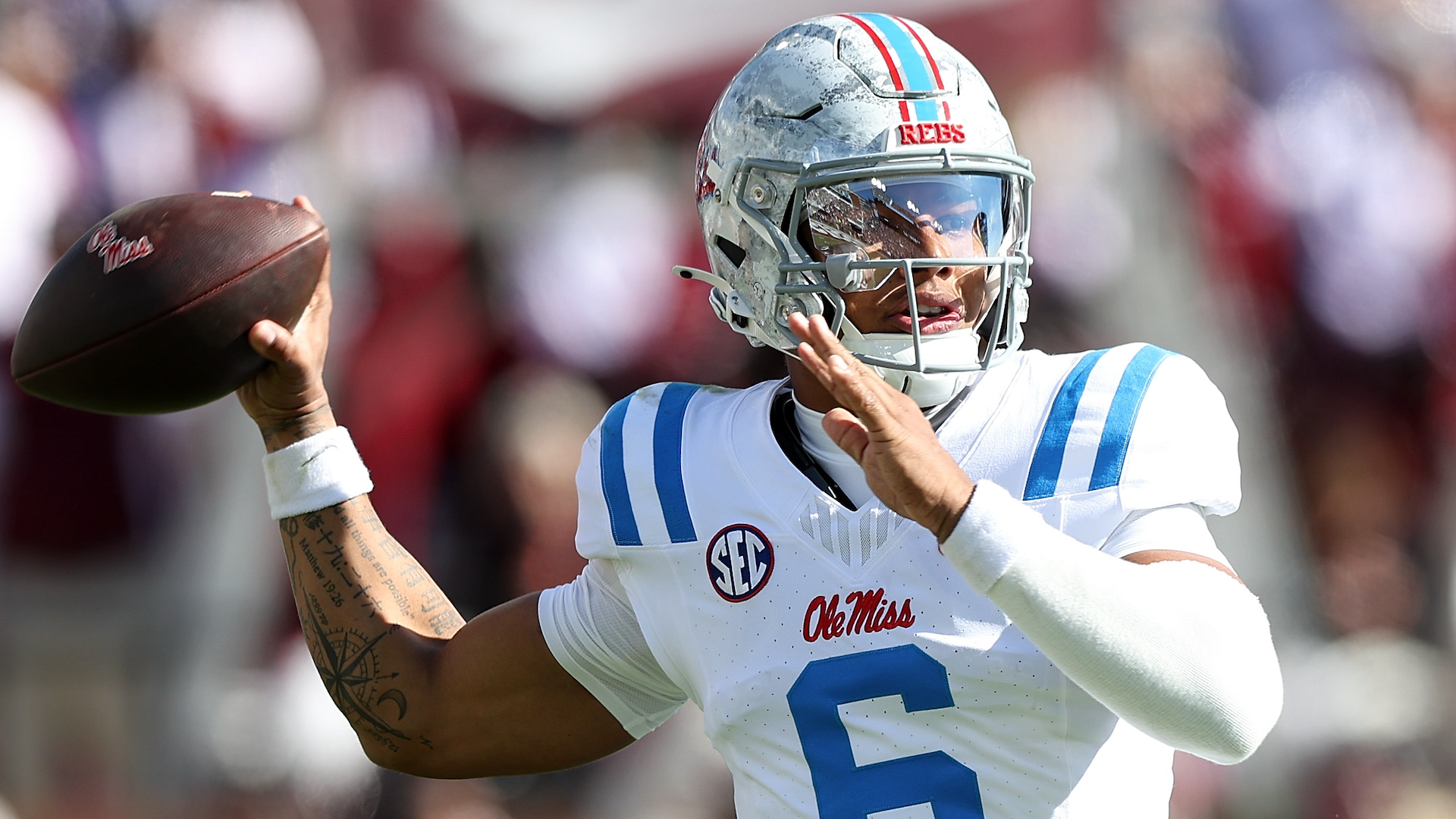
At the conclusion of a more than an hour-long ruling in favor of Ole Miss quarterback Trinidad Chambliss, Mississippi judge Robert Q. Whitwell appeared to choke up with emotion.
When Whitwell ruled that Chambliss would be granted a preliminary injunction against the NCAA, the crowd in attendance broke into applause.
Ole Miss got its quarterback back. The evil NCAA had been defeated. A chancery courthouse in the tiny town of Pittsboro, Mississippi — population 157 — delivered Chambliss a win for the program and the state.
At least that would be the script if Chambliss’ win played out as a TV courtroom procedural — a win for the little guy against the archvillain NCAA.
The reality is far more complicated.
Chambliss’ case is the recent example of a rapidly eroding eligibility system in which courts — not conferences or the NCAA — increasingly determine who is allowed to play college football.
No one objects to Chambliss receiving another season. He is one of the sport’s most exciting players, and the 2026 college football season will be better with him in Oxford.
The concern is precedent.
Chambliss’ fight for a sixth season hinges on an argument he should have been granted a medical redshirt at Ferris State in 2022. He used his traditional redshirt as a true freshman in 2021 and stated he sat out in 2022 because of medical condition: lingering tonsillitis.
The NCAA disagreed and denied his waiver three separate times, determining the illness did not meet the threshold for a medical hardship waiver.
In a Mississippi courtroom, however, the case drew obvious sympathy.
So much so that at one point Whitwell seemed to coach Chambliss around one of his answers after Chambliss stumbled in the face of NCAA cross-examination.
When asked by a NCAA lawyer if he was limited in practice during the 2022 season, Chambliss stated: “No sir.” He participated the entire season on the scout team.
After the cross-examination finished, Whitwell and Chambliss had this exchange:
Whitwell: “In 2022 you just got through saying you didn’t have any issues. My understanding is you stated you complained to the trainers, and you were out there with the scout team and that you weren’t up to par. Were you up to par or not?”
Chambliss: “No sir.”
Whitwell: “I didn’t understand why you were saying what you were saying a while ago, because 2022 is the year we’re looking at. Did you go in and report to the training staff that you were having problems?”
Chambliss: “Yes sir, multiple times.”
Whitwell: “Dr. Howard stated you didn’t have any flare ups. But you still had some swelling from the injections in December after you had three-plus in August of 2022. You still had some swelling, did you not? Was it bothering you or not?
Chambliss: “Yes sir. It was constant. It was like a roller coaster.”
Whitwell: “That’s why you believe you couldn’t play in 2022.”
Chambliss: “Yes sir.”
Whitwell: “You never played a down in 2022.”
Chambliss: “Not one.”
Judges often clarify testimony. Still, the moment illustrated why athletes have increasingly turned to local courts for their eligibility lawsuits. A sympathetic local jurisdiction can succeed when the NCAA appeals process fails.
That strategy has worked repetitively since Diego Pavia successfully sued the NCAA in Tennessee, leading to a wave of eligibility lawsuits.
It’s all part of an eroding enforcement and eligibility model for the NCAA.
A historic boogeyman the NCAA may be, but the organization is only trying to enforce rules schools like Ole Miss helped create. Remember, the NCAA is a bureaucratic body whose primary function is to enforce rules approved by its membership.
Chambliss stood to lose millions because the NCAA denied his medical redshirt appeal. Prior generations would have just had to deal with it. But in the post-Pavia landscape billable hours always provide another avenue of attack.
It doesn’t work every time. The NCAA wins the majority of the cases. Even the wins by the athletes are usually narrow, temporary decisions. But the assault on eligibility standards from multiple fronts erodes the foundation of the sport.
“This decision in a state court illustrates the impossible situation created by differing court decisions that serve to undermine rules agreed to by the same NCAA members who later challenge them in court,” the NCAA stated in a statement Thursday following the Chambliss decision.
Another test comes Friday when Tennessee quarterback Joey Aguilar will appear in a Knoxville courtroom arguing that junior college competition should not count against his eligibility clock since junior colleges are not part of NCAA membership. He began his college football career in 2019. That’s eight years ago.
Things won’t get any easier for the NCAA moving forward.
Chambliss’ lawsuit differed from many others as it hinged on a contract issue, not an antitrust case like so many others who have sued for additional seasons of eligibility. It’s a new blueprint for future lawsuits.
Antitrust violations carry a high burden of proof. Chambliss argued the NCAA breached its contract with Ole Miss, failing to apply its rules in good faith when it comes to the development of student athletes.
The NCAA will likely appeal, and this is only a preliminary injunction allowing Chambliss to play while litigation continues. Still, the direction is clear: eligibility is no longer being decided by rulebooks but by judges in local courtrooms.
College football is better for it in 2026. Chambliss is back. Fans win. SEC Saturday afternoons are more fun.
Long term, the consequences are far murkier. How can college football operate if the rules vary from state to state and courtroom to courtroom? Every eligibility lawsuit is a further danger to the foundation of the sport.
The good guy won in this TV procedural. The question is the cost.