Now matchweek 16 has finished, the Women’s Super League will take a month-long break.

It is not a total pause on fixtures, with players, managers and fans switching focus to various other competitions in the meantime.

Arsenal and Manchester United will contest the second legs of their Champions League knockout play-off ties on Wednesday and Thursday, while 10 of the 12 top-flight teams play in the FA Cup fifth round next weekend.

After that, many players will join their national teams, with the start of March occupied by World Cup qualifiers, the Asian Cup and various other international matches.

However, coming just six weeks after the WSL’s winter break, BBC Sport takes a look at the impact this recent hiatus might have.

Why do teams play different numbers of games?

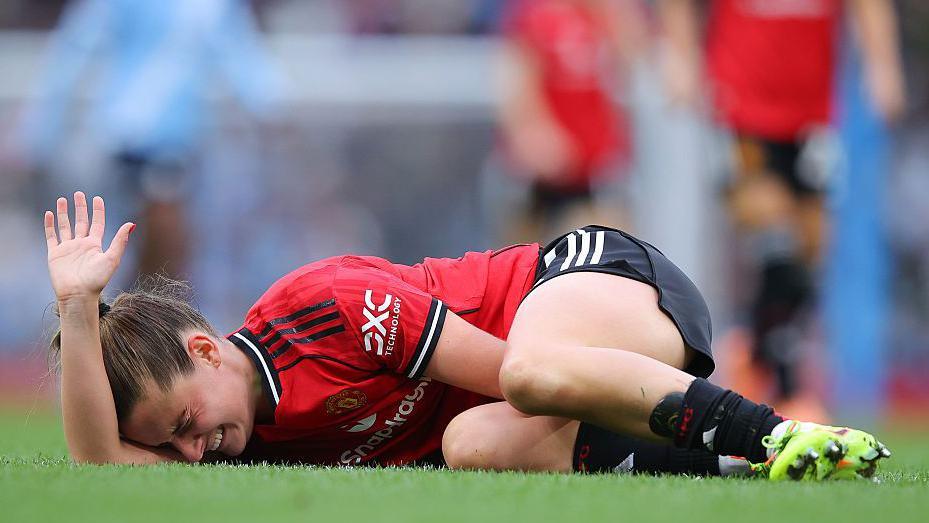
Ella Toone signals for treatment while lying on the floorImage source, Getty Images

Since action resumed on Saturday, 10 January, it has been a hectic period.

Four rounds of WSL action, FA Cup fourth round, League Cup semi-finals, the return of the Champions League and Arsenal competing in the inaugural Fifa Champions Cup have all been squeezed into a packed schedule.

Yet there is a stark difference between the amount of games played by the top teams and those lower down the division, including concerns about schedule congestion for teams fighting on multiple fronts, and the toll it could take on players.

Bottom side Leicester City have played the fewest games so far this season (19) and, having suffered early exits in both domestic cups, they now face an entire month without a competitive fixture.

Their next fixture is a crucial game against 11th-placed Liverpool in the WSL on Sunday, 15 March (11:55 GMT).

It’s an entirely different scenario for Manchester United though, who have played the most games to date (30).

This week, they will play Atletico Madrid in the Champions League on Thursday (20:00 GMT), and then take on Chelsea next Sunday in the FA Cup fifth round (13:30 GMT) before they return to WSL action in mid March.

The below graph shows the amount of fixtures played by every team in the WSL so far – with the green bars representing the maximum number each could play, should they win out in each competition that they are playing in.

Such discrepancy in fixtures will be impacted next season as the Women’s Super League expands from 12 to 14, although it may just mean more games all round.

Former England defender Anita Asante says a four-week break at this stage of the season could have a hefty impact on the momentum of WSL teams.

“I think it does, because for players and staff it affects consistency that allows them to build from one performance to the next,” she stated.

“It’s the close connection on the training pitch and the learning that takes place off the pitch. When they are away from that, it makes it really challenging.

“You have to start from the beginning again.”

Those effects may be felt more keenly by certain Women’s Super League teams, with Asante suggesting the break favours bigger clubs.

“It’s not to say that players and staff can’t get back to playing quickly, because we’ve seen that the top teams are able to do that,” stated Asante.

“Their squads have been built and have been together for more than one season – that puts them in a better position. However if you have a new squad you don’t want those breaks and pauses in the season.”

  • WSL expanding to 14 teams – but relegation remains

    • Published
      16 June 2025

What do fans think?

Asante also thinks that the break could do more harm than good for WSL fans, both existing and potential.

“For the wider marketability of the game, my gut feeling is the break is too long,” she stated. “While we are still growing the women’s game, can we afford to have these pauses?

“If you are talking about keeping engagement and keeping fans aware of when the next games are, you want continuity and momentum. That allows for good storytelling.

“With four weeks away, other sports, passions or distractions can fill that time.”

There have been mixed thoughts from supporters. Here are some of your opinions:

  • Cathy: There are too many breaks in the WSL – there aren’t actually that many games anyway because the league is so small. Understand need for international break but shouldn’t have so soon after winter break (which is too long).

  • Niamh: Hopefully with the expansion of the league it means that more games will happen so less breaks!

  • Dan: Football is a winter sport! Saturday at 3pm, Tuesday at 7:45pm (Sunday and Wednesday for women’s games if need be). Why do they need to keep changing everything? The game isn’t broken, governing bodies are.

  • Tom: I was guessing that with two more teams in the league next season these breaks might have to shrink a bit anyway. Let’s build slowly we don’t want to exhaust the players.

  • Mary: When there are comments about the packed WSL schedule, along with other competitions, it’s a double-edged sword. More games to fit in but a rest from the pressure. It does disrupt the flow in the league, contributing to inconsistent game performances and results.

Ellen White, Jen Beattie and Ben Haines

Ben Haines, Ellen White and Jen Beattie are back for another season of the Women’s Football Weekly podcast. New episodes drop every Tuesday on BBC Sounds, plus find interviews and extra content from the Women’s Super League and beyond on the Women’s Football Weekly feed

Related topics

  • Football
  • Women’s Super League
  • Women’s Football

More on this story

✔ today silver rate

✔ 2026 winter olympics

✔ chat gtp

✔ silver rate today

✔ silver rate today live

✔ 2030 winter olympics

Read More

Sports

Leave a Reply

Your email address will not be published. Required fields are marked *