This is part of an ongoing look at the 2027 quarterback class, combining my scouting reports with more than a decade of historical data. We’ve already looked at why this supposedly loaded class may be closer to 2025 than 2024. We’ll keep checking back during the season as the tape — and the numbers — change.
The 2027 quarterback class has been called loaded for so long that it almost feels like we’ve skipped a step. Arch Manning and Dante Moore have been discussed as potential No. 1 picks. LaNorris Sellers has the physical ability NFL evaluators love. Julian Sayin, CJ Carr and Darian Mensah are generating early-round buzz, while several others have spent time in the conversation, too. There are more recognizable names than obvious answers.
The Summer Scouting that Ran Carthon and I do on the With the First Pick podcast gives us one answer. More than a decade of historical quarterback data gives us another. And sometimes they don’t agree.
We’ve already gone deep on Moore, Manning and Jayden Maiava. So let’s get to 12 other quarterbacks who could help determine whether the 2027 class lives up to the hype.
What is FRED and how does it work?
The model I’ve been using for this QB series is the First-Round Readiness Score — FRED, for short. It looks at the things that have historically separated first-round quarterbacks — passing efficiency, touchdown and interception rates, QBR, experience and, importantly, a quarterback’s best three- and five-game stretches.
The scale is simple: 50 is the historical first-round threshold. Twenty-two quarterbacks in our historical sample had played enough football to reach 50 before their final college seasons. All 22 went in Round 1, including Drake Maye (78.0), Patrick Mahomes (55.7), Jaxson Dart (54.7) and Josh Allen (51.6). One quarterback in the 2027 class is already there: Ohio State’s Julian Sayin at 55.3.
FRED isn’t my draft grade and it doesn’t supersede what we see on the field. It’s a way to identify where history agrees with what I’m seeing, where it doesn’t and what each quarterback needs to show us next.
| QB | My Rank | FRED | What we’re trying to learn in 2026 |
|---|---|---|---|
| Julian Sayin | QB4 | 55.3 | Can the early efficiency hold up over another season? |
| Darian Mensah | QB6 | 39.4 | Can Miami unlock another level? |
| CJ Carr | QB7 | 10.6 | What happens with another full season to evaluate? |
| Trinidad Chambliss | QB8 | 29.7 | Can the processing catch up with the arm talent, mobility and production? |
| Drew Mestemaker | QB9 | 40.4 | Can the historical profile hold up against better competition? |
| Nico Iamaleava | QB10 | 1.5 | Can he reverse a concerning trajectory? |
| John Mateer | QB11 | 19.6 | Was 2025 an injury-plagued detour or the beginning of a trend? |
| Josh Hoover | QB12 | 12.5 | Can an experienced QB make a meaningful late jump? |
| Sam Leavitt | QB13 | NA* | Can the passing catch up with the mobility? |
| LaNorris Sellers | QB15 | 11.9 | Can he become a much more consistent passer? |
| Drake Lindsey | QB16 | 8.6 | Can the flashes become consistent production? |
| Demond Williams | QB17 | 22.6 | Can the promising efficiency become a complete QB season? |
*Leavitt does not have an eligible 2025 FRED score after finishing with 239 attempts, 11 short of the model’s 250-attempt minimum.
One notable quarterback isn’t included in the table: Brendan Sorsby, my QB3. He won’t play in 2026 after being ruled ineligible by the NCAA for gambling violations. Following an unsuccessful attempt to enter the NFL supplemental draft, he’ll spend the year preparing for the 2027 NFL Draft.
For everyone else, the numbers don’t tell the same story, and neither does the tape. So let’s break them into three groups based on what they’ve shown, what history tells us and how much they still have to prove.
The first-round hype is ahead of the production
LaNorris Sellers (South Carolina)
It’s easy to understand the fascination. Sellers is a big, powerful athlete with a huge arm who can create plays few quarterbacks can. He’s also a locker room leader and, by all accounts, a fantastic human being. But neither my notes going back to 2024 nor the historical profile come particularly close to matching his reputation. Sellers enters 2026 as my QB15. His FRED score? Just 11.9.
That’s low for a quarterback entering what could be his final college season. And there are some familiar names who entered their final years in the same neighborhood: Kyle Trask was at 11.9, Sam Ehlinger at 11.5, Will Grier at 9.6 and Drew Lock at 15.2. None became a first-round pick. The exception remains Cam Ward, who entered his final season at 6.8, then jumped to 49.3 at Miami and became the No. 1 pick.
Ward’s path illustrates just how much Sellers would have to change. Ward’s adjusted YPA went from 8.1 to 10.4 and his QBR from 62.7 to 84.0. Sellers’ completion percentage dropped from 64.8% to 59.8% last season. If he’s going to follow anything resembling Ward’s path, the accuracy, processing and consistency have to take a big leap forward.
Sam Leavitt (LSU)
Leavitt, like Sellers, is another QB whose physical ability is easy to see. He can create with his legs, extend plays and make throws outside of structure, and his move from Arizona State to join Lane Kiffin at LSU could make the difference. Kiffin helped turn Jaxson Dart into a first-round pick in 2025, then watched Trinidad Chambliss make the jump from Division II to become one of the SEC’s best players last season (more on him later).
But Leavitt doesn’t have an eligible 2025 FRED score. An injury limited him to seven games and 239 attempts, 11 short of the model’s 250-attempt minimum, so there’s some important context here. There are first-round throws on the tape. And when the play breaks down, he’s one of the most creative quarterbacks in this class.
The problem is that he can almost be too comfortable there. My biggest concern going back to Arizona State is how frenetic he can be from a clean pocket, especially if his first read isn’t there. He’ll leave the pocket when he doesn’t have to, turn down throws that should be made on time and occasionally try to force the spectacular play when the boring one is the better option. The accuracy can be hit or miss, too, particularly when pushing the ball downfield.
If Leavitt becomes more comfortable playing on time and in structure without losing what makes him dangerous when things break down, we’ll be having a much different conversation next spring.
Nico Iamaleava (UCLA)
Iamaleava was an elite recruit, and it’s still easy to see why: He’s a long, explosive athlete with a huge arm who can rip intermediate throws and create explosive plays with his legs.
The problem is what happens when he isn’t comfortable. My notes consistently come back to how dramatically his processing and decision-making can deteriorate under pressure. He’ll hold the ball, take unnecessary sacks and force throws instead of finding the easier answer. That shows up beyond his first read, too, where he can be slow getting to the next option in the progression and too quick to drop his eyes or try to escape the pocket.
And the production went backward, too. His 1.5 FRED score is the lowest of the 12 quarterbacks we’re looking at here. His QBR fell from 70.5 in 2024 to 54.5 last season, his yards per attempt dropped from 8.3 to 6.0 and his TD-to-INT margin went from plus-14 to plus-6.
Simply put: 2026 isn’t about reminding us how talented Iamaleava is. We already know that. It’s about showing he can consistently play quarterback when the conditions around him aren’t perfect.
Drake Lindsey (Minnesota)
There are parts of Lindsey’s game I already really like. He’s a traditional pocket passer with a big arm, and he throws with anticipation as well as the top passers in this class.
The problem starts from the ground up. Lindsey’s footwork can be problematic at times; he’ll throw off his back foot or fall away from his target, even from a clean pocket, and the accuracy suffers. His deep-ball accuracy was particularly inconsistent in 2025, and he’ll occasionally predetermine throws or try to force a ball into coverage. It’s also worth noting that Lindsey is entering just his second full season after redshirting in 2024.
That limited experience is important context for his 8.6 FRED score, and we’re still evaluating a quarterback with only one full year of college football. We see the NFL throws. The question in 2026 is whether cleaning up the mechanics allows us to see them consistently enough to change the larger evaluation.
Josh Hoover (Indiana)
Hoover may be the most interesting quarterback in this group when it comes to understanding how FRED works because I like considerably more about his game than his score might suggest. He’s a rhythm passer with a quick release, consistently works through progressions and throws accurately into tight windows over the middle of the field.
He can leave clean pockets because of perceived pressure, occasionally come off his first read too quickly and trust his arm into windows he shouldn’t. But the bigger issue for the model is that we aren’t dealing with a small sample. He’s played 33 games and attempted 1,151 passes over the last three seasons, yet his FRED score is still just 12.5.
He needs all of those pieces to come together more consistently over the course of a season. After this much football, it’s fair to wonder if another solid year is enough to dramatically change his historical evaluation.
There’s something here, but we need more
Trinidad Chambliss (Ole Miss)
Chambliss is another quarterback FRED says we should probably be paying more attention to. His 29.7 score is seventh in the 2027 class, and the production behind it is interesting: He averaged 8.8 yards per attempt last season while posting 0.30 EPA per dropback.
My summer evaluation had him as QB8 with a Day 2 grade, and the tape explains a lot of the appeal. Chambliss plays with urgency from the pocket and uses subtle movement to buy time while keeping his eyes downfield. He has a quick release, throws accurately on intermediate in-breaking routes and consistently makes off-platform plays. He’s also a legitimate part of the run game, though he’s not a run-first QB.
To make the leap from the top 50 to the top 32, I want to see him get better at working through the entire play. Chambliss can lock onto his first receiver, and while he’ll get through his reads, he didn’t do it as consistently as you’d like. There were also instances where he appeared to predetermine the second read if his first read wasn’t there. The arm talent, mobility and production are already there.
A 29.7 FRED score doesn’t put him in Sayin’s neighborhood, but it’s a much stronger historical starting point than most passers in this class. Now I want to see whether the processing catches up with the rest of his game.
Demond Williams (Washington)
Williams is an explosive athlete, and some of his best out-of-structure moments are ridiculous — whether it’s avoiding pressure or escaping the pocket and turning a broken play into a downfield completion. The concern is how often Williams uses that creativity as a crutch because he has a knack for making routine plays much more complicated than they need to be. He’ll abandon an open first read, rush through a progression or predetermine a downfield throw — only to use his athleticism to escape the problem.
Williams’ 22.6 FRED score is below 50, but he also has just one full season as a starter. That’s why I view him differently than, say, Hoover. We need more football, but we also need a different kind of football: more patience, more trust in the play as it’s designed and fewer situations where he defaults to his God-given physical gifts to save him.
CJ Carr (Notre Dame)
Carr is where we need to be careful with the model. His 10.6 FRED score is low, but he has only one season of starting experience, which makes that number very different from Hoover’s 12.5 after three years of extensive playing time. More than that, Carr was impressive enough on tape during his first season as a starter that I gave him a second-round grade heading into 2026.
He’s a good athlete both inside and outside the pocket, but what I like most is the anticipation. He’ll consistently throw receivers open, both on intermediate outbreaking routes and balls up the seam, and has shown he can get through his reads.
The biggest concern is what happens when defenses speed up his internal clock. Carr can play panicked at times against pressure, drop his eyes and hold the ball too long. He’ll also need to improve his blitz-recognition skills.
Five months ago, the Rams took Ty Simpson 13th overall after just one year as the starter at Alabama. Carr’s situation isn’t that extreme, as he enters the season as my QB7, and I’m considerably more optimistic than his current FRED score might suggest.
And unlike some of the older quarterbacks in this class, Carr has two seasons of eligibility left. If the anticipation and accuracy I liked in 2025 become the foundation of his game — and he can push his FRED score above 50 this fall before returning in 2027 — he’d enter his final college season having followed the same path as all 22 quarterbacks in our historical sample who reached 50 before their final seasons and eventually became first-round picks.
John Mateer (Oklahoma)
Mateer’s 19.6 FRED score trails Sayin, Mensah and Williams among the quarterbacks we’re discussing here, but the season-by-season numbers are interesting. His QBR fell from 73.2 in 2024 to 67.1 last season, and his yards per attempt dropped from 9.0 to 7.2. There is some important context: Mateer suffered a hand injury early in the season that required surgery and affected much of the year that followed.
The injury provides important context for that regression, but it doesn’t erase what I like. On short and intermediate throws, Mateer has some of the best ball placement in the class. He’ll change arm angles, escape pressure and create throws outside structure that most quarterbacks can’t (or won’t). He’s also incredibly difficult to corral in the pocket because of his athleticism and elusivity.
But sometimes that confidence works against him. He can unnecessarily run himself out of a clean pocket and make one or two throws a game you wouldn’t expect Mahomes or Allen to consider, let alone attempt.
For Mateer, 2026 is about proving last season was an injury-plagued detour rather than the beginning of a trend — without asking him to eliminate the playmaking ability that makes him interesting in the first place.
History may be telling us to pay more attention
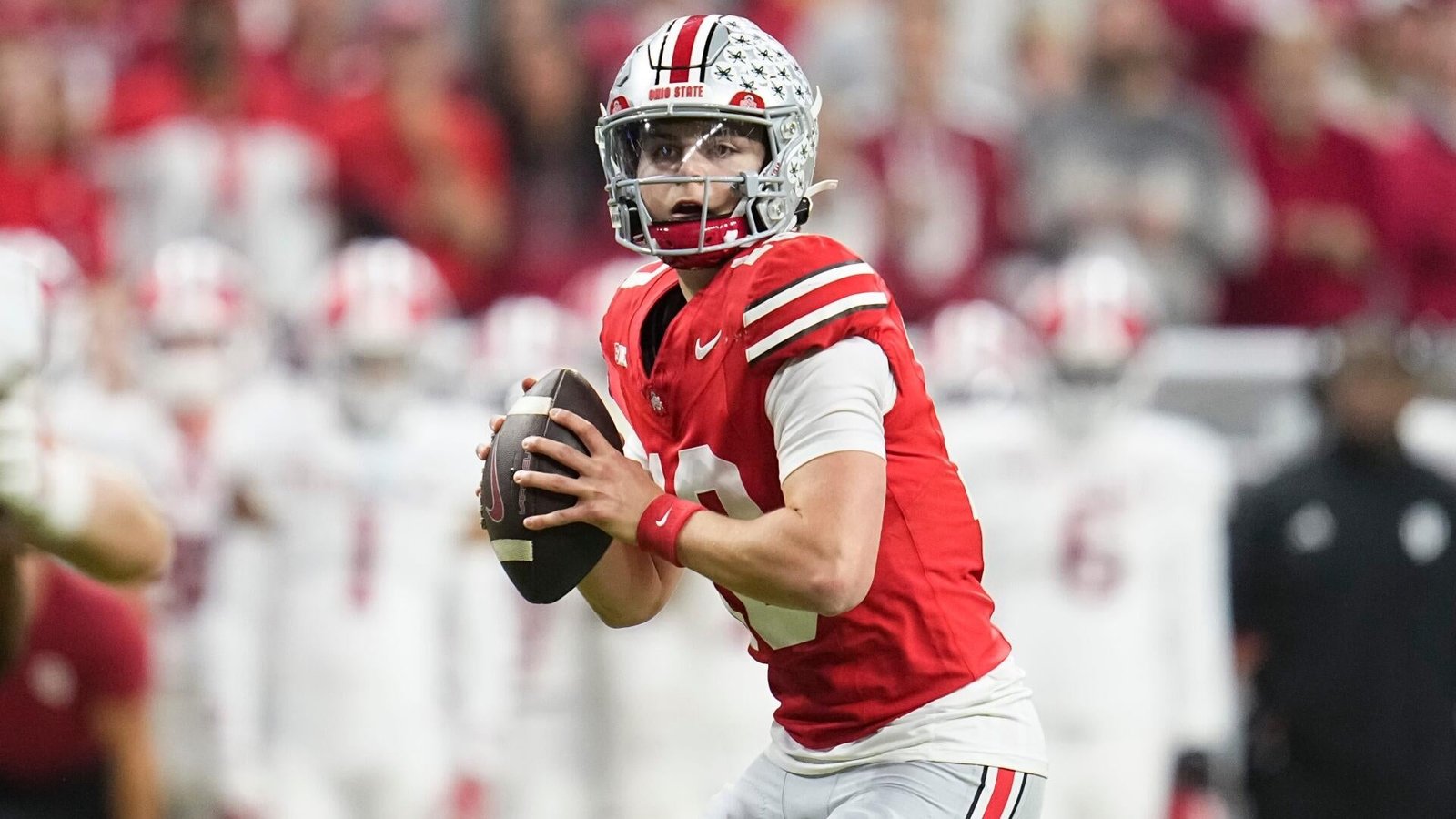
Julian Sayin (Ohio State)
Sayin is the fascinating one because his 55.3 FRED score is considerably higher than anyone else’s in this group. He’s also the only quarterback in the 2027 class at or above 50, with Mensah next at 39.4. Sayin’s 2025 production helps explain why: He completed 78.4% of his passes, averaged 9.3 yards per attempt, threw 31 touchdowns against six interceptions and posted an 84.9 QBR.
Sayin is my QB4 and one of four first-round QB grades I have entering the season. He’s incredibly patient and accurate from the pocket, consistently works through his progressions and has the touch to make throws to all three levels. There are still areas where I want to see improvement: I’d like more anticipation on intermediate in-breaking routes, and he’s considerably less comfortable when he’s forced to create outside structure.
But Sayin doesn’t need to overhaul his game. He just needs to continue building on what we saw in 2025.
Darian Mensah (Miami)
Mensah is my QB6 with an early second-round grade, while his 39.4 FRED score is fourth in the entire 2027 class. He has already built a stronger historical profile than most of the quarterbacks we’re discussing.
He has a big arm and excellent pocket mobility and can make difficult off-platform throws look effortless (sound like a recent Miami QB who went in the first round?). He can layer deep sideline balls, rip intermediate throws while on the move and step up in a collapsing pocket to keep the play alive.
So why isn’t my grade higher? The inconsistencies. Mensah’s footwork can suffer if his first read isn’t there, even from clean pockets, and sometimes predetermined throws pop up on tape that get him in trouble.
Now he’s going to Miami, which has had recent success with transfer quarterbacks. Mensah led Duke to an ACC title (!) in 2025, posting a 75.8 QBR and throwing 30 touchdowns against five interceptions.
Yes, the Ward comparison is unavoidable — another talented transfer quarterback arriving in Coral Gables with plenty already on his resume. But Mensah doesn’t need a full Ward-like makeover. He needs to clean up the inconsistencies enough for the eye test to catch up with what FRED already likes about his game.
Drew Mestemaker (Oklahoma State)
Mestemaker might be the easiest quarterback in this class to overlook, but his 40.4 FRED score is third among all 2027 quarterbacks, behind only Sayin and Maiava. And unlike some of the more experienced players we’re talking about, that comes after essentially one season of college football.
I have Mestemaker at QB9 entering the fall, but there is a lot to like: He’s unpanicked in the pocket, keeps his eyes downfield and will work through his reads to find the checkdown when the first option isn’t there. I also like his touch on intermediate throws and his ability to move inside the pocket, reset his feet and deliver accurately downfield.
On tape, his arm looks above average. Admittedly, things can look a whole lot different in person — which is why I love the college all-star games and pro days — but there are times when he doesn’t have the velocity to squeeze throws into NFL-sized windows. When he tries to compensate by putting extra juice on the ball, his accuracy can suffer. He can also be late downfield and occasionally lock onto a read and force the ball into coverage.
After throwing for 4,379 yards and 34 touchdowns at North Texas last season, the move to Oklahoma State gives us another year to find out whether the historical profile is identifying something real — or whether those limitations become more pronounced against better competition. I’m betting on the former.
The wild card
Jaden Craig (TCU)
Craig transferred from Harvard to TCU after starting 24 games for the Crimson. Because our historical model is built from FBS data only, he doesn’t have a FRED score.
But there is plenty to evaluate on tape. Craig has a big-time arm and a quick release, and I love the touch he shows on deep boundary throws. The concern is what happens when that rhythm disappears. Craig can become frenetic when his first read is covered, leave clean pockets because he senses pressure that isn’t there and sometimes force throws over the middle.
Craig left Harvard as the program’s career leader in passing yards and touchdowns; now we get to see whether it all translates against Big 12 defenses.
FRED can’t tell us where Craig stands entering the season. And that’s fine — by November, we should have a much better idea ourselves.
So now what?
Putting my summer evaluations next to FRED makes one thing clear: These quarterbacks aren’t all starting from the same place. Sellers and Iamaleava need big jumps. Carr and Williams are high-upside passers who just haven’t played a lot of snaps. I already have a first-round grade on Sayin, and his 55.3 FRED score is not only the best in the class, but also the only one at or above 50. Mensah’s strong historical profile largely supports what I already like about him on tape.
Ward remains the reminder that none of these are hard-and-fast rules. He never reached 50, but he did give NFL teams enough new information to decide that it didn’t matter.
Someone in this class could do the same. But until they do, there’s reason to wonder whether the so-called loaded 2027 quarterback class is actually loaded at all.