Battle of Los Angeles: USC, UCLA among top five recruiting classes as Big Ten’s West Coast vision takes shape
Early recruiting momentum in the 2027 class from both USC and UCLA is testing the Big Ten’s long-term bet on the LA market
tamil yogi
Battle of Los Angeles: USC, UCLA among top five recruiting classes as Big Ten’s West Coast vision takes shape
Early recruiting momentum in the 2027 class from both USC and UCLA is testing the Big Ten’s long-term bet on the LA market
Cody Nagel
May 5, 2026
at
9:45 am ET
•
5 min read
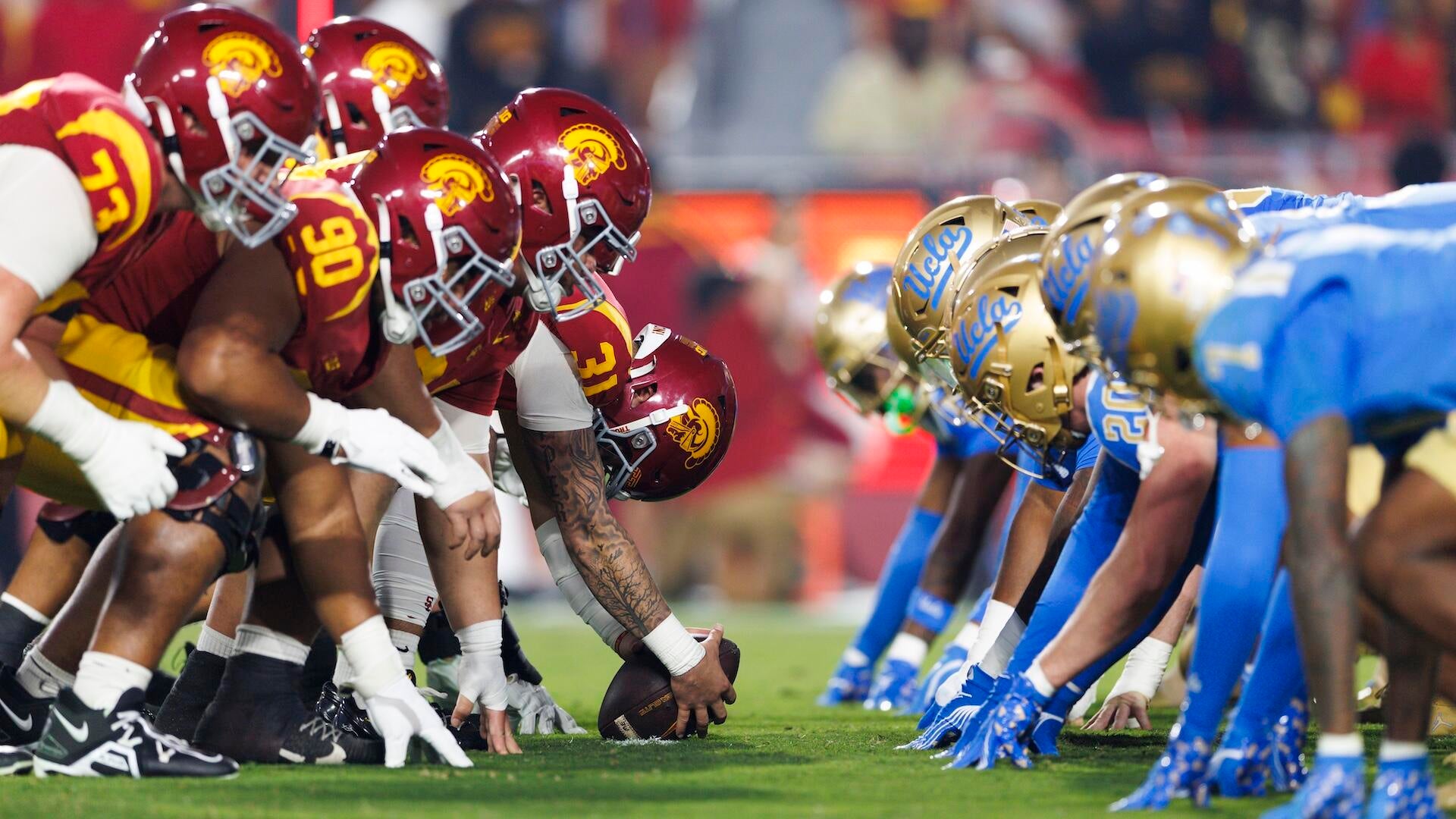
The Battle of Los Angeles is taking on a different shape on the recruiting trail this cycle. Fresh off a No. 1 class in 2026, USC currently holds the No. 3 haul for 2027, according to 247Sports. Right behind them, UCLA sits at No. 4 as new coach Bob Chesney and a revamped staff have surged early this spring.
The rankings will move, and plenty will change between now and signing day, but the early snapshot is still notable. For the first time in years, USC and UCLA are climbing together in a market where two winning programs would further elevate the Big Ten’s reach and value.
When the two rival schools moved into the Big Ten in 2024, the expectation was that Los Angeles would eventually become one of the league’s defining footholds. A market this size, with two historic brands and a deep local talent pool, was supposed to shift the balance of power over time.
Instead, the early standard has come from the Northwest.
Oregon has already emerged as the most complete football addition, backing up its national recruiting profile with a Big Ten title and two College Football Playoff appearances. Washington arrived with recent national title game experience still fresh, having reached the championship the season before joining the league.
USC and UCLA, by contrast, are still working through the gap between roster upside and week-to-week consistency in their new conference. That’s what makes this cycle more notable than a routine rankings snapshot. If both programs are building at this level, the Big Ten may finally be moving closer to the Los Angeles it envisioned when it expanded west — not just visibility in a major market, but sustained football relevance within it.
Duece Jones-Drew commits to UCLA: Son of Maurice Jones-Drew adds to Bruins’ top-five recruiting class
Brad Crawford
USC’s 2027 class again reflects a familiar structure: elite Southern California talent forming the backbone, supported by national evaluations that widen the board. Ten of its commitments are already top-100 prospects nationally by 247Sports, and the group includes multiple in-state headliners, reinforcing how central USC remains to the local talent ecosystem.
The Trojans have already secured pledges from six of the top 20 in-state recruits, including four of the top 10, according to 247Sports, while also adding high-ceiling prospects across multiple position groups.
That early-cycle approach is intentional. 247Sports recruiting analyst Blair Angulo described it as a defining feature of how USC operates on the trail.
“USC has really mastered the early cycle commitment spree,” Angulo reported. “There is a real sense that they load up early, and rankings can be a bit distorted because of that, but there is also staying power there. The Trojans just signed the No. 1 class in 2026 and did so with a bulk of early commitments.”
UCLA, meanwhile, has taken a different path while reaching similar early national positioning.
The Bruins are up to five Top247 commitments and have added six total players since the beginning of May, pushing them into the top-five range and marking one of the most active early cycle surges in the country.
What separates UCLA’s climb is not just volume, but approach. The staff has significantly widened its recruiting footprint, moving beyond traditional regional boundaries and targeting national boards more aggressively than in previous cycles.
“The Bruins are much more aggressive in every sense,” Angulo reported. “More visits, more offers, a wider scope of evaluations and a deeper investment in the revenue-share aspect of talent acquisition.”
That shift has already produced results across multiple regions. UCLA has flipped defensive backs committed to Georgia and Notre Dame, beaten out Big Ten and SEC programs for top-ranked talent in Colorado, and landed key in-state pieces such as four-star athlete JuJu Johnson after long recruiting battles.
“New general manager Darrick Yray is swinging for the fences early, and there is a sense of urgency in and around the program that fans haven’t seen since early in the Jim Mora era when the Bruins were contending for Pac-12 titles,” Angulo reported. “Chesney has quickly reshaped the entire operation.”
The composition of the class reflects that change. Seven of UCLA’s 16 commitments come from outside California, and while the Bruins have made inroads locally, they currently hold just two commitments from top-20 in-state prospects and none from the top 10.
That shift has already reshaped the program’s recruiting identity, but as Angulo noted, it still has to translate on the field.
“The Bruins are in uncharted territory in the NIL era, and a lot of their future pitch will depend on how they improve on the field under Bob Chesney,” Angulo reported.
That uncertainty now defines UCLA’s position in the cycle. Two programs are reaching similar early cycle results through distinct recruiting approaches. For the first time in about a decade, USC and UCLA are recruiting at a high level in the same cycle, even if they are not yet consistently battling for the same prospects.
“The head-to-head battles are still going USC’s way, as has traditionally been the case, although there hasn’t been much overlap this cycle,” Angulo reported. “Both teams are recruiting at different tiers at the moment, particularly because the financials are not equal.”
USC has maintained elite recruiting under Lincoln Riley, but it still hasn’t translated into the kind of on-field results expected when he was hired. Four years into his tenure — and now two full seasons into Big Ten play — USC still hasn’t reached the College Football Playoff, even as access to it has expanded.
The recruiting profile is not the issue. It’s converting top-25 classes into a team that consistently plays into January.
At UCLA, the direction is different, but the urgency is just as real. Since Chesney arrived from James Madison, the program has moved quickly to reshape its recruiting operation, expanding its footprint and accelerating its evaluations. The result is not just a spike in activity, but early cycle traction that has pushed UCLA closer to USC in the recruiting rankings than it has been in recent years.
For years, LA football hasn’t functioned as a truly shared competitive space. USC has set the standard locally, while UCLA has largely operated behind it or adjacent to it. That separation is beginning to narrow, even if Chesney has yet to coach a game early in his tenure in Westwood.
And that narrowing matters for reasons that extend beyond Los Angeles.
The Big Ten didn’t expand west simply for more games in another time zone. It added Los Angeles, expecting it to function as a competitive engine; producing programs that recruit nationally, contend consistently and give the league a second true power center alongside its Midwest core.
USC may still control most of the elite battles for now, as Angulo noted, but UCLA is trying to change that. This cycle doesn’t confirm a power shift, but it does suggest Los Angeles could soon matter more to the Big Ten than it has through the first two years post-expansion.
✔ today silver rate
✔ 2026 winter olympics
✔ chat gtp
✔ silver rate today
✔ silver rate today live
✔ 2030 winter olympics