NBA free agency 2027 preview: Our Way-Too-Early look at next summerplayWindy: Draymond’s return sets up Warriors for a ‘huge’ 2027 offseason (1:47)Bobby MarksAug 4, 2026, 07:00 AM ETClose
On Monday, we examined the NBA offseason trends that have developed over the first month of the 2026 free agency. Now, we’re looking ahead to the players, teams, deals and decisions that will impact summer 2027.
Who are the top names to watch? Which franchises are projected to have the most cap space? Could draft lottery reform change how teams view superstar trades?
Let’s fast-forward 11 months to get the answers.
Jump to a section:
The return of salary cap space?
FAs to watch: Giannis, KD, more
How Warriors retool around Steph
Should Nuggets worry about Jokic?
Max and rookie extensions to watch
Aprons’ impact on Thunder, Knicks
Traded picks to watch | ’27 prospects

Will cap space be more prevalent next offseason?
Last August, we identified 10 teams that could have cap space in 2026. During last season, that group shrunk to just the Brooklyn Nets, Chicago Bulls and Los Angeles Lakers after teams such as the Utah Jazz (Jaren Jackson Jr.) and Washington Wizards (Trae Young and Anthony Davis) acquired stars at the trade deadline. The Portland Trail Blazers and Charlotte Hornets, meanwhile, either handed out long-term extensions or re-signed their players.
This summer was the second consecutive offseason that three or fewer teams had room.
Next offseason, the number of projected cap teams could range from three teams to nearly a third of the league: the Atlanta Hawks, Nets, Bulls, Golden State Warriors, LA Clippers, Memphis Grizzlies, Milwaukee Bucks, New Orleans Pelicans and Sacramento Kings could enter summer 2027 with room.
Editor’s Picks
NBA free agency fact vs. fiction: Bobby Marks examines 10 offseason trends
Stacking which teams can keep the NBA’s parity run going
Grades for every free agent signing, extension: Draymond, LeBron, Marshall and more
The Warriors are the headliners — Stephen Curry, Draymond Green and Jimmy Butler III can become free agents — but Atlanta could be the wild card from that group.
With CJ McCollum, Luguentz Dort and Jock Landale on expiring contracts and Buddy Hields’ non-guaranteed $10 million salary, the Hawks could have up to $50 million in cap space next summer.
The availability of cap space around the league will once again depend on any extensions signed during the regular season — the Nets extending Michael Porter Jr. and the Bucks extending Tyler Herro would likely remove both teams from the list — and on the salary cap, which the league projects to increase by just 5.5% for the second straight offseason. (The maximum year-to-year increase is 10%.)
Who are the top free agents in 2027?
Similar to the fluidity of available cap space, the number of potential free agents is also likely to diminish as the 2026-27 season progresses.
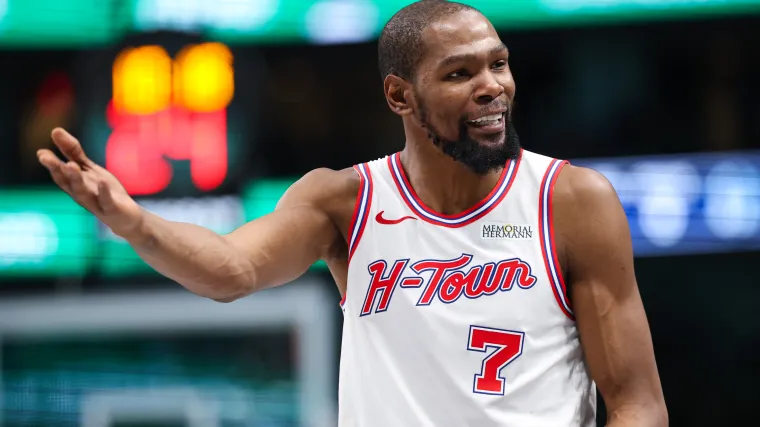
The current group could include former MVPs in Giannis Antetokounmpo, Curry, Nikola Jokic, LeBron James and All-Stars in Butler, Davis, Kawhi Leonard, Karl-Anthony Towns, Kevin Durant, Brandon Ingram and Kyrie Irving. (Antetokounmpo, Curry, Jokic, Butler, Leonard, Davis, Towns and Ingram are eligible to sign extensions this upcoming season and bypass free agency.)
Players signing lucrative contracts with new teams has become a rarity. Of the 35 free agents who switched teams this summer, only Norman Powell (Bulls) and Walker Kessler (Lakers) signed for more than $25 million in the first season. And since 2022, just eight players — Powell, Kessler, Jalen Brunson, Fred VanVleet, Tobias Harris, Paul George, Isaiah Hartenstein and Myles Turner — signed elsewhere for a contract of more than $20 million in Year 1.
Top names to watch in 2027 free agency:
-
Franchise level: Giannis Antetokounmpo (player option), Stephen Curry, Nikola Jokic (player option)
-
All-NBA level: Kawhi Leonard, LeBron James (player option), Karl-Anthony Towns (player option)
-
All-Star level: Jimmy Butler, Anthony Davis (player option), Kevin Durant (player option), Brandon Ingram (player option), Kyrie Irving (player option)
-
Top-starter level: RJ Barrett, Miles Bridges, Amen Thompson (restricted free agent), Ausar Thompson (restricted free agent), Luguentz Dort, Keyonte George (restricted free agent), Paul George (player option), Rudy Gobert (player option), Jalen Green (player option), Tyler Herro, Jrue Holiday (player option), Zach LaVine, Damian Lillard (player option), Brandon Miller (restricted free agent), Michael Porter Jr., Julius Randle (player option), Fred VanVleet
-
Starter level: Saddiq Bey, Anthony Black (restricted free agent), Max Christie (player option), Bilal Coulibaly (player option), Moussa Diabate, Donte DiVincenzo, Kris Dunn, Jerami Grant (player option), Rui Hachimura (restricted free agent), Josh Hart (player option), De’Andre Hunter, Cameron Johnson, Pelle Larsson (restricted free agent), Dereck Lively II (restricted free agent), Ajay Mitchell (team option), CJ McCollum, Dejounte Murray (player option), Brandin Podziemski (restricted free agent), Kristaps Porzingis (player option), Maxime Raynaud (restricted free agent), Marcus Smart (player option), Cason Wallace (restricted free agent)
Is 2027 the Warriors’ final offseason to build around Steph?
1:47
Windy: Draymond’s return sets up Warriors for a ‘huge’ 2027 offseason
It would almost be an insult to call this season a gap year with Curry on the roster.
“The path forward is to win,” Warriors general manager Mike Dunleavy Jr. stated in a brief statement to ESPN. “Never changes.”
But with Butler’s uncertain injury timeline and a relatively quiet offseason, Golden State will likely jockey for one of the final play-in spots in 2026-27. But Warriors coach Steve Kerr would disagree with that statement.
“I think sometimes when you fail like we did last year, there’s kind of a natural bounce back,” Kerr told ESPN’s Anthony Slater. “Everybody’s going to be really, really motivated and excited, and we’ve got good players. We do need some better luck health-wise, but I think we’ll get that. What we did last year wasn’t good enough.”
Barring them trading their three available first-rounders this season, next summer is setting up to be a roster revamp around Curry.
Depending on a possible Curry extension (the 38-year-old becomes eligible to sign a two-year deal Aug. 29), Golden State could hit the 2027 offseason with a clean cap ledger. Curry, Butler and Green are potential free agents, while only $3 million of Kristaps Porzingis’ $20 million salary is guaranteed.
Golden State could have between $50 million and $100 million in cap space. To use the room, Butler and Green would need to be renounced or signed at a significantly lower salary.
The last time the Warriors had cap space was in summer 2016 when they added Durant.
Should there be concern about Jokic’s future in Denver?
We are not ready to sound the alarm in Denver, especially after Jokic signaled his commitment to re-signing next summer.
“My idea and desire is to stay in Denver. I’ll probably sign next year,” Jokic told reporters in Serbian after a FIBA World Cup qualifying game last week.
Jokic is under contract for two seasons (2027-28 is a player option) and has been eligible to negotiate a four-year, $278 million max extension since June 14. By waiting until next summer, Jokic will be eligible to sign a five-year, $359.5 million contract as a free agent. That contract would be the largest in NBA history and would propel his career on-court earnings to $724 million. (This is the second consecutive offseason in which Jokic was eligible to sign an extension. He was eligible in the 2025 offseason to sign a three-year $200 million extension.)
The Nuggets’ finances played into their relatively quiet offseason. Denver signed veterans Tyus Jones and Marvin Bagley III to the veteran minimum and matched the two-year, $12 million offer sheet Spencer Jones signed with the Thunder.
Denver is the only team in the second apron with luxury tax payments that will likely exceed $100 million if restricted free agent Peyton Watson signs his $6.5 million qualifying offer. The Nuggets have no tradeable first-rounders in the next seven seasons, and their 2034 pick becomes frozen if they finish 2026-27 over the second apron. Not including 2027 free agents Cameron Johnson, Julian Strawther and Watson, Denver projects to be $14 million below the luxury tax next offseason.
Will extensions impact next year’s free agent class?
Since the current CBA started in the 2023 offseason, an average of 23 players have extended their contract each season. For comparison, there were 1.8 per season under the 2011 CBA and 12.3 under the 2017 CBA.
But so far this offseason, just four players — Donovan Mitchell, Neemias Queta, Jordan Walsh, Andrew Wiggins — signed veteran extensions. The Spurs’ Victor Wembanyama, meanwhile, is the only player to sign a rookie extension.
There are reasons for optimism that the extension list could grow:
-
Antetokounmpo, Davis and Curry are not eligible yet to sign the maximum allowed. Antetokounmpo must wait six months from the time he was traded (he is eligible starting Jan. 6) to sign either a three- or four-year max deal. Davis (eligible starting Aug. 6) could sign up to a four-year, $275 million extension with Washington. Curry (eligible Aug. 29) could sign up to a two-year, $137 million extension. Other notable 2027 free agents who are eligible to extend include Karl-Anthony Towns, Butler (eligible in February), RJ Barrett, Miles Bridges, Lu Dort, Dillon Brooks and Herro.
-
Rookie extension candidates are more likely to sign contracts closer to the start of the regular season. In the prior three offseasons, 62% of rookie extensions have been signed in October. Amen Thompson, Ausar Thompson, Keyonte George, Brandin Podziemski, Dereck Lively II, Jaime Jaquez Jr. headline players eligible to extend up to Oct. 19.
As ESPN’s Shams Charania unveiled in early July, it is likely Kawhi Leonard and the Toronto Raptors will engage in extension talks. The trade to acquire Leonard, however, is on hold as the Raptors wait for the NBA findings into alleged salary cap circumvention by the Clippers.
Who are the supermax candidates to watch this season?
Tyrese Maxey and Anthony Edwards.
Maxey was named All-NBA in 2026 but was not eligible to sign a supermax extension this offseason with the Philadelphia 76ers because he was one year short of seven years of service. If Maxey is named All-NBA (or MVP or Defensive Player of the Year) this season, he would become eligible to sign a four-year, $301 million extension in the 2027 offseason or a five-year, $389 million extension in 2028. (Maxey would automatically be eligible to sign the five-year extension via All-NBA selections in two out of three seasons.)
Breaking News from Shams Charania
Download the ESPN app and enable Shams Charania’s news alerts to receive push notifications for the just in updates first. Opt in by tapping the alerts bell in the top right corner. For more information, click here.
Edwards’ 28.8 points per game last season trailed only Luka Doncic and Shai Gilgeous-Alexander, but the Timberwolves’ superstar was ineligible for All-NBA because he fell short of the 65-games-played threshold. If Edwards had played four more games, he would have been eligible to sign a four-year, $301 million supermax extension next summer.
Similar to Maxey, Edwards will need All-NBA, MVP or Defensive Player of the Year honors in 2026-27 to become eligible for that deal. Edwards will not be eligible to sign the five-year supermax extension in the 2028 offseason even if he is named All-NBA in 2026-27.
Other players to watch include Jaden McDaniels, Zion Williamson and Jalen Johnson. Johnson was named All-NBA in 2026 and would become eligible to sign a four-year, $316 million extension with Atlanta in 2028 if he is named All-NBA again this upcoming season.
For the first time under the current CBA, no players were eligible to sign a supermax extension this summer. In the previous three offseasons, Brown, Jayson Tatum and Gilgeous-Alexander signed supermax deals.
Who will be eligible for rookie extensions next summer?
The five-year streak of former No. 1 picks (Wembanyama, Paolo Banchero, Cade Cunningham, Edwards and Williamson) signing a five-year rookie max extension will likely end next offseason.
However, despite former Hawks No. 1 pick Zaccharie Risacher likely not signing for 25% of the salary cap in Dallas, there are players to watch in the class of 2024.
In San Antonio, there is a financial runway to extend Stephon Castle despite Wembanyama recently signing a five-year extension and De’Aaron Fox in the middle of a four-year, $222 million max contract.
Wembanyama chose not to include the 30% escalator clause for MVP, All-NBA and Defensive Player of the Year that would have added $50 million to the contract. The nearly $10 million in savings will help secure a long-term deal with Castle.
Other possible rookie extension candidates include Alex Sarr, Reed Sheppard, Donovan Clingan, Zach Edey, Matas Buzelis, Bub Carrington, Jared McCain, Kel’el Ware, Tristan da Silva, Ja’Kobe Walter, Jaylon Tyson, Yves Missi, Kyshawn George, Terrence Shannon Jr., Ryan Dunn, Isaiah Collier and Baylor Scheierman.
Will aprons again be a hot-button topic in the offseason?
It wouldn’t be a modern NBA offseason without it.
This summer, the Thunder escaped the second apron via the Dort trade but are likely entrenched there next season. With Year 1 of Gilgeous-Alexander’s super max extension set to begin, Oklahoma City will be $3.3 million over the second apron. Barring a trade to free up room, that number will increase when factoring in Cason Wallace’s next contract. The former first-rounder is eligible to sign a rookie extension but will become a restricted free agent if a contract is not reached by Oct. 19.
Elsewhere on the Thunder roster, Ajay Mitchell has a $2.9 million team option next season and is eligible for a four-year, $100 million extension if the option is exercised. The first year of the extension would start in 2028-29.
The second apron isn’t done impacting the defending champs, either.
Including Towns’ $61 million player option for 2027-28, the Knicks will be $12.9 million below the second apron with just 10 players under contract. Josh Hart, eligible to extend Aug. 10, has a $22.4 million team option. OG Anunoby is eligible to sign an extension next offseason.
Similar to the approach taken by Brunson and Mikal Bridges, Towns and Hart could explore extending at a lesser salary than their option number but with the reward of future guaranteed money.
Brunson, the Finals MVP, will be eligible for a four-year, $254 million extension next summer or could wait until 2028 to sign a five-year, $371 million contract with New York. The first-year salary in either deal would start in 2028-29. In the scenario that Brunson extends or signs a new contract as a free agent, his $43.3 million player option is likely to increase to $56.8 million (on an extension) or $64 million (as a free agent) in the first season of a new contract.
Which traded picks should we be tracking?
With draft lottery changes taking effect for 2026-27, the value of recently traded first-round picks has become much less predictable.
For example, from the Jackson trade with Utah, Memphis acquired the most favorable first-rounder among Utah, Cleveland and Minnesota. However, because of the new rules, the first-rounder from Utah cannot be in the top five. (Teams are no longer permitted to select first in consecutive drafts or in the top five in three consecutive drafts.) The Grizzlies also have a top-four protected first-rounder from the Lakers and their own first. The Rockets, meanwhile, have swap rights with Brooklyn that could be impacted by the new rules.
Once again, the Thunder could be in position to draft high in the lottery and compete for a championship. Oklahoma City has the two most favorable first-rounders between their own, the Nuggets (if 6-30) and Clippers.
The Pelicans, despite finishing with a bottom-10 record, did not have a pick in 2026 as part of a draft-night trade with the Hawks in 2025. But this upcoming season, New Orleans has the more favorable pick between their own and Milwaukee. Atlanta has the least favorable if either pick falls outside the top four, and the Hawks’ own 2027 pick will head to San Antonio as part of the Dejounte Murray trade in 2022.
‘The Hoop Collective'”The Hoop Collective” podcast, hosted by Brian Windhorst, releases new shows every Monday, Wednesday and Friday during the NBA season.
• Listen to the just in episodes
Charlotte could join Memphis as the only teams with three first-rounders next June. In addition to their own pick, the Hornets have a top-two protected first-rounder from Dallas and a top-14 protected first-rounder from Miami.
Other potential first-round picks that could change hands between now and the end of 2026-27:
Brooklyn has New York’s pick unprotected. Sacramento has San Antonio’s pick if it lands between Nos. 1 and 16. Oklahoma City has San Antonio’s pick if it lands outside the top 16. Phoenix has the least favorable pick among Cleveland, Minnesota and Utah. Utah has the second most favorable pick among its own, Cleveland and Minnesota.
Who are the top draft prospects for next June?
ESPN NBA draft expert Jeremy Woo provides an early look at the class of 2027:
Though NBA teams don’t expect a star-studded 2027 draft, a group of players with interesting skill sets and plenty of room to grow over the next 11 months headlines the class.
The most talented player in the class is Tyran Stokes, currently my projected No. 1 pick. Whether he stays there hinges on what type of season he has at Kansas. Stokes could become a highly valuable NBA archetype as a 6-foot-8 point forward who can create his own shot and contribute in several areas. Scouts understand the value of his skill set but want to see improved consistency and on-court maturity from him next season. If Stokes can tie it all together, the pathway is there for him to be the No. 1 pick, but that’s far from a foregone conclusion at this stage.
Another name to keep a close eye on is 6-8 Slovenian guard Stefan Joksimovic, who has built momentum in recent months, winning MVP at Adidas Eurocamp and featuring for Slovenia internationally. A big left-handed playmaker with exceptional craft and creativity, he has looked very much like a prospect who can contend for the top spot, particularly if he puts together a strong season in Spain. He has legitimate lead-creator upside and looks like one of the class’ more intriguing long-term bets.
The next group includes Jordan Smith Jr. (Arkansas), Caleb Holt (Arizona) and Bruce Branch (BYU), who all bring value but don’t fit neatly into traditional No. 1 pick molds. Smith is an explosive two-way guard but not a natural point, the best long-term position for his 6-2 frame. Holt is a top-end backcourt defender who is still fleshing out his offensive identity; taking a step forward as a shot-creator would boost his projection. Branch has excellent physical tools and obvious two-way potential, but the wing is still learning to consistently impact games as a scorer.
Consider the 2027 draft puzzle to be fluid at this point, with tons of room for players to work their way into the first round and up the board. Though NBA teams aren’t overly excited about this group, draft classes with flatter talent curves always present opportunities to discover value.