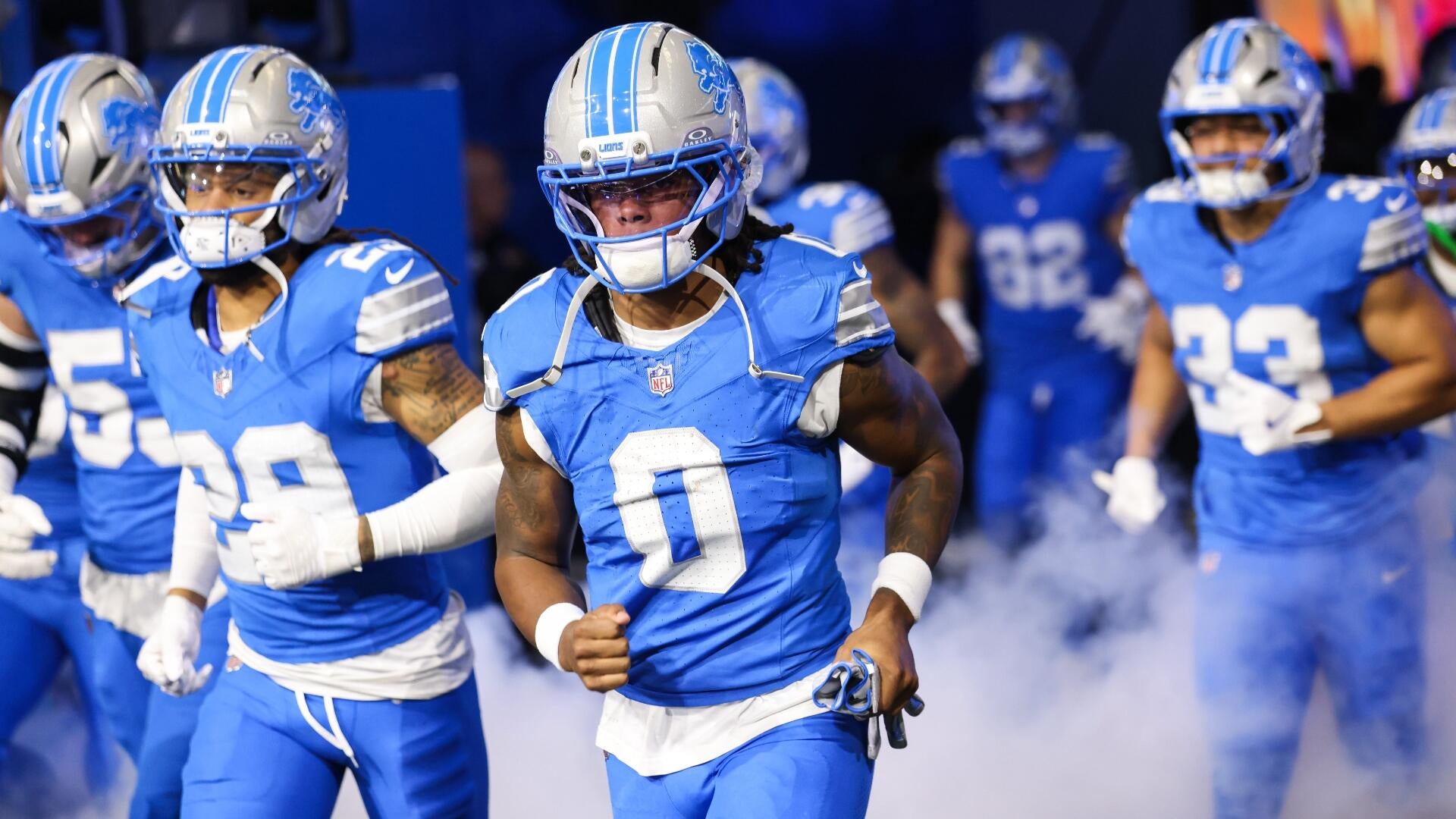
There are likely three candidates for the No. 1 overall pick this season in a one-quarterback, PPR league, and that’s Jahmyr Gibbs, Bijan Robinson or Ja’Marr Chase. While I love Chase, and I’m excited for Robinson with Tyler Allgeier gone in Atlanta, I want Gibbs with David Montgomery now in Houston.
The Lions added Isiah Pacheco to replace Montgomery, but I expect Gibbs to dominate touches this year. Since 2023, Montgomery missed six games due to injury, and Gibbs scored at least 25.4 PPR points in five of them. When Montgomery missed three games in 2024 due to a knee injury, Gibbs averaged 32.6 PPR points over that span.
I’m not going to hesitate to select Gibbs with the No. 1 overall pick in PPR. And that’s what happened here when I had that selection.
This is our 12-part, pick-by-pick series where me, Adam Aizer, Dave Richard, Jacob Gibbs, Dan Schneier and Heath Cummings all took part in a six-person PPR mock draft. We each built two of the 12 teams in this 14-round draft to show you a different strategy from each spot.
This is an outline that you can follow if you pick No. 1 overall in your league. The key is to study the strategy and not necessarily the players to see if this works for you.
The toughest part of picking at No. 1 overall is what happens at the Round 2-3 turn. You’ll likely find most of the top-12 consensus receivers — Chase, Puka Nacua, Jaxson Smith-Njigba, Amon-Ra St. Brown, CeeDee Lamb, Justin Jefferson, Drake London, Rashee Rice, George Pickens, Nico Collins and A.J. Brown — are gone. You might be able to draft Brock Bowers or Trey McBride. And the running backs who could be available might be Derrick Henry, Jeremiyah Love, Josh Jacobs or Kyren Williams. Or you can likely select any quarterback that you want.
If Bowers is there at the turn like he was here then it’s a no-brainer, and I expect him to be the No. 1 Fantasy tight end this season, ahead of McBride. And I like DeVonta Smith as a No. 1 Fantasy receiver, which is why I drafted him with the first pick in Round 3. Smith, with Brown gone in Philadelphia, has top-10 upside (see below).
I love this start with the No. 1 running back, No. 1 tight end and a breakout candidate at receiver. Now, let’s see how the rest of the team turned out.
As a reference point, all touchdowns in this league are worth six points, and we award one point for every 10 yards rushing and receiving and one point for every 25 yards passing. We also award one point for every reception. We feature a starting lineup of QB, 2 RB, 3 WR, TE and FLEX (RB/WR/TE).
Here’s my team from No. 1 overall:
1.1: Jahmyr Gibbs, RB, Lions
2.12: Brock Bowers, TE, Raiders
3.1: DeVonta Smith, WR, Eagles
4.12: D.J. Moore, WR, Bills
5.1: Quinshon Judkins, RB, Browns
6.12: Marvin Harrison Jr., WR, Cardinals
7.1: Carnell Tate, WR, Titans
8.12: Chuba Hubbard, RB, Panthers
9.1: Rico Dowdle, RB, Steelers
10.12: Jalen Coker, WR, Panthers
11.1: Trevor Lawrence, QB, Jaguars
12.12: Matthew Stafford, QB, Rams
13.1: Tyler Allgeier, RB, Cardinals
14.12: Jalen McMillan, WR, Buccaneers
I was ecstatic to get Moore at the end of Round 4, and I’m expecting him to have a standout campaign in Buffalo. He’s reunited with Joe Brady, who was his former offensive coordinator in Carolina, and Moore should thrive being paired with Josh Allen. If Moore wasn’t there, I was probably still drafting a receiver, and I would have selected Mike Evans.
I could have taken Evans with Moore, but I wanted to draft Judkins. He should dominate touches in Cleveland, and it felt like there was a drop-off at the position after him with the next running backs on the board Bucky Irving, Tony Pollard, TreVeyon Henderson and David Montgomery. I like Judkins better than that entire group.
Since this is a three-receiver league with a flex, I wanted to add more options at receiver at the Round 6-7 turn. I’m comfortable enough with only drafting two running backs through this point in the draft, so I selected Harrison and Tate.
I still have hope Harrison can be successful in his third season, and he played well in 2025 with Jacoby Brissett, albeit in a small sample size. There were four games where Harrison played at least 61 percent of the snaps with Brissett, and Harrison scored at least 12.9 PPR points in three of those outings while averaging 14.4 PPR points per game over that span. Harrison also averaged 8.8 targets per game in those four outings.
Tate should be the No. 1 receiver in Tennessee, and he should be the top rookie receiver this year in the NFL. I like my receiving corps a lot now with Smith, Moore, Harrison and Tate, and I was thrilled to get Coker and McMillan with late-round selections, especially with Bowers on this roster.
Running back depth was now a priority at the next turn, and I liked getting Hubbard and Dowdle in Rounds 8 and 9. Hubbard could lose his job to Jonathon Brooks, who sat out 2025 while recovering from a second torn ACL, or Hubbard could revert to his 2024 form when he averaged 16.1 PPR points per game. If the latter happens then Hubbard is the steal of this draft.
I like Jaylen Warren more than Dowdle, but he could still lead the Steelers in carries. Remember, Dowdle started his career in Dallas with new Pittsburgh coach Mike McCarthy, and that relationship could help Dowdle’s workload in 2026.
I added Allgeier in Round 13, and he’s a good lottery ticket to stash on your bench. If something happens to Love then Allgeier could be at least a flex option. This roster came together nicely at running back, receiver and tight end.
Of course, I’ll need quality quarterback play to make it all work, and I loved getting Lawrence and Stafford with late-round picks. Lawrence averaged 30.2 Fantasy points over his final eight games, including the playoffs. And Stafford was the No. 1 Fantasy quarterback for the season at 26.1 points per game.
You might not get a quarterback or quarterback duo of that level after Round 10 in your drafts. But there are plenty of quarterbacks you can wait for this season — Lawrence, Stafford, Jared Goff and Bo Nix all have a CBS Sports Average Draft Position after Round 10 — if you like this strategy.
Favorite pick: Jalen Coker
Tetairoa McMillan is the No. 1 receiver in Carolina, but Coker will be heavily involved in the offense. And he was excellent to close 2025 — even better than McMillan. In their final five games last season, including the playoffs, Coker averaged 14.1 PPR points and 6.0 targets per game. During that same stretch, McMillan averaged 9.8 PPR points and 6.2 targets per game. Coker has the potential to be a top-30 Fantasy receiver this season, and he’s a great reserve to stash on my bench.
Pick I might regret: Marvin Harrison Jr.
As stated above, there’s plenty of upside for Harrison this season, but there’s also plenty of downside. He still shares the field with McBride and Michael Wilson, who performed like a star when Harrison was out in 2025. The run game with Love, Allgeier and a healthy James Conner should drastically improve from last year, which should mean fewer pass attempts for the Cardinals, who led the NFL. And Brissett might not be the starter all season if Arizona wants to see if Carson Beck has any future potential. Harrison is worth drafting in Round 6, but I might regret selecting him over Chris Godwin, who I considered in this spot.
Player who could make or break my team: DeVonta Smith
With Brown gone, Smith is now the No. 1 receiver for the Eagles, and he’s headed for the best season of his five-year career. It’s a small sample size, but Smith has played three games over the past two seasons without Brown, and Smith averaged 16.6 PPR points over that span. More importantly, he averaged 9.7 targets per game, and he should see plenty of opportunities from Jalen Hurts in 2026. Brown will leave behind 8.1 targets per game, and while some of that will go to Makai Lemon and the other new additions at receiver, we expect Hurts and Smith to improve their rapport and propel Smith to stardom. If that happens, then this Fantasy roster could be awesome. But if Smith struggles, then this Fantasy team could be good, but it might not be great.