It might not seem like it, but the 2026 NBA playoffs are already almost halfway over. Through Wednesday, there have been 39 postseason games played; over the past decade, the number of playoff games each year ranged from 79 to 87, with an average of 83 per postseason.
So it’s high time to analyze the most important trends of these playoffs. Let’s run through five key developments of the first round, starting with an in-depth exploration of a significant leaguewide change on the scoreboard.
Jump to a trend:
A sizable scoring slump
Rudy Gobert, redeemed
Bottom-seed Magic
Jayson Tatum’s terrific return
Injury woes

A sizable scoring slump
The most important trend of the playoffs thus far is the massive decline in scoring.
In the regular season, teams scored in double digits — rather than triple digits — in 260 out of 2,460 games, or 11%. But in the playoffs through Tuesday, they’ve been stuck below 100 points in 21 of 72 games, or 29%.
Denver had two sub-100-point games all regular season, then matched that total in back-to-back games in Minnesota last week.
Points production typically declines in the postseason. Since 1983-84, when the NBA moved to 16 playoff teams, postseason scoring has fallen by an average of 2.8 points per game, compared with the regular season.
Editor’s Picks
Updated 2026 NBA mock draft: Who’s rising and falling ahead of the lottery?
Jeremy Woo
Kawhi Leonard trade guide: Four deals that could land the six-time All-Star
NBA insiders
An eight-city, yearlong conversation with LeBron James
Dave McMenamin
2 Related
Yet even against that historical context, the 2025-26 playoffs stand out. Scoring has declined by 8.3 points per team per game this year, which is the third-largest gap in league history.
But wait, there’s more. This postseason, the overall true shooting percentage has declined by 2.3 percentage points compared with the regular season, which is the second largest ever. (The gap in 1978-79 was 2.7%.) And offensive rating has fallen by 4.3 points per 100 possessions, per Basketball Reference, which is the worst decline in any season on record.
The postseason decline in points is typically a function of pace, as the league slows down as the stakes rise almost every year. Indeed, this postseason, 15 out of 16 teams are playing slower than they did in the regular season, with Denver the only exception.
But on a per-possession basis, contrary to popular belief, offensive performance doesn’t actually decline much in the playoffs. After all, while the best defenses tend to make long playoff runs, so too do the best offenses.
From 1973-74 — the first season with per-possession data on Basketball Reference — through last year, the average offensive rating actually increased slightly (0.5 points per 100 possessions) in the playoffs.
Largest Declines in Postseason Offensive RatingsSeasonPlayoff Efficiency Drop*2025-26-4.32003-04-4.12023-24-1.82006-07-1.62024-25-1.5*As measured by points per 100 possessions in the postseason vs. regular season.It’s worth noting two things about this chart, which shows the five largest playoff efficiency drops on record, per Basketball Reference. First, the only other postseason with anywhere near this kind of decline was 2003-04 — which led to immediate rule changes to add more offense.And second, three of the five seasons with the largest playoff efficiency drops are 2023-24, 2024-25 and 2025-26. Increasingly, playoff basketball is looking like a different sport than its regular-season counterpart — although even with that growing disconnect, the last two champions were still the 68-14 Oklahoma City Thunder and 64-18 Boston Celtics, who were the No. 1 overall seeds both years.
But even compared to the last two postseasons, the 2025-26 disparity is much wider. One culprit is an unprecedented shift in shot quality, as defenses are forcing opponents into worse shots in the playoffs.
Through Tuesday’s games, the average shot quality had declined by 1.0 percentage point compared with the regular season, according to an analysis of GeniusIQ data. That’s twice as big as the previous largest drop in the tracking era (since 2013-14), which was 0.5% last postseason. In general, regular-season and postseason shot quality tend to track fairly closely, but there’s a meaningful drop in the playoffs this year.
Shot Quality Change from Regular Season to Playoffs
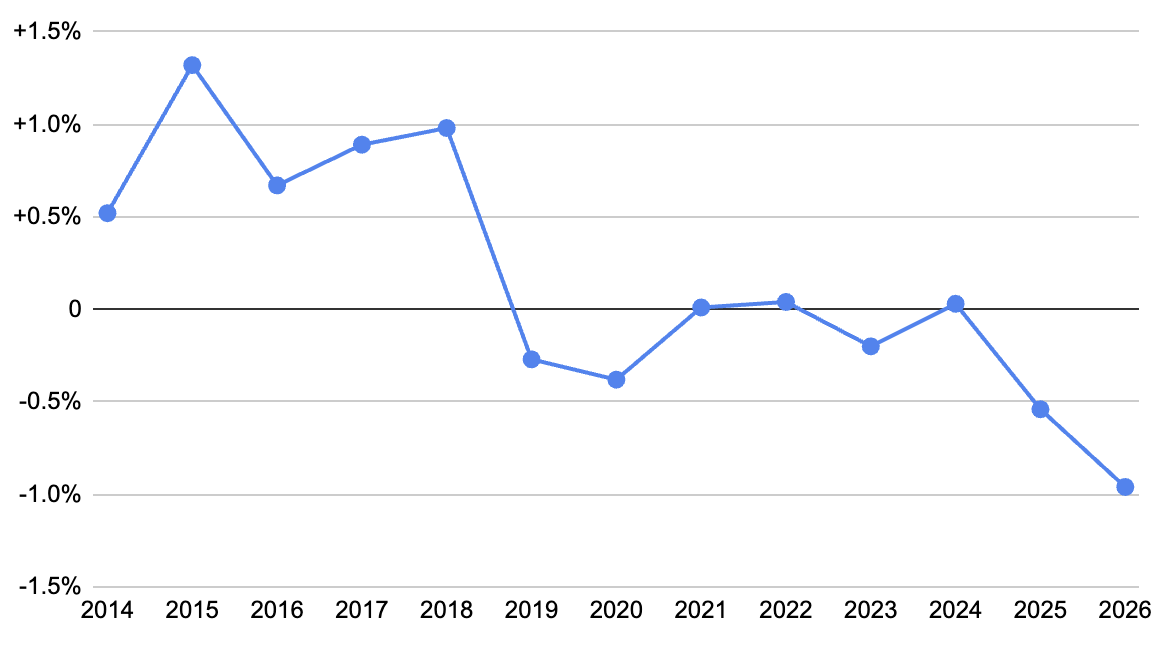
If that trend continues, then scoring will likely remain deflated for the remainder of the postseason. So expect more grind-it-out games with point totals in the 90s in May and June, rather than the 130-point outbursts that have dominated the league landscape for the past six months.
Rudy, redeemed
One of the brightest individual storylines of the first round is the redemption of Rudy Gobert, who has always been more maligned than one would expect of a four-time Defensive Player of the Year.
But even his greatest critics must give credit where it’s due, and Gobert’s performance against Nikola Jokic and Denver’s offensive machine deserves it.
The Denver Nuggets scored a league-leading 121.1 points per 100 possessions in the regular season. But they’re down at 108.7 in the playoffs, which would have ranked 29th in the regular season. Put another way, Gobert, Jaden McDaniels and friends have combined to make the Nuggets’ offense look worse than the Wizards’.
Upcoming NBA games on ESPN/ABCThursday, April 30
Knicks at Hawks, Game 5: 7:00 p.m. ET (ESPN)
Nuggets at Timberwolves: 9:30 p.m. ET (ESPN)
En route to the Minnesota Timberwolves’ 3-2 series lead — albeit a tenuous one, given the injuries to Anthony Edwards and Donte DiVincenzo — Gobert specifically stands out via his one-on-one play against Jokic. The three-time MVP has a mere 36% effective field goal mark on 65 shots when matched up against Gobert, according to GeniusIQ. That’s Jokic’s worst eFG% against any individual defender in a series (minimum 30 shot attempts, for a sample size of 19 opponents) in his playoff career.
Yet Gobert has always been a positive contributor in the playoffs, even amid the angst about his limitations. For instance, everyone remembers Luka Doncic’s game winner in Gobert’s face in the 2024 Western Conference finals. But what people probably don’t remember is that throughout that postseason, the Timberwolves dominated the minutes that Gobert played and were themselves dominated when he sat.
Overall, across Gobert’s four postseasons with Minnesota, the team has a net rating that’s 7.8 points higher with Gobert on the court versus when he’s off, per databallr. That’s the second-best margin on the team, behind only McDaniels’ 8.9.
Before that, Gobert had a plus-10.9 on/off differential over his last three postseasons with the Jazz, which was the best mark in Utah’s rotation in that span. (He had been worse earlier in his career, to be fair.) Those are star-level numbers, and Gobert remains a significant force, even if he’s still searching for his first Finals appearance and — because of his team’s injuries — unlikely to find it this spring.
Bottom-seed Magic
On a team level, the brightest storyline of the first round resides in Orlando, where the eighth-seeded Orlando Magic are making up for an erratic, disappointing regular season with a 3-2 playoff lead against the top-seeded Detroit Pistons. The Magic are one win away from the seventh 8-over-1 upset in NBA history.
There weren’t any realistic indications of this upset possibility before this series began. If you remove garbage time, the Magic were actually outscored this season, per Cleaning the Glass, while the Pistons had the third-best net rating in the league, behind only the Thunder and Spurs. Detroit had a better offense, a better defense and two more All-Stars than Orlando.
However, it would not have been a surprise before the season for Orlando to beat Detroit in a playoff series. The Magic had an over/under of 51.5 wins, according to Basketball Reference, and the Pistons were at 46.5.
That made Orlando the sixth No. 8 seed this century — and the first since 2009 — with a higher preseason over/under line than the No. 1 seed it faced in the first round.
Somewhat surprisingly, though, those No. 1 vs. No. 8 matchups ended up just as lopsided as the average No. 1 vs. No. 8 series. In the five previous instances with a worse preseason projection for the No. 1 seed, the No. 1 seeds still went 19-5 in individual games, for a 79% win rate. For comparison, No. 1 seeds this century have a 74% win rate overall.
YearNo. 1 SeedNo. 8 SeedResult2002NetsPacers3-2 Nets2003PistonsMagic4-3 Pistons2005SunsGrizzles4-0 Suns2008LakersNuggets4-0 Lakers2009CavaliersPistons4-0 Cavaliers2026PistonsMagic3-2 Magic so farCoincidentally, one of the previous instances involved the top-seeded Pistons and eighth-seeded Magic, back in 2003. In that series, Orlando won Games 1, 3 and 4 before losing the 3-1 series lead — and 23 years later, history might be repeating itself, as Orlando won Games 1, 3 and 4 but squandered its first chance to close out the series on Wednesday.
Eliminating Detroit with one more victory won’t be easy, especially after Franz Wagner missed Game 5 because of a right calf strain. Wagner had been Orlando’s primary defender on Cade Cunningham through four games, and Cunningham scored 45 points — a Pistons franchise playoff record — against other defenders in Game 5.
Tatum’s terrific return
Another comeback story is taking place in Boston: Although the Boston Celtics are surprisingly still stuck in their first-round series with the Philadelphia 76ers, with a 3-2 series lead instead of already clinching advancement, that’s not the fault of Jayson Tatum.
Less than a year ago, Tatum tore his right Achilles tendon in New York during Game 4 of the Eastern Conference semifinals. But somehow, he hasn’t just rebounded to his old form this postseason — he has improved.
This chart compares Tatum’s statistics through five games in the 2025-26 playoffs with his performance from 2022 through 2025, when he was a first-team All-NBA honoree four years in a row.
Statistic2022-25 Playoffs2026 PlayoffsPoints26.224.6Rebounds9.110.6Assists5.87.6Turnovers3.32.82P%49.7%59.5%3P%34.4%37.0%TS%56.6%61.6%PER20.425.5His scoring has dropped a bit, but he’s now averaging more rebounds, more assists and fewer turnovers per game on much better efficiency. With this version of Tatum in the starting lineup, Boston remains the favorite to win the East, even if its first-round matchup has been trickier than expected.
Injury woes
Let’s end with a downer, to balance out the emotional highs of Tatum’s comeback: One unavoidable trend in this postseason is other stars missing games. Victor Wembanyama missed one full game and most of a second because of a concussion. Edwards has missed a game and a half, and counting, because of a left knee injury. Luka Doncic hasn’t played at all in the postseason after suffering a hamstring injury. And Kevin Durant has appeared in just one game because of knee and ankle problems.
Four All-Stars missing games in the same postseason isn’t close to the record — in 2020-21, 10 different All-Stars did — but that raw count undersells the impact of injuries on the playoffs thus far. Wembanyama, Edwards, Doncic and Durant aren’t ordinary All-Stars; they’re the elite of the elite, including two players who are sure to place on the All-NBA first team this year. And Wembanyama is the only member of that group whose absence was limited to a single game.
Moreover, beyond the class of 2026 All-Stars, key players who have missed games this postseason include Jalen Williams, Austin Reaves, Aaron Gordon, Peyton Watson, DiVincenzo, Mark Williams, Joel Embiid and Franz Wagner. That’s a full roster’s worth of stars, near-stars and vital role players who are stuck recuperating on the bench instead of helping their teams and entertaining fans across the world.
For as long as basketball involves human bodies stretching to — and sometimes past — their physical limits, injuries will continue. But some years, that problem concentrates more severely than others. And the missing stars can’t help but cast a shadow over the 2025-26 playoff field.