It’s become a trend in recent years to avoid running backs on Draft Day and focus on wide receivers. Receivers are generally considered to be safer based on health, along with the volatility of the running back position given the amount of tandems and committees around the league.But as defenses have tried to take away big plays in the passing game, we’ve seen more teams become reliant on the run game in recent years. For example, in 2021 there were 17 teams that averaged at least 26 rushing attempts per game. That number jumped to 21 teams in 2025.It’s not a huge leap, but it does show run games making a resurgence in the NFL — and for Fantasy managers. It’s OK to lean into running backs once again.
With that in mind, you should go into your Fantasy draft with a plan of when to select your running backs. My favorite strategy in half-PPR remains Hero-RB — drafting one running back in the first two or three rounds and then attacking the position with mid-round picks — but I’m not opposed to starting RB-RB depending on your draft spot.
I don’t love Zero-RB this season, but it can still work. You just have to know when to start drafting your running backs. And that’s where tiers come into play.
These are running back tiers you can follow on Draft Day, and they are a better guide than just going down a rank list. I’ll tell you the round range for these running backs, as well as some stats of note, and this blueprint should help you dominate your league.
Tier 1
Early Round 1
Jahmyr Gibbs
Bijan Robinson
With David Montgomery gone, Gibbs could be amazing for Detroit and Fantasy managers. Over the past three seasons, Montgomery missed six games due to injury, and Gibbs scored at least 21.5 half-PPR points in five of them. When Montgomery missed three games in 2024 due to a knee injury, Gibbs averaged 29.1 half-PPR points over that span. Isiah Pacheco could be an issue, but I’m not overly concerned. Gibbs could break Fantasy this year.
Robinson was awesome in 2025 with 287 carries for 1,478 yards and seven touchdowns, and he added 79 catches for 820 yards and four touchdowns on 103 targets. He should continue to have a prominent role in the passing game thanks to Tua Tagovalioa, who helped De’Von Achane get 172 targets over the past two seasons for 145 catches, 1,080 yards and 10 touchdowns. And new coach Kevin Stefanski should continue to feed Robinson on the ground. I plan to draft Robinson at No. 2 overall in all leagues.
Tier 2
Middle to the end of Round 1
Jonathan Taylor
Christian McCaffrey
Chase Brown
Ashton Jeanty
James Cook
Taylor averaged 25.2 half-PPR points through the first 10 games of the season in 2025 when Daniel Jones was healthy. Taylor never eclipsed 15.5 half-PPR points in the final seven games of the season after Jones suffered a broken leg and then ruptured his Achilles. We hope Jones is back at 100 percent this year, and Taylor will hopefully perform like the running back we saw in the first half of 2025. He also set a career-high with 46 receptions last year, which would be great if he could replicate that in 2026.
Last season, McCaffrey was the No. 1 non-quarterback at 20.7 half-PPR points per game, with 311 carries for 1,202 yards and 10 touchdowns and 102 catches for 924 yards and seven touchdowns on 129 targets. All of his receiving stats were the best among running backs in 2025. He also added 26 carries for 83 yards and 11 catches for 105 yards and two touchdowns on 14 targets in two playoff games. In total, McCaffrey had 450 total touches in 19 games, and that’s a lot of work. He turned 30 in June, so there are red flags for his Fantasy value this season. That mentioned, not many players, let alone running backs, can do what McCaffrey does in Kyle Shanahan’s offense. He’s risky, but I would still gamble on McCaffrey in the back half of Round 1.
Brown scored at least 16 half-PPR points in four of his final five games, which coincided when Joe Burrow returned from his toe injury. For the season, Brown had 1,016 yards and six touchdowns on 232 carries and was sixth among running backs with 437 receiving yards, while adding five touchdowns on 69 catches with 88 targets. He’s in a contract year, and Brown is worth drafting in Round 1.
Jeanty only averaged 12.1 half-PPR points per game as a rookie, which made him a bust, but he should rebound in his sophomore campaign. He was No. 9 in total touches in 2025 with 321 (266 carries), and his 55 receptions were No. 7 among running backs. I’m excited about Klint Kubiak taking over as the head coach, and the quarterback play in Las Vegas should be improved with the duo of Fernando Mendoza and Kirk Cousins. Most importantly, the offensive line should be better with a healthy Kolton Miller at left tackle and the free agent addition of center Tyler Linderbaum. Jeanty should challenge to be a top-five Fantasy running back this season.
Cook led the NFL in rushing yards in 2025 with 1,621. He was third in carries (309), tied for fifth in rushing touchdowns (12) and also managed 33 receptions for 291 yards and two touchdowns on 40 targets. We hope he’s more involved in the passing game with offensive coordinator Joe Brady now the head coach, but the recent history of rushing leaders isn’t ideal. Since 2020, the rushing champ — Derrick Henry, Taylor, Josh Jacobs, McCaffrey and Saquon Barkley — had their rushing yards decrease by at least 848 the next year. And they had a decline by at least six touchdowns. Only Barkley played a full season the following year with Henry and McCaffrey getting hurt. That mentioned, Cook still warrants enough upside to draft toward the end of Round 1.
Tier 3
Round 2
Kenneth Walker III
Omarion Hampton
De’Von Achane
Derrick Henry
Saquon Barkley
Walker scored at least 16 half-PPR points in all three postseason games for the Seahawks and now becomes the lead running back for the Chiefs. We’ll see how much he shares work in Kansas City, but Walker’s track record with a quality workload is impressive. For example, in 2025, he had 12 games with at least 13 carries and averaged 14.1 half-PPR points per game. He’s expected to have a big role in the passing game, and in 2024 he was on pace for 71 receptions in Seattle. Draft him in early Round 2.
I’m excited about Hampton this season with Mike McDaniel calling plays, as well as having offensive tackles Rashawn Slater (knee) and Joe Alt (ankle) healthy. Hampton scored at least 21 half-PPR points in two of his first five games before suffering an ankle injury that cost him seven contests. He returned in Week 14 and scored at least 13 half-PPR points in three of his final four outings. I wouldn’t be surprised if Hampton finished as a top-five Fantasy running back this year.
Achane makes me nervous with McDaniel and Tagovailoa gone. I’m worried Achane won’t be as successful in the passing game with Malik Willis under center, and the Dolphins offense could also be miserable with a projected win total of 4.5. That mentioned, we know Achane is a home-run threat every time he touches the ball, and he’s had at least 11 total touchdowns in every year of his career and at least 60 catches in each of his past two seasons. I’m OK with drafting him in Round 2.
In two seasons in Baltimore, Henry has averaged 316 carries for 1,758 yards and 16 touchdowns and 17 catches for 172 yards and one touchdown. He’s 32 but has showed no signs of slowing down. We’ll see what happens with a new offensive system under Declan Doyle, and Linderbaum being gone could hurt the offense. But until Henry shows signs of a decline then he’s worth drafting in Round 2.
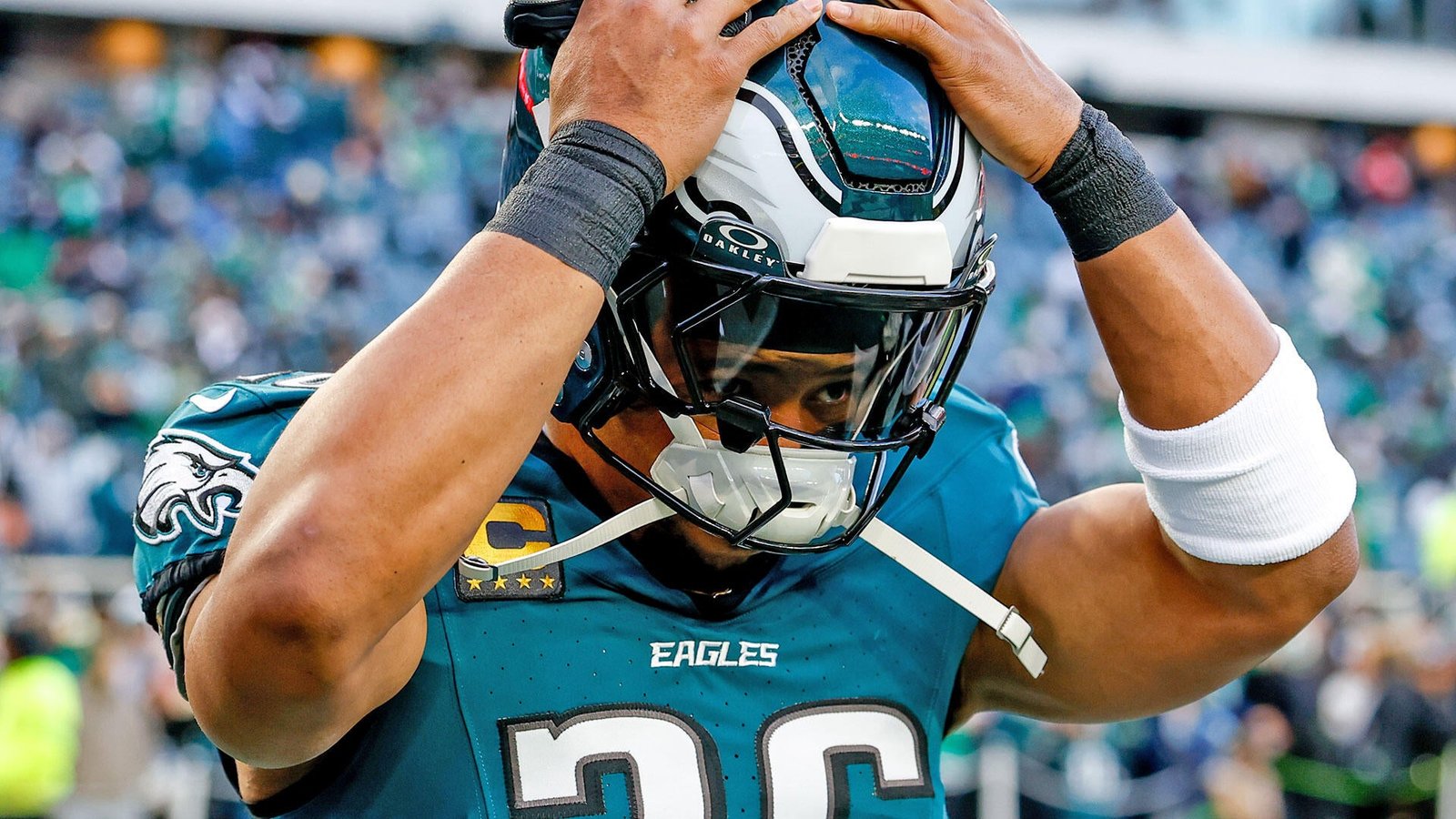
Barkley was a bust in 2025 when he averaged 12.7 half-PPR points per game after he was at 20.3 half-PPR points in 2024. Philadelphia’s offensive line should rebound this season, and Barkley is expected to be more involved in the passing game for new coordinator Sean Mannion. There’s reasons for optimism with Barkley this year, but he’s only worth selecting in Round 2.
Tier 4
Round 3
Josh Jacobs
Kyren Williams
Jeremiyah Love
We’re keeping an eye on the legal situation for Jacobs after he was arrested in May on five charges related to an alleged domestic situation, and we’ll see if he can play in 2026 without any issues. He’s also dealing with a groin injury in training camp. Jacobs was No. 8 last season at 13.9 half-PPR points per game, and he has top-10 upside again in 2026 if he plays the full season.
Williams is expected to once again lose work to Blake Corum this year, but Williams still has the potential to be a top-10 Fantasy running back. In three years as the lead running back for the Rams, Williams has averaged 15.4 half-PPR points per game, and he has at least 1,480 total yards, 34 receptions and 13 total touchdowns in each of the past two years. Corum lowers the ceiling for Williams, but Round 3 is the right spot for him.
Love could have a problem reaching his potential since the Cardinals have Tyler Allgeier, James Conner and Trey Benson on the roster, but Love was still the No. 3 overall pick in the NFL Draft this season for a reason. He’s going to get work, and he finished the past two seasons at Notre Dame with a combined 362 carries for 2,497 yards and 35 touchdowns and 55 catches for 517 yards and five touchdowns in 28 games while sharing touches with Jadarian Price. There’s top-10 upside here if the workload is high, and it’s worth the gamble in Round 3 to see if Arizona will lean on Love in his rookie campaign.
Tier 5
Rounds 4 and 5
Javonte Williams
Breece Hall
Cam Skattebo
Quinshon Judkins
D’Andre Swift
Travis Etienne
David Montgomery
Williams started hot in 2025 with at least 16.5 half-PPR points in six of his first nine games, but he never reached that total again in his final seven outings. The Cowboys brought in no competition for Williams, and he should once again be a workhorse. I would draft him as early as the end of Round 3.
Hall had the worst season of his career in 2025 at 11.1 half-PPR points per game despite his first 1,000-yard campaign. He only scored five total touchdowns, and his role in the passing game was reduced with just 48 targets. I’m hopeful that part of his game bounces back — he averaged 85.5 targets the previous two seasons — and the Jets offense should improve under new coordinator Frank Reich. Hall still has top-12 upside, and he’s worth drafting early in Round 4.
Skattebo (ankle) appears on track for Week 1 after getting injured in Week 8 last season, and hopefully he can pick up where he left off prior to getting hurt. Last year, his rookie campaign got off to a great start when he scored at least 12 half-PPR points in four of his first seven games. He was on pace for 56 receptions prior to Week 8, and he should be a solid No. 2 running back worth drafting in Round 4 of 5.
Judkins (ankle) should be fine for Week 1, and he’s a candidate to lead the NFL in rush attempts this season if he stays healthy. New Browns coach Todd Monken should make Judkins the centerpiece of his offense in 2026, and Judkins scored at least 12.5 half-PPR points in six of eight games as a rookie when he had at least 15 carries. I’ll reach for Judkins in Round 4, but I would prefer to get him in Round 5.
Swift had the second-best season of his career in 2025 at 12.4 half-PPR points per game, and he finished with 223 carries for 1,087 yards and nine touchdowns, along with 34 receptions for 299 yards and a touchdown on 48 targets. He’ll continue to share touches with Kyle Monangai, but Swift should once again excel in Ben Johnson’s offense. He’s a great value pick in the early part of Round 5.
I’m a little nervous about Etienne in New Orleans this year, especially since Alvin Kamara will remain on the roster. Kamara should work on passing downs, and we’ll see how much that hinders the production for Etienne. He was great in 2025 with the Jaguars when he averaged 13.0 half-PPR points per game. But keep in mind he only has two seasons in his career over that average, and he was miserable in 2024 when he averaged a career-low 6.6 half-PPR points. Kamara’s presence lowers the ceiling for Etienne, which is why I would only draft him in Round 5.
Montgomery had the worst season of his career in 2025 at 8.5 half-PPR points per game, but he should rebound in 2026 now that he’s in Houston. Reports this offseason suggest Montgomery will be the featured back for the Texans, and he was solid once upon a time as the lead rusher for Chicago when he averaged at least 12.5 half-PPR points in two of his first four seasons in the NFL. He’s 29 now, but Montgomery has the potential for 1,200 total yards and 10 touchdowns. He even averaged over two receptions a game for the past two years in Detroit. Montgomery is a solid pick toward the end of Round 5.
Tier 6
Rounds 5 and 6
Bucky Irving
Bhayshul Tuten
Jadarian Price
TreVeyon Henderson
Tony Pollard
Irving is a tricky running back to rank because he could be awesome — he averaged 12.3 half-PPR points as a rookie in 2024 and 14.9 half-PPR points in the first four games last season — or he could be in a committee with Kenneth Gainwell and Sean Tucker. I love that Irving is healthy after dealing with a shoulder injury earlier this offseason, but Gainwell will steal work on passing downs, with Tucker potentially being a touchdown vulture. The right spot to draft him is Round 5, and hopefully he’s not a trap back this season.
Tuten should be the No. 1 running back for the Jaguars, but reports out of training camp suggest he could lose passing-downs work to LeQuint Allen and goal-line work to Chris Rodriguez Jr., which isn’t ideal. Tuten could also prove so dynamic that he doesn’t come off the field. Etienne leaves behind 296 total touches (260 carries) from 2025, and we expect Tuten to get the majority of work in this explosive offense. That mentioned, Tuten struggled last year in a part-time role and averaged just 4.9 half-PPR points per game. He’s worth the upside play in Round 6.
Price was having a strong start to training camp before missing practice with “lower-body soreness,” and coach Mike Macdonald mentioned “it’s a minor issue.” That’s good because we want to see Price ready to go for Week 1. He might not have a long leash as the starter if Zach Charbonnet (knee) returns early in the season, and George Holani should also share touches with Price. But there’s potentially a big role for Price if Charbonnet remains out with Walker gone (405 carries and 51 receptions left behind from 2025). He wasn’t a full-time running back at Notre Dame because of Love, but Price could be a RB2 worth drafting in Round 6.
Henderson’s Average Draft Position on CBS Sports is Round 5, but the earliest I would draft him is Round 6. While I would love to rank him higher and see him perform like a standout Fantasy option, he might have a Rhamondre Stevenson problem for the second year in a row. As a rookie in 2025, Henderson played in 18 games with Stevenson, including the playoffs, and Henderson scored more than 8.5 half-PPR points just three times. There’s no denying his upside — he averaged 22.0 half-PPR points in three games Stevenson was out — but don’t overvalue Henderson on Draft Day if Stevenson is healthy.
Pollard averaged 100 rushing yards per game in his final five outings last season, as well as 14.2 half-PPR points per game over that span. We’ll see if he can pick up where last year ended, and the new offense in Tennessee under coordinator Brian Daboll should be favorable for Pollard. He’s a good flex option to target in Round 6 or a low-end RB2 if you wait on the position.
Tier 7
Rounds 7-9
Rhamondre Stevenson
Jaylen Warren
Jonathon Brooks
Chuba Hubbard
Rico Dowdle
J.K. Dobbins
Jacory Croskey-Merritt
Rachaad White
Stevenson outplayed Henderson last season and could do so once again. As noted above, Henderson has more upside than Stevenson, which is why Henderson is in a higher tier. But Stevenson can still be a solid flex play, and he scored at least 13.5 half-PPR points in five of his final seven games in 2025, including the playoffs.
The Steelers backfield is one to monitor throughout training camp with Gainwell now in Tampa Bay. Dowdle has a history with new coach Mike McCarthy going back to their time in Dallas, and that could make Dowdle the starter. Warren is coming off a career season in 2025 at 11.6 half-PPR points per game, but he could become the pass-catching back, which is important for Aaron Rodgers. Given that potential, I favor Warren over Dowdle, but I like both as flex options. I would draft Warren in Round 7 and Dowdle in Round 8.
I started the offseason with Hubbard as my favorite Carolina running back, but there’s too much momentum for Brooks to ignore. Now, I would draft Brooks in Round 7 and Hubbard in Round 8. Brooks hasn’t played since 2024 after he suffered a torn ACL in his right knee for the second time, and he has just three NFL games on his resume. But all reports suggest he looks 100 percent, and he has the chance to be special if given enough work. In 2023 at Texas, Brooks had 187 carries for 1,139 yards and 10 touchdowns and 25 catches for 286 yards and one touchdown in 11 games. That mentioned, Hubbard isn’t going away, and he could also be a flex option in tandem with Brooks. In 2024, Hubbard averaged 14.1 half-PPR points per game, and he could be a starter in all formats if Brooks gets hurt again.
The Broncos could use three running backs this season with Dobbins, RJ Harvey and rookie Jonah Coleman, which might make it hard to trust any of them. Harvey has the most upside of this trio, but he struggled last season until Dobbins suffered a foot injury in Week 10. Dobbins scored at least 13 half-PPR points in five of his first eight games last year, and I prefer him over Harvey and Coleman in this format. I would draft Dobbins as early as Round 8.
The Commanders’ backfield is another one to watch in training camp, and I expect Croskey-Merritt to be the starter. He closed last season on a high note with at least 15 half-PPR points in two of his final four games. Reports in training camp suggest Croskey-Merritt could have a role in the passing game, which is important, because White has three seasons on his resume with at least 50 catches in Tampa Bay. Most likely, both will split work, but Croskey-Merritt has more upside. Neither should be drafted before Round 8.
Tier 8
Rounds 9 and 10
Jordan Mason
Blake Corum
Kyle Monangai
Kenneth Gainwell
RJ Harvey
Mason has the chance to be the lead running back for the Vikings, and I would draft him ahead of Aaron Jones. We’ll see what happens throughout training camp, but Mason, 27, is the better rusher than Jones, 31, at this point. Mason has averaged at least 4.8 yards per carry in every year of his career, but don’t expect much from him in the passing game. In four seasons he has 28 catches for 173 yards on 34 targets.
Corum has the chance to be a flex option in tandem with Kyren Williams, and Corum scored at least 11.5 half-PPR points in four of his final six games in the regular season in 2025. Corum would also be a potential top-15 Fantasy running back if Williams were to miss any time. But I don’t want to overvalue Corum, and he should only be drafted in Round 9 or later.
Monangai should have the chance to perform like a flex, and he’ll be a top-15 Fantasy running back if Swift gets injured. Just keep in mind that when Swift was healthy, Monangai scored more than 8.0 half-PPR points just five times in 18 games, including the playoffs. He should only be drafted in Round 9 or later.
Gainwell is expected to split work with Irving, with Gainwell working on passing downs. He just had 73 catches for 486 yards and three touchdowns on 85 targets in Pittsburgh in 2025, and Tampa Bay offensive coordinator Zac Robinson should keep Gainwell heavily involved as a receiver with the Buccaneers. Gainwell is also an underrated rusher since he had 114 carries for 537 yards and five touchdowns for the Steelers. Tucker will also be in the mix, which lowers the ceiling for Gainwell, but he’s a good flex option worth drafting in Round 9.
Harvey scored at least 15.5 half-PPR points in four of his final six games in the regular season, but that was when Dobbins was sidelined with a foot injury. Harvey scored more than 7.5 half-PPR points just three times in his first 10 games of his rookie campaign. Now, Coleman makes this backfield even more crowded, and Harvey doesn’t have the luxury of being a solo act if Dobbins were to miss any time. I wouldn’t draft Harvey before Round 9.
Tier 9
Rounds 10 and 11
Tyrone Tracy Jr.
Chris Rodriguez Jr.
Aaron Jones
Tracy is one of the best handcuffs you can target in Round 10 or later since Skattebo is coming off a broken ankle from last year. And the Giants want to be a run-heavy team, which means Tracy might get more work than expected in tandem with Skattebo. Last year, Tracy closed the season with at least 13.5 half-PPR points in four of his final seven games, and he would have top-20 upside if Skattebo were to miss any time again in 2026.
Rodriguez seems destined to start the year as a short-yardage option and backup to Tuten, but his role could increase as the season goes on. Last year in Washington, Rodriguez had seven games with at least 10 carries, and he scored at least 10 half-PPR points in four of them. The drawback for Rodriguez is he has six career catches in three seasons. For now, consider him a high-end handcuff with the potential to score touchdowns in a potent offense.
Jones could drop a tier if the Vikings make it official that Mason is the starter. Jones could also move up a tier if Minnesota remains committed to him as the No. 1 option. No matter who starts, Jones should continue to work on passing downs, which still gives Jones flex appeal in deeper leagues.
Tier 10
Rounds 11 or later
Isiah Pacheco
Zach Charbonnet
Woody Marks
Tyler Allgeier
Dylan Sampson
Tyjae Spears
Keaton Mitchell
Pacheco is the now the handcuff for Gibbs, but Pacheco could still help Fantasy managers if he gets the goal-line work that Montgomery left behind in Detroit. Montgomery scored 33 rushing touchdowns over the past three seasons, and if Pacheco gets those chances then he might have flex appeal in deeper leagues. He’s dealing with a knee injury in training camp, but Pacheco should be ready for Week 1.
Charbonnet’s timeline from the torn ACL suffered in the divisional round of the NFL playoffs last year will determine his Fantasy value, but don’t expect him to help Fantasy managers early in the season. At best, he could make an impact later in the year, but he will still share carries with Price and have limited upside in 2026. Hopefully, if healthy, Charbonnet could be a nice surprise in the playoffs, and you can stash him on IR in the meantime.
Marks had some solid games for the Texans as a rookie in 2025 when he was the lead running back, but he also failed to impress enough to keep the starting job. Montgomery has pushed Marks to No. 2 on the depth chart, but Marks should get chances to make plays in the passing game. He could be a surprise flex option in deeper leagues, and Marks had 261 catches in five seasons over 57 games at Mississippi State and USC.
I would love the Cardinals to trade Conner and leave Allgeier in the No. 2 role behind Love, but this backfield could be messy. That mentioned, Allgeier will likely be the short-yardage and goal-line back for Arizona, and he scored eight rushing touchdowns in 2025 for the Falcons. It will be interesting to see what the Cardinals do if Love misses any time with how Allgeier and Conner would work in tandem.
There are two ways where Sampson can help Fantasy managers this season. Most importantly, he could be a flex option if Judkins suffers a setback coming off last year’s broken ankle. And the Browns could use Sampson more in the passing game. Last year, Sampson had five games with at least three catches, and he could end up being a surprise receiver out of the backfield in 2026 if things go right.
Spears should be the No. 2 running back for the Titans this year behind Pollard, but we’ll see how much they use rookie Nicholas Singleton as well. In 2025, Spears played in 13 games and had 45 catches for 264 yards on 50 targets. He has the potential to be one of the better pass-catching running backs this year.
McDaniel made it a point to want Mitchell on the Chargers this season, which could make him the No. 2 running back behind Hampton. Now, that doesn’t mean Mitchell would take over for Hampton if an injury occurred — we still expect Kimani Vidal to handle that role — but Mitchell could work in tandem with Hampton and play on passing downs. Mitchell is a good late-round flier, but don’t overvalue him in half-PPR leagues.
Tier 11
Handcuffs to target with late-round fliers
Ray Davis
MarShawn Lloyd
George Holani
Jonah Coleman
Alvin Kamara
Tank Bigsby
Brian Robinson Jr.
Mike Washington Jr.
Jaydon Blue
James Conner
Kimani Vidal
Emmett Johnson
Jordan James
Kaelon Black
Demond Claiborne
Jaylen Wright
Nicholas Singleton
Kaytron Allen
Braelon Allen