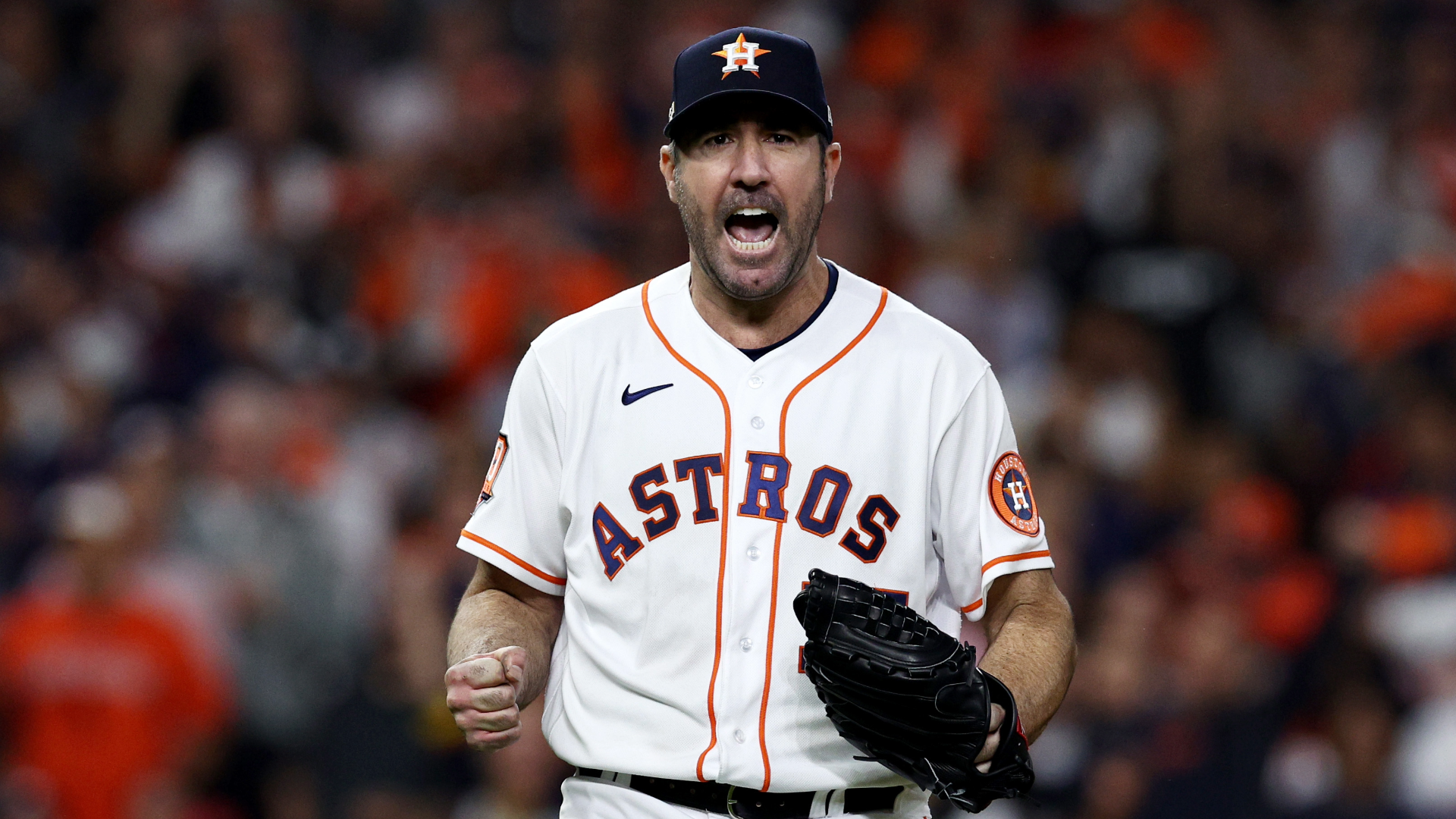
The term “generational talent” gets thrown around in sports. We use it to signal that the player is an all-time great talent and has a shot to become a Hall of Famer someday. It was applied to Justin Verlander many times, and it was correct. He’s the best pitcher of his generation.
It’s a stacked generation of pitchers, too. He crossed over with the careers of many Hall of Famers and future Hall of Famers and fringy “Hall of the Very Good” types. In his first All-Star Game, he was rostered with CC Sabathia and Johan Santana while the National League had John Smoltz, Cole Hamels, Trevor Hoffman and Billy Wagner. In 2022, he was there with Gerrit Cole. This time, we’ll see him along with the likes of Paul Skenes and Chris Sale. Along the way, he’s also pitched in the same years as guys like Greg Maddux, Roger Clemens, Randy Johnson, Pedro Martinez, Mike Mussina and Tom Glavine down through Jacob deGrom and Zack Wheeler.
Verlander’s career is often tied into all-time great discussions with Clayton Kershaw and Max Scherzer, and possibly Zack Greinke. For good reason. Their primes were mostly aligned and all four hit most or all Hall of Fame standards. Verlander is the best of the bunch, too. Let’s rack them up.
| Pitcher | WAR | W-L | ERA/ERA+ | WHIP | K | IP |
|---|---|---|---|---|---|---|
|
Justin Verlander |
82.3 |
266-159 |
3.33 (128) |
1.14 |
3,554 |
3,571 ⅓ |
|
Clayton Kershaw |
78.1 |
223-96 |
2.53 (154) |
1.02 |
3,052 |
2,855 ⅓ |
|
Max Scherzer |
73.8 |
222-121 |
3.27 (129) |
1.09 |
3,503 |
2,985 |
|
Zack Greinke |
72.4 |
225-156 |
3.49 (121) |
1.17 |
2,979 |
3,389 ⅓ |
These are all Hall of Famers, but Verlander is, again, the top of the stack. Kershaw was better on a rate basis, but Verlander accumulated more production due to his relative durability and longevity. The combination of dominance and longevity is what makes him truly special and gives me reason to rank him above Kershaw.
Verlander has a case to be called one of the greatest pitchers of all time. He sits 24th in pitcher WAR, but in adjusted WAR — to account for the absurdly high innings totals racked up in the 19th and early 20th centuries — he’s 12th behind, in order, Walter Johnson, Clemens, Randy Johnson, Lefty Grove, Martinez, Maddux, Tom Seaver, Christy Mathewson, Bob Gibson, Cy Young and Grover Alexander.
Only Clemens finished in the top five of Cy Young voting more often (10 times; Verlander, Maddux and Randy Johnson nine times). The only pitchers with more Cy Youngs than Verlander’s three are Clemens (seven), Randy Johnson (five), Maddux (four) and Steve Carlton (four). Verlander was jobbed in 2016 when Rick Porcello beat him by five voting points despite Verlander getting six more first-place votes and having the objectively superior season.
Verlander is also one of 25 pitchers in history to win the MVP.
The 266 wins in this era are spectacular and staggering. Among active players, Scherzer is second at 222 and Cole is third with 154. Sale is the only other pitcher over 150. deGrom recently won his 100th game.
Verlander is seventh all-time in strikeouts and has a decent shot to move into sixth before the year is up. He’ll finish behind, in order, Nolan Ryan, Randy Johnson, Clemens, Carlton, Bert Blyleven and Seaver. Don Sutton is only 20 ahead of Verlander for sixth place. Every pitcher ahead of Verlander on this list is well above 4,000 innings, with Ryan, Carlton and Sutton over 5,000. Verlander will end up in the 3,600s.
Let’s look at win probability added, which does exactly what it says: it takes the win probability of each game and figures out how much a player added or took away the probability of his team winning. Verlander is 23rd all-time among pitchers, and a good number of the guys ahead of him had really heavy workloads — and, thus, more opportunities to increase their teams’ chances of winning (to be fair, we should note that Kershaw has him beat here).
On top of all this, Verlander was a stalwart in many a postseason. He made the playoffs 10 different times and was part of the rotation — usually the ace — on five different pennant winners and two World Series champions. He was the ALCS MVP in 2017 after putting the Astros’ pitching staff on his back down the stretch. Overall, he was 17-12 with 244 strikeouts in 226 innings over the course of 38 playoff appearances. He won a playoff game at age 23 and one at age 40.
Again, the dominance and longevity combination rears its head.
In a sea of impressive feats, I think the biggest one was Verlander’s 2022 season. He was 39 and had missed all of 2021 after undergoing Tommy John surgery. In 175 innings, he had a 1.75 ERA and 0.83 WHIP, a career-best ERA among his qualified seasons. He won the Cy Young. At age 39. Coming off major elbow surgery. He became the fourth-oldest pitcher ever to win the award after Clemens (42 in 2004), Gaylord Perry (40 in 1978) and Early Wynn (39 in 1959; only 40 days older than Verlander in their respective seasons).
There’s also the eye test. I don’t think this is necessarily the case with everyone because the Hall of Fame standards are lower than this threshold, but some people like to say something like “when you’re watching a Hall of Famer, you just know.” Or maybe, “you don’t have to think about it.” Verlander clears every bar there. We knew we were watching true greatness. Watching his starts felt special from 2009 all the way through at least 2023.
When he was in his prime in the playoffs, it was a thing of beauty. How about Game 5 of the 2012 ALDS in Oakland when he threw a shutout to push his team into an ALCS that they’d win, securing the Tigers a pennant? Man, that was the good stuff. A decade later, he was winning a pivotal Game 5 in Philadelphia to put his team on the verge of winning Dusty Baker’s first World Series as a manager. It happened in Game 6, giving Verlander his second ring.
We don’t really need to question whether or not Verlander will make the Hall of Fame five years after his retirement. He’ll make it on the first ballot with more than 95% and his detractors will be shamed for costing him a unanimous induction.
Instead, we can just focus on where he ranks among the greatest pitchers in history. The short, simple answer is pretty damn high. For the past 22 years, we’ve seen one of the best pitchers Major League Baseball has ever seen and he’s the best of his generation, even in a very crowded field.