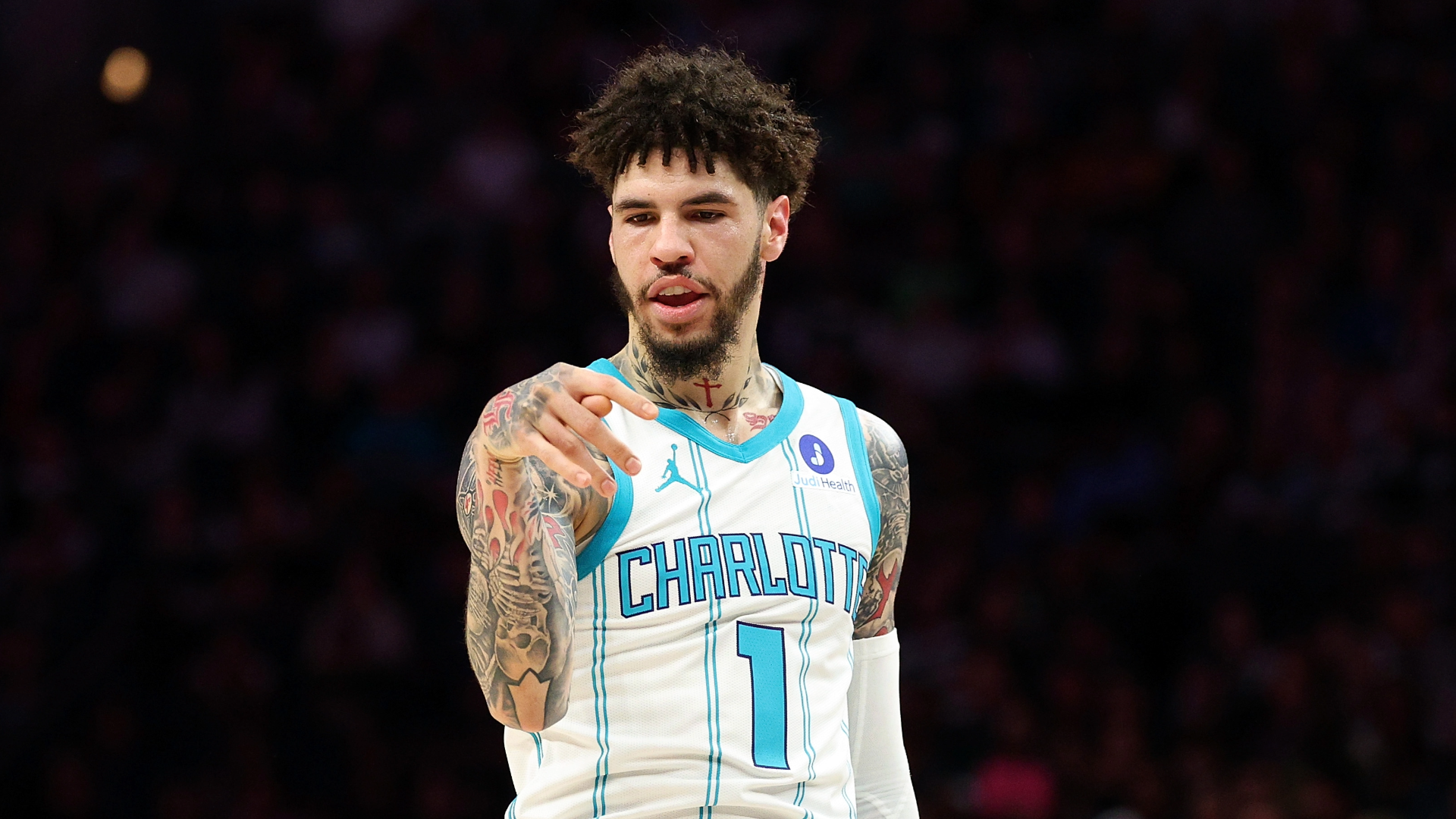
The Charlotte Hornets are trading LaMelo Ball to the Minnesota Timberwolves, according to ESPN. Rumors of Charlotte shopping their All-Star point guard first emerged during the second round of the NBA Draft on Wednesday, and a line of aggressive suitors reportedly emerged quickly. Ultimately, though, Minnesota won the bidding war for the following package:
- Timberwolves receive: LaMelo Ball, Josh Green
- Hornets receive: Naz Reid, 2033 first-round pick, three first-round pick swaps (2028, 2029, 2030), three second-round picks (2029, 2032, 2033).
The deal comes as one of the more stunning trades in recent NBA history. While Ball has been the subject of trade rumors in the past, he is coming off one of his best seasons in the NBA. He played 72 games — his most since 2022 — and averaged 20.1 points, 4.8 rebounds and 7.1 assists while shooting 36.8% on 10.3 3-point attempts per game. He fiinished ninth in the league in assists, second in 3-pointers, and the Hornets’ offensive rating was 125.8 with him on the floor (compared to 112.7 when he sat).
The Hornets, after starting 4-14 last season, went 40-24 the rest of the way and emerged as the NBA’s best offense after Jan. 1. Their 44 wins were their most since 2016, and while they ultimately fell short of the playoffs with an embarrassing 31-point loss to the Orlando Magic in the final round of the Play-In Tournament, they were a team on the rise with a thrilling young core of Ball, 2026 Rookie of the Year runner-up Kon Knueppel and Brandon Miller.
Now, the latter duo will move forward without Ball, who was a fan favorite in Charlotte and one of the most popular players in the league, especially among younger fans.
In Minnesota, Ball will team up with Anthony Edwards to form one of the most exciting backcourts in the league on a revamped Timberwolves team. After back-to-back Western Conference Finals appearances in 2024 and 2025, the Wolves were knocked out of the playoffs in the second round this season and decided to shake things up around Edwards.
On Monday, they sent Julius Randle and the No. 28 pick in the 2026 NBA Draft (Joshua Jefferson) to the Brooklyn Nets in a three-team deal that also involved the Chicago Bulls. The Timberwolves only took back the No. 33 pick (Isaiah Evans) in that deal, but created plenty of cap space. They immediately used much of it to give Ayo Dosunmu a five-year, $112 million extension, and it seemed as though both he and Naz Reid would take steps up the depth chart. Now, Reid is gone, which leaves a big hole in the Wolves’ frontcourt, and Dosunmu will likely remain in a bench role.
While the Wolves likely would have preferred to keep Reid, they ultimately couldn’t pass on acquiring Ball. The 24-year-old, who was the No. 3 pick in the 2020 NBA Draft, two spots after Edwards, has three guaranteed years and just more than $130 million remaining on his current contract. He is eligible to sign a two-year, $119.2 million extension on July 6.
So, how did both teams do in the deal? Let’s grade the trade:
Minnesota Timberwolves: B+
Let’s get this out of the way up front: LaMelo Ball is a risk. Though he played 72 games last season, he only suited up for 105 combined in the three seasons prior. He’s never played much defense. If Anthony Edwards is on another team in the next few years, this trade blowing up in Minnesota’s face is probably going to be the reason why.
But this is the reality Minnesota was facing: when they faced Oklahoma City in the 2025 Western Conference Finals, outside of their Game 3 blowout, they lost four games by 73 combined points, and when Victor Wembanyama was on the floor in the second round this season, the Spurs outscored the Timberwolves by 79 points.
Minnesota was not good enough to genuinely compete with San Antonio and Oklahoma City. The Spurs and Thunder have simply broken the scale in the Western Conference. They are so good and so young and so asset-rich that competing with them as a normal team, especially one as asset-poor as Minnesota made itself through the Rob Dillingham and Rudy Gobert trades, probably means taking at least one significant risk. This is a risk the Timberwolves had to take, because the potential reward of Ball working out is that substantial. If Minnesota was going to make itself talented enough to win a championship, something like this trade was probably how it had to happen.
Playmaking had been Minnesota’s biggest weakness as Mike Conley declined. The only player on last year’s roster to average at least 10 points created off assists per game last season was Julius Randle, and he is now gone. Only the Clippers averaged fewer potential assists per game than the Timberwolves. This offense has been screaming for a real point guard. Now it has one.
The Edwards-Ball fit makes plenty of sense on paper. Passing is the closest thing Edwards still has to a weakness. He’s become a lethal, high-volume 3-point shooter over the years, and last season, he grew by leaps and bounds as a mid-range shotmaker. Those are the sort of shots you need to win late in games, but you need easier offense for the rest of them. Ball can set up teammates for the first 43 minutes, and then Edwards can finish the job late. Edwards averaged the third-most pull-up 3s per game in the NBA last season. Ball ranked fifth. Defending the two of them at the same time is going to be a nightmare.
The trio of Edwards, Jaden McDaniels and Rudy Gobert should create a solid defensive foundation with which to protect Ball on that end of the floor. Gobert is headed into his age-34 season, so only time will tell how much longer he can extend his prime. For now, Joan Beringer seems to be the succession plan at center. Ball is the pick-and-roll partner of his dreams. Figuring out the post-Gobert defense will be a challenge. There are only so many rabbits left in Connelly’s hat.
There are still real questions left to answer here. For one: who’s playing power forward? The Wolves are only about $11 million below their second-apron hard cap, and they have to sign four more players. They reportedly want to do right by Donte DiVincenzo and keep him as he recovers from his torn Achilles. Can a team with this much invested in the present really afford to have $12.5 million in salary potentially miss the season? Josh Green makes $14.7 million. Moving that cap figure for a playable power forward is the next order of business here. Without any remaining draft capital, young guard Terrence Shannon might have to be included in that deal. Minnesota isn’t done.
Tim Connelly still has most of the offseason to figure that out. He needed an upside swing to get back into the championship picture and he found one. Now Minnesota has one of the most talented backcourts in NBA history, two All-Stars who haven’t yet hit their 25th birthdays to go along with the untouchable McDaniels at small forward. If this swing connects, the Timberwolves are going to be a Western Conference threat for a long, long time. And if it doesn’t? Well, then they weren’t beating the Thunder or Spurs anyway.
Charlotte Hornets: B
The Hornets know Ball better than we do, and they know him better than the Timberwolves do. They know his medical history. They know his strengths and weaknesses as a player. They know his personality. And they seemingly decided that he was not the person they wanted to build their franchise around.
Obviously, that sort of knowledge can be a double-edged sword. The Dallas Mavericks came to the same conclusion with Luka Dončić, though Charlotte probably did better in this return than they did simply because of how much younger Naz Reid is than Anthony Davis. Sometimes teams overthink these things. But remember, there were LaMelo Ball trade rumblings early last season, before Charlotte’s breakout. We live in a world in which Trae Young was cap-dumped and Darius Garland was traded for someone a decade older than him. The point guard market is not exactly robust right now. In that context, this is Charlotte selling high.
How viable is this concept of Charlotte’s team without Ball? The numbers suggest not very. In the 800 minutes Brandon Miller and Kon Knueppel played with Ball last season, the Hornets scored 133.6 points per 100 possessions, per Databallr. When those two played without Ball, that figure fell to 108.3. Knueppel and Miller are elite shooters, but neither can create at anywhere near the level Ball does. Charlotte is probably about to take a step back. After a feel-good season in which Charlotte had the NBA’s best offense after Jan. 1, that’s going to be a bitter pill for fans to swallow.
But take the 10,000-foot view here for a moment. Knueppel is 20 and Miller is 23. The Hornets are now among the most asset-rich teams in the NBA. They control all of their own first-round picks, plus the following first-round picks from other teams:
- 2027 Mavericks (top-2 protected)
- 2027 Heat (lottery-protected, becomes unprotected 2028)
- Least favorable of Jazz, Cavaliers and Timberwolves in 2029
- 2033 Timberwolves
They picked up swap rights with Minnesota in 2028, 2029 and 2030 as well, though some of those rights are complicated and tangled into other trades. If Ball can’t stay healthy, or if this goes so badly, so quickly that Edwards leaves Minnesota, those assets become even more valuable. Their own draft picks, especially in the flattened lottery era, are probably more valuable in the short-term than they were before the trade. Trading Ball creates a $40.8 million trade exception. The Hornets have a long way to go, but every imaginable resource with which to build.
Point guard is, obviously, a long-term question now. The Hornets drafted Christian Anderson at No. 18, and Coby White, whom they traded for in February, is re-signing on a three-year, $74 million contract, per ESPN. Maybe one of them is a long-term solution. If nothing else, they’re reasonable short-term replacements. Again, look at Young and Garland. Ja Morant is sitting out on the trade market, available to anyone. Point guards tend to become available. At some point, given the tools at their disposal, Charlotte will have shots at more notable Ball replacements.
Reid is the linchpin of the deal. He’s never been a full-time starter, but he’s more than ready for that role. Had Minnesota failed to land Ball, he would have replaced Julius Randle in their lineup. In NBA history, there have only been 61 seasons in which a player 6-foot-9 or taller attempted at least 400 3-pointers and made 35% of them or more. Reid has three of them. He is genuinely among the best shooting bigs in NBA history, and he’s joining a Hornets team that had a higher 3-point attempt rate than anyone but Golden State last season. They remain among the NBA’s best shooting teams.
In the long run, Reid and Moussa Diabaté probably aren’t big enough to be defensively viable, especially with no perimeter stoppers in place to support them. That’s fine. Diabaté is better-suited as a high-level backup anyway. The Hornets needed a long-term center before this trade and they need one after it. The defense still has a way to go. The Hornets are not short-term contenders.
This trade is about the long view. For some reason, perhaps one of the ones we can easily discern, perhaps not, the Hornets decided that they did not want to move forward with LaMelo Ball as their franchise player. Whether they are right or wrong in that determination, we won’t know for years. But even if there are cosmetic similarities to the choice Dallas made with Dončić, the situations aren’t remotely analogous. The Hornets are very well-positioned to build a long-term winner. They had two other young building blocks in Knueppel and Miller and added a third in Reid. They’re loaded with picks. Their cap sheet is flexible. A team in their position just doesn’t need to take the sort of risks Minnesota did in order to build a contender. They could afford to be picky, so that’s what they did.