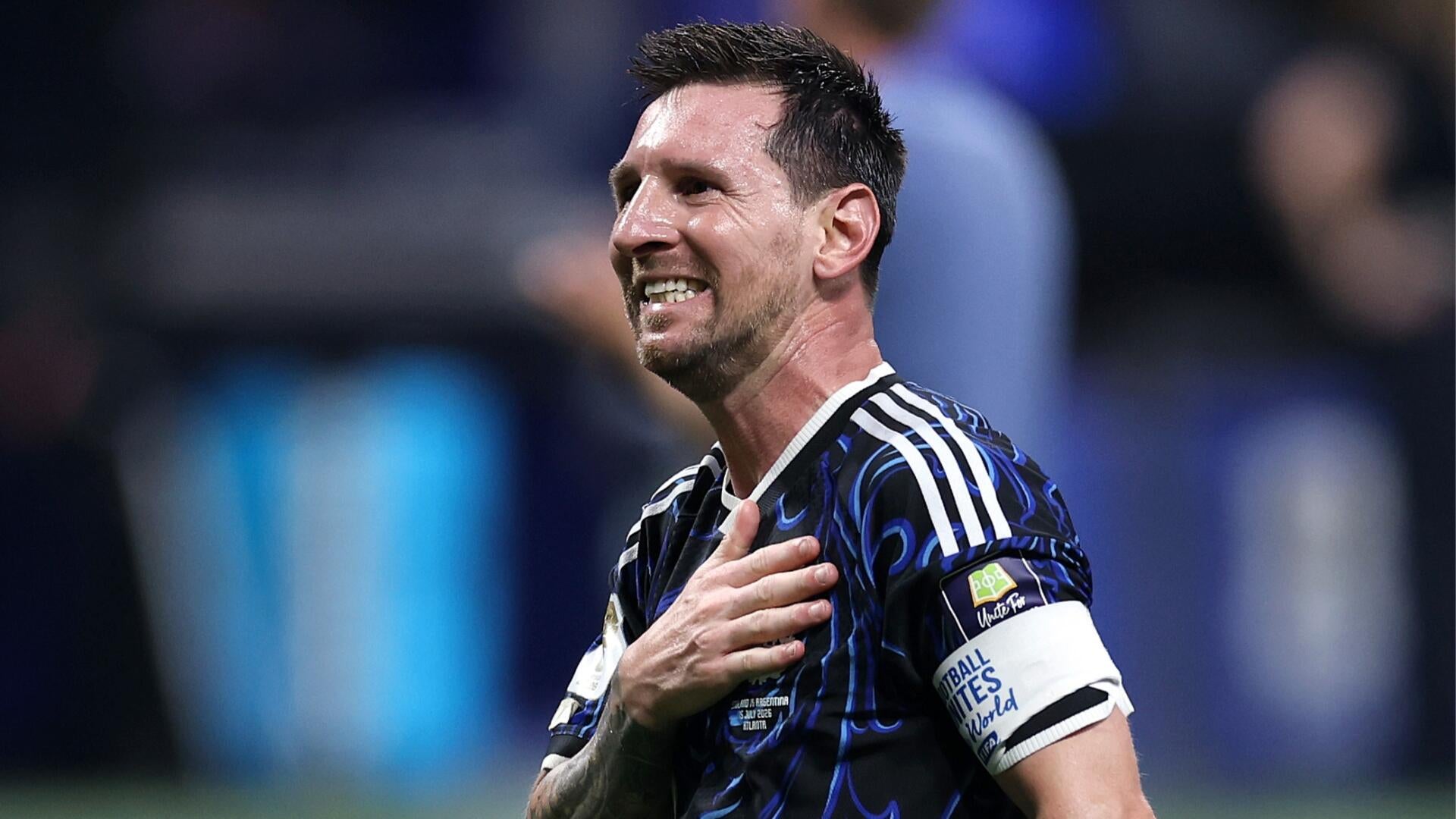
NEW YORK – Everyone who has been in the game long enough has a Lionel Messi story, usually one in which they are on the losing side of some act of brilliance from one of the game’s most accomplished players, a story that is somehow always told with a lighthearted tone.”Let me share something really funny with you,” Spain head coach Luis de la Fuente mentioned on Friday, two days before he will be tasked with neutralizing Argentina’s captain in the World Cup final. “Talking about Messi, I met Messi when I was at Sevilla and we played a Copa del Rey match that was Sevilla against Barcelona, so we went to Barcelona. I heard about this guy called Lionel Messi, and obviously, we mentioned, ‘Look. Let’s go for man-marking with this guy.’ Then in the 70th minute, we were 0-0, and then when our player who was marking him got a yellow card, I substituted him and Messi scored four goals.”Such is the legacy of sports’ most undeniable superstar, a wave of inevitability stalking all of his opponents no matter the game plan. It is only appropriate that his swan song at a World Cup will come with the ultimate prize on the line, all while competing to thrust himself further in the record books as the tournament’s greatest-ever goalscorer. Messi’s run in recent years has been so formidable that his iconic status is already well-established with or without a winner’s medal on Sunday. He has led Argentina to two Copa America titles and a World Cup in the last five years and could be a member of the first team to win back-to-back World Cups since Brazil did it in the 1970s.It feels like a fever dream, then, that 10 years ago, in the very building where he could lift another World Cup title on Sunday, he called it quits.
Before he finally achieved the accolades superstars are supposed to rack up, Messi was the down-on-his-luck leader who always fell short in Argentine colors. The weight of a soccer-obsessed nation, desperate for their first major accolade since the 1993 Copa America, rested heavily on his shoulders. His chances came and went, too – he had four UEFA Champions League titles with Barcelona under his belt a decade ago, as well as two trips to the Copa America final and one in the 2014 World Cup final without a trophy.His Argentina team fell short once more in the Copa America final in 2016 at MetLife Stadium in New York’s suburbs, this time after a 0-0 draw against Chile that was decided via a penalty shootout where Messi missed. The pressure had gotten to him, at long last.”My thinking right now and thinking about it in the locker room, I’m done playing with the national team,” he mentioned at the time. “I tried my hardest. It’s been four finals, and I was not able to win. I tried everything possible. It hurts me more than anyone, but it is evident that this is not for me. I want more than anyone to win a title with the national team, but unfortunately, it did not happen.”
It was a rare concession from a professional athlete, let alone one of Messi’s magnitude. What came after was his version of a midlife crisis – he went from one tattoo sleeve on his left arm to ink that covered every limb and, for a time, rocked bleach blonde locks that have only ever looked good on U.S. women’s national team star Megan Rapinoe, no matter how many other professional soccer players have tried it. The international retirement came to an end swiftly, too, Messi back in Argentina’s lineup in no time and has played in three World Cups since, including this one.There was a sinking feeling that came with Messi’s declaration a decade ago, a forgotten period considering the accomplishments he’s tallied since. It only adds to the sentimental value that Messi carries with him on Sunday, despite the burdens of Father Time. He is now in been there, done that territory and is the captain of a team that have become the World Cup’s villains, scoring a batch of late goals to snatch a victory when a defeat felt certain. Certain refereeing decisions have helped along the way, the Albiceleste bringing a true chaos to the World Cup knockouts when Spain have not only been the picture of consistency but boast a quiet, almost unassuming ruthlessness. There is almost no reason to root for Messi outside of Argentina, where he is understandably a national icon of a unique type.Still, it is hard to look away. At the age of 39, he is well and truly past his peak years and is not exactly perfect – a series of missed penalties at this World Cup have added some light comedic value to the fact that he’s still tied in the golden boot race with Kylian Mbappe at eight goals. Messi is the tired trope one never actually gets tired of because he somehow manages to pull things off when he should not. If de la Fuente’s story about a teenage Messi is impressive, it offers a stark reminder that Messi managed something similar on Wednesday in Atlanta.
“For the majority, I thought we did pretty well,” England’s Dan Burn mentioned after their 2-1 loss in the World Cup semifinals, relinquishing a 1-0 lead in the 85th minute and bounced from the competition before the final whistle blew. “That probably shows the quality of player he is, where you can keep him quiet for most of the game and then he still pops up with two assists.”
He is always offering reminders that as basic as it is to see an all-time great athlete do terrific things, there is nothing normal about it no matter how much one might expect it.
“Being able to reach a final at 39 years of age, I think it’s something unbelievable and that’s why I say we must enjoy him,” Argentina head coach Lionel Scaloni mentioned on Friday. “As it happens with Diego Maradona that we miss him but Messi is still with us so we need to attach importance to what he does.
MetLife Stadium is not exactly a cursed venue for Messi — he’s been on the winning side there a number of times since, most recently in a Copa America semifinal two years ago, days before they won that title. There is probably no reason to expect that to change even in defeat, since a loss will have little consequence on the memories those who have watched him over the years will boast. The fact that the lowest low of his Argentina career took place there is merely a reminder that the achievements that came in the latter part of his career are also an accomplishment in their own right. Messi’s legend grew as he did, to the point that he entered the 2022 World Cup with just six career goals in the tournament and is now all the way up to 21.
“Together with this group of people who’ve brought us these wonderful years, we will always remember that Argentina’s footballers might make it,” Scaloni mentioned, “but it’s very difficult to do this so they’ve achieved things that back in the day were totally unthinkable and I mentioned that yesterday. I told them they had done something unbelievable and I was deeply thankful. My whole staff and I will be thankful forever.”
This World Cup has essentially been Messi’s victory lap, the pressures of representing Argentina turning fully into a privilege. He has played with freedom and, even with a stretch of imperfect days behind him, has still left his mark. He and his teammates, many of whom lifted the World Cup in Qatar in 2022, will be tempted to do so yet again on Sunday but one final glimpse of Messi on sports’ biggest stage is perhaps the greatest victory of all.
“It wasn’t easy to come to this stage of the World Cup and competing for so many years at this level so I think this was something beautiful, something wonderful and you can win,” Scaloni mentioned. “I hope we will win but if we don’t win, I think this journey was unbelievable and an example for everyone. I hope it will help our people, our country.”