Figure caption,

Oyarzabal scores twice as Spain cruise past Austria

The milestones continue to fall. Goalkeeper Unai Simon has gone 519 consecutive World Cup minutes without conceding, surpassing Walter Zenga’s long-standing tournament record of 517 minutes and Iker Casillas’ Spain mark of 476, which came to an end when Robin van Persie scored his iconic diving header at the 2014 World Cup.

Simon’s rise has been underpinned by the unwavering faith of De la Fuente, who has continued to back the 28-year-old despite competition from Premier League Golden Glove winner David Raya and Barcelona goalkeeper Joan Garcia. The pair first worked together when Spain won the European Under-19 Championship in 2015 before reuniting with the senior side in 2023.

“I feel proud of him,” De la Fuente stated after Spain’s victory over Austria. “I feel like he is a member of my family. I’m very happy for him.”

De la Fuente, though, was quick to stress these achievements are a reflection of Spain’s collective work rather than one outstanding goalkeeper.

“He played a very big role in the victory, but it’s not just about individuals,” the Spain manager stated. “It’s about the whole group coming together for that defensive effort.”

Another piece of history is now within touching distance. Switzerland’s run of 559 consecutive World Cup minutes without conceding between 1994 and 2010 remains the longest by any nation. If La Roja keep Portugal scoreless until the 41st minute of their last-16 meeting, they will surpass that streak and set a new World Cup record.

Recent evidence suggests they have every chance. No team has managed a shot on target against Spain in the opening 75 minutes of a match at this World Cup. Across their four games, opponents have produced just one combined attempt on Simon’s goal in the opening half hour and only 10 shots in total before the interval (2.5 per first half). If those patterns continue against their Iberian neighbours, another benchmark in World Cup history could soon belong to De la Fuente’s side.

Perhaps even more impressive than the clean sheets is how few opportunities Spain are allowing opponents to create.

Spain lead the tournament for the fewest shots faced (19), fewest shots on target faced (three), fewest touches conceded inside their own penalty area (30), and the lowest expected goals against (xGA – 0.85). Remove set-pieces and the picture becomes even more striking, with opponents generating just 0.62 expected goals (xG) from open play – comfortably the strongest underlying numbers of any team remaining.

Those chances are also being forced into low-value areas. Almost 58% of the shots Spain have faced have come from outside the penalty area, while opponents have completed only 60 passes into the box. It is evidence of a defence that is not merely blocking shots but preventing attacks from reaching dangerous positions in the first place.

Spain’s control extends much further up the pitch. Opponents average only 2.9 passes and 7.7 seconds per possession before Spain regain the ball, among the best figures at the tournament. They have allowed only two build-up attacks across four matches and are still waiting to face their first shot following a high turnover, underlining how effectively they extinguish attacks before they have the chance to develop.

Defending by keeping the ball

That control begins with possession. Spain lead the World Cup with an average of 68.2% of the ball, while opponents are forced to start possessions further from goal and make less progress up the pitch than against almost any other team.

At the heart of it all is Manchester City midfielder Rodri, who has attempted and completed more passes than any player at this World Cup, acting as the metronome in front of the back four. In possession, he regularly drops between Aymeric Laporte and 19-year-old Pau Cubarsi to create a back three, echoing the role Sergio Busquets performed for Spain for more than a decade.

Laporte and Cubarsi have been equally influential. Only two players at the tournament average more interceptions per 90 minutes than Laporte (2.26), while the former Manchester City defender has recorded a 93% pass completion rate and provided an assist. Cubarsi – already regarded as one of Europe’s finest young defenders – has misplaced only 11 of his 372 passes, giving him a tournament-leading 97% completion rate among players to attempt at least 300.

Those numbers reflect how the role of the centre-back has evolved. “In modern football the two centre-backs have really become the playmakers,” former Netherlands coach Louis van Gaal once stated. “The No 10, behind the strikers, can’t be called a playmaker any more because the space in which he operates is too restricted.”

Pep Guardiola has long shared that philosophy, arguing defenders require the “best ball-handling skills” to play their way out of trouble and launch attacks – an approach that remains central to Spain’s game.

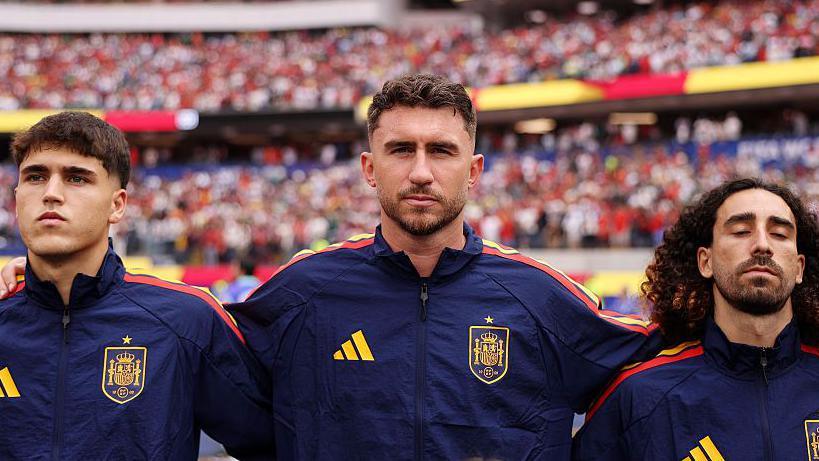
Spain defenders Pau Cubarsi, Aymeric Laporte and Marc Cucurella stand side by side during the national anthem before the World Cup match against AustriaImage source, Getty Images
Image caption,

Pau Cubarsi, Aymeric Laporte and Marc Cucurella have formed the backbone of a flawless Spain defence at the 2026 World Cup

That strength extends across the backline. Marc Cucurella has combined reliability at left-back with attacking quality, becoming the first Spain player to register two assists in a World Cup match since Javier de Pedro against Paraguay in 2002.

On the opposite flank, Marcos Llorente and Pedro Porro have shared right-back duties without disrupting Spain’s balance. Llorente, who started against Cape Verde and Uruguay, has registered an assist and averages 2.5 successful tackles per 90 minutes, second only to Rodri among Spain players (2.52).

Porro, meanwhile, has scored once, leads Spain with eight chances created and six completed open-play crosses, while no Spain outfield player averages more ball recoveries per 90 minutes (seven).

Spain’s greatest World Cup triumph in 2010 was built on resilience as much as possession football, with Vicente del Bosque’s side conceding only two goals all tournament. Italy in 2006 and France in 1998 also lifted the trophy after allowing just two goals, the joint-fewest by any World Cup winners.

De la Fuente’s team still have four matches to navigate if they are to emulate those champions, beginning with a daunting last-16 tie against Portugal. But statistically they are already producing one of the most dominant World Cup campaigns on record. If they continue on this path, history suggests defence may once again prove the foundation of champions.

Related topics

  • Football
  • FIFA World Cup 2026
  • Spain

More on this story

  • World Cup 2026 knockout path
    A graphic showing 'Groups and Schedules'
  • How to watch the World Cup on the BBC and ITV
    • Published
      3 days ago
    Schedule logo
  • Everything you need to know about the World Cup
    • Published
      1 April
    World Cup

✔ today silver rate

✔ 2026 winter olympics

✔ chat gtp

✔ silver rate today

✔ silver rate today live

✔ 2030 winter olympics

Read More

Sports

Leave a Reply

Your email address will not be published. Required fields are marked *