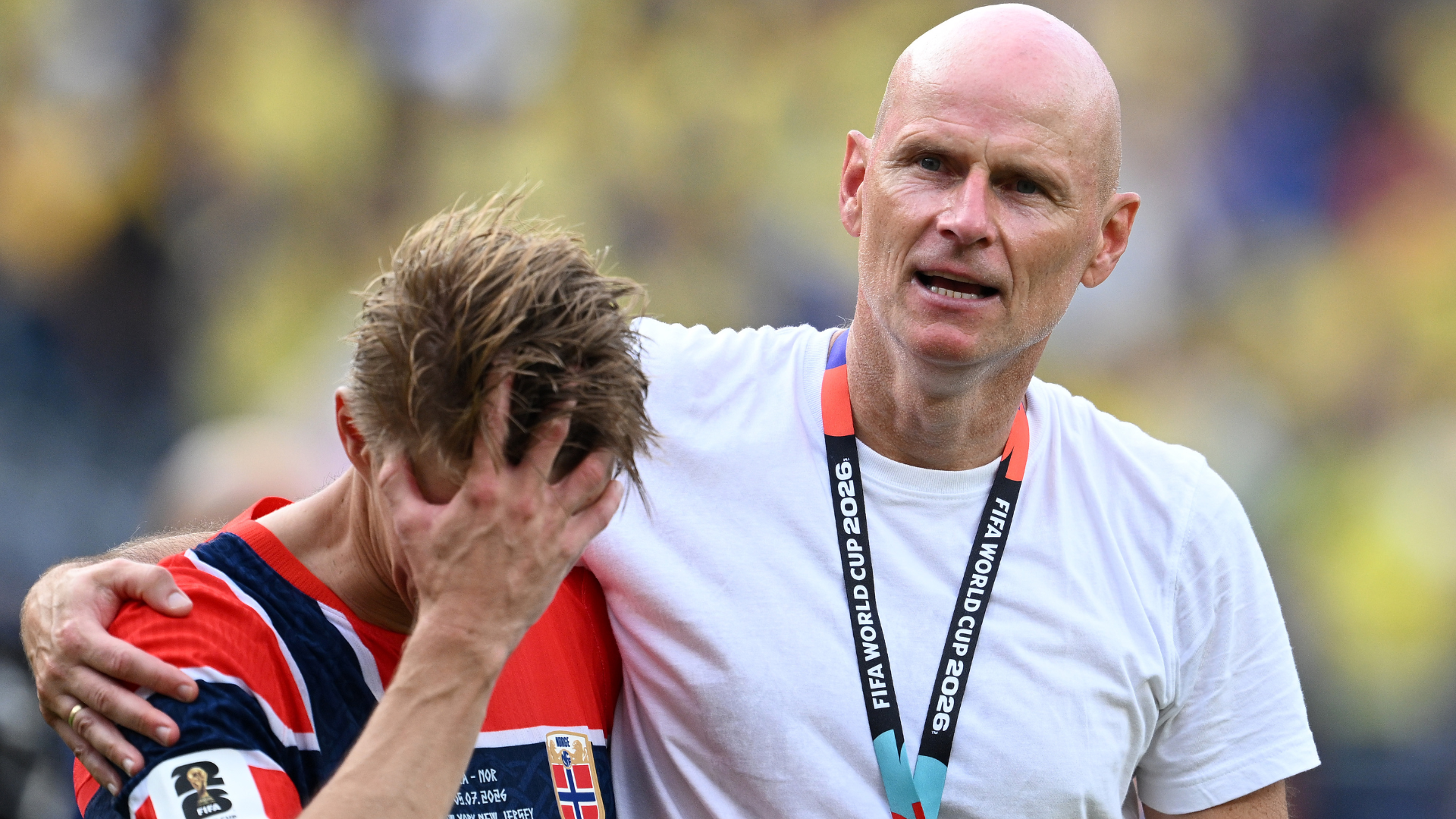
It wasn’t until the final whistle at MetLife Stadium, marking the end of Brazil’s round of 16 match against Norway, that the magnitude of what had happened truly sank in. Norway, a country rarely regarded as a soccer powerhouse, had defeated Brazil, the five-time world champions and the nation that has long embodied the very essence of the sport. On one side there was Neymar Jr. crying moments after realising his career with the national team was over, on the other side of the pitch there were players crying for a different reason. Manchester City striker Erling Haaland was one of them. Usually stoic and reserved, he was crying like a six-year-old, and for a good cause.
The Viking Row
Minutes after the end of the game, the players and the coaching staff were sitting on the pitch ready to start their iconic ‘Viking Row’, a coordinated chant performed by supporters in which fans raise their arms above their heads, clap in unison at steadily increasing intervals, and chant after each clap. It has become one of the symbols of this World Cup, and was fully endorsed by the Norwegian national team. However, this wasn’t a surprise at all. Norwegian soccer drastically grew over the last decade and players such as Erling Haaland and Martin Odegaard are the perfect reflection of a long-term project that is now reaching the international stage.
Haaland’s numbers are just sensational and impossible to describe: He has scored 62 goals in 54 games played with Norway, including the deciding brace against Carlo Ancelotti’s Brazil. He is one of those talents that has nothing to do with the rivals, he’s just the best central striker in the world right now. Norway made it to the World Cup after winning twice against Italy, the four-time champions, in less than six months, forcing the Azzurri to play the playoffs where they lost to Bosnia-Herzegovina. Norway easily won the group stage and put themselves as one of the underdogs of the summer tournament, seeded in a challenging group with France, Iraq and Senegal.
The incredible story of the coach
They have talented players but also a manager who was able to create the right mentality among the most experienced managers but also one of the youngest. Ståle Solbakken was also part of the roster at the 1998 World Cup, the last time Norway was at the tournament. After that, he started his coaching career early as in 2001 his professional career ended. On March 13 of that year, during a training session with FC Copenhagen, Solbakken suffered a cardiac arrest. The club’s doctor, Frank Odgaard immediately understood the severity of the situation and saved the midfielder’s life. Solbakken was declared clinically dead and remained so for eight minutes. He spent several days in a coma before making a full recovery. Later, doctors implanted a pacemaker but his career was over.
“My family flew in from Norway immediately. During the flight, my mother was already thinking about how to arrange my funeral. Then the fear shifted to whether I would suffer permanent brain damage. To this day, my wife still can’t bring herself to talk about those moments. She was only 23 or 24 years old, and we had two children, one was four, the other just a year old”, he mentioned later, speaking on the incident.
The rise of Norwegian soccer
The success of Norway is not just about a talented coach or the incredible numbers of Haaland. It started years ago. Throughout the 2025–26 season, there was one story that perfectly emphasised the rise of Norwegian soccer: Bodø/Glimt’s remarkable Champions League campaign (as always you can catch the Champions League all season long, only on Paramount+). The Norwegian team managed to win against both Manchester City and Atletico Madrid in the league phase before knocking out Inter from the playoffs, one of the most remarkable upsets of the season, before losing to Sporting CP at the round of 16. The Norwegian side were one of the first one teams around Europe to use Fokus, a data collection company exclusively dedicated to gathering useful statistical information on player performance. Sporting director Havard Sakariassen spoke to La Gazzetta dello Sport, explaining their approach and how it made the process of scouting young Scandinavian talent easier and more effective. The Bodo/Glimt model showed how data and statistics can help a smaller club to achieve the same levels as the European giants and possibly help the national team to improve and reach the level of the biggest soccer countries in the world.
For years, Norway looked with admiration at soccer traditional powers. Today, it stands among them. The journey has been built on patience and belief but it is not over yet: Thomas Tuchel’s England is next.